All Things to All People: Some Brief Notes on Solidarity and Free Speech

Pictured: the idea so often lacking from non-debates about free speech.
The idea so often lacking from non-debates about free speech.

If transgender people have a “superpower” it is our remarkable ability to stand for anything:  living, breathing “floating signifiers.” Our meaning d’jour is, for some on Fleet Street, “a professionally offended, Left wing lobby group” that is now the latest “post-Leveson” threat to free speech and a free press. Meanwhile, on the opposite side of things—fleeting as these meanings are, such that we can even speak of stable oppositions—Suzanne Moore and Julie Burchill had accused trans people of dividing and distracting the Left from its “important” goals and its “true” cause.

If this seems exasperating and contradictory, you ain’t seen nothing yet, as they say.

But for now, it is enough to deal with these two absurdities one at a time and bring a bit of light to a decidedly un-illuminating heat.

Free Speech: From Posturing to Substance

Toby Young and all the other vacuous, fly-by-night defenders of “free speech” filch lovely rhetoric that whistle stops past all manner of liberal democratic tropes while failing to specify the connection between, say, hate speech and liberty. They use language meant to bypass both the intellect and one’s reason, while subtly refusing any attempt at being substantive. To do so would be to pull back the curtain at Oz and reveal the great democratic wizard to be nothing more than a petty would-be tyrant in disguise. In his entire blog post, Young does not mention the content of Burchill’s article once, instead gesturing to the void indirectly by casting trans people as some monolithic left lobby opposed to free speech.

He has archived Burchill’s piece for the world to see, so readers can judge for themselves, but it is a curious choice—to say the very least—to use an article that was almost entirely vapid schoolyard bullying and name-calling as some kind of heroic exemplar of courageous speech. He takes this to a laughable pinnacle by comparing Burchill’s screed to The Observer’s opposition to Prime Minister Anthony Eden and his 1956 invasion of the Suez Canal, now widely regarded by historians as the last gasp of the British Empire. Clearly these were equal acts of great courage.

Yet, if one refuses Young’s attempts to cut their intellectual brake lines, it’s plain to see that Burchill’s article was no Watergate, no “Pentagon Papers.” To compare Burchill’s privileged tantrum to great acts of journalism is offensive to the profession (and if one wants to read incisive feminist journalism, I cannot recommend Ms. Magazine more strongly—their investigations into the plague of rape in the US Military, and the anti-abortion lobby’s links to terrorism are, alone, reminders of what truly courageous pens might write).

Instead of asking substantive questions about Burchill’s writing, Young thoughtlessly defends it without any regard for its content, nor any attempt to engage with it meaningfully. This is profoundly anti-democratic. We do not, in a truly free society, throw our hands up in childlike awe and say “Oooh, there are so many ideas out there, that’s nice!”—ideally, we engage with them, we debate, and we argue; we consider them on their merits, weigh them, and are fully allowed to find them woefully wanting.
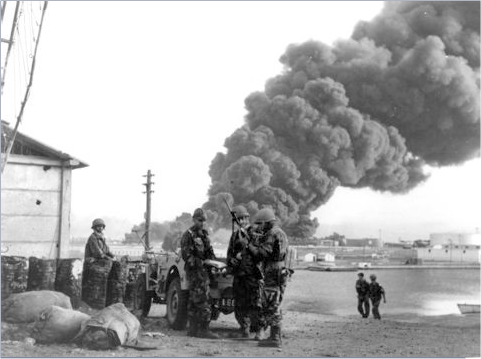
Pictured: Something exactly like Julie Burchill's Observer article.
According to Toby Young, the Observer’s willingness to oppose this historical event is the moral equivalent to publishing Julie Burchill’s piece. As you can see, they’re exactly the same thing.

That is precisely what trans women, our loved ones, and allies did with Julie Burchill’s codswollop. And it is here that we come to what else is so utterly pernicious about Young’s unthinking editorialising: he has completely misrepresented and lied about the motivations of Burchill’s critics. Many of us, myself included, did not want the Observer article taken down. What we wanted was to be heard, and to counter the spreading of hate. Some of us wanted Burchill to apologise, and some wanted the piece taken down, yes, but I’d not say the latter was a widespread, agreed-upon, much promoted goal. It is certainly fair to say that few of us are mourning the piece’s loss. It is no Vindication of the Rights of Woman (quite the opposite, in fact), nor is it Candide. It was gutter trash of the lowest order, and even if you don’t give a toss about transphobia, one would have to concede it was tenth-rate writing. Its deletion from the Observer’s website is no loss to anyone.

And yet, while Mr. Young may think himself a dutiful democrat for preserving and republishing the piece, he might be surprised that he was beaten to the punch by many of the same trans activists he was attacking. Most of us had a problem with the article being used as “link bait” for the Observer, driving up their ad costs with every click. This shock and awe tactic is, tragically, a commonplace in online news websites. Many of us, who wanted to preserve the public record of Burchill’s hate, have reposted the piece elsewhere—both to ensure that it was not flushed down the memory hole, and to ensure that people could read and judge for themselves, while denying The Observer profit-from-hate. If Mr. Young had bothered to talk to any of those faceless and nameless activists he decries, he might have seen that our motivation was not to punish “political incorrectness” but to add to the discourse, with the urgency that hate speech always demands.

That is democracy.

Speech Acts

It is also worth remembering that if one wishes to defend free speech, one must know what they are defending and why. More of those nattering specifics that tend to deflate gassy rhetoric, yes.

Speech does something. That is why it’s so powerful, cherished, and defended as a fundamental right. But like any right, it can be abused, used to the detriment of others, and cause great harm. Citizenship, by contrast, is the craft of using rights and liberties to further the cause of freedom. Burchill’s piece, on the other hand, was both puerile and dangerous in the most vulgar way. Words like hers are hurled along with glass bottles at trans women fleeing for their lives from angry, hateful cisgender men. Ideas like hers fuel housing discrimination, see trans people excommunicated from their families, usher us with sibilant urgings to suicide, and are deployed by people who need to justify violence against trans people.

Burchill’s words and ideas, to the extent they have any substance at all, are simply the anima of hatred; hatred that revokes trans women’s rights. It sees our free speech muzzled, lest we be attacked for naming our experience and concerns. It sees our right to life snuffed out and declared conditional—less important than a privileged journalist’s right to lose her intellectual lunch in a national newspaper. It sees our right to free movement drastically curtailed, our right to healthcare passively but firmly denied.

None of this has a whit to do with “being offended.” It has everything to do with survival.

Our speaking up—as feminists, LGBTQ activists, and concerned citizens—was an attempt to ensure that Burchill’s article, which ended with an unambiguous threat and was essentially one long piece telling us to “shut up” (where was Mr. Young then?), did not have its intended silencing effect. If Mr. Young seeks enemies of free speech, instead of rudely stereotyping trans women he might well simply look in the mirror.

Solidarity and the “Real Issues”

Only a briefer note is necessary to deal with the odious counterpart to Young’s Left-baiting, and that is Suzanne Moore and Julie Burchill’s snide suggestion that we are a single issue group devoted to a myopic cause at the expense of wider solidarity. Never mind that this exact argument has been used against feminists since the 19th Century and is a common silencing tactic.

I am proud to work for an organisation that is devoted to precisely the kind of solidarity that Burchill so disingenuously “defended.” The Sylvia Rivera Law Project is concerned with those wider economic issues that structurally oppress so many in our society—the austerity and cuts crusades now being trumpeted from Whitehall to Washington. We’ve been on the front lines trying to fight the manifestations of that malignancy as they particularly affect low income trans people of colour, and do so in solidarity with organisations and nonprofits serving different communities. Our goal is to not only provide our clients with basic legal needs and representation, but also to help them join activist communities of their fellows, educating them about often opaque and esoteric rights they may have (in the social services system, for instance), and enjoining them to take part in discourse, education, protests, and the fight for justice.

This is not done through an artificial focus on trans issues, as if they can they be neatly and discretely parcelled away from all others, but through recognising that whatever “trans issues” are, they are made up of class politics, immigration politics, racial inequality, social-structural sexism, a culture of policing and incarceration, and so on. These are inseparable from each other, and necessarily inform our response to the issues of our time.

It was one of many reasons that I found Moore and Burchill’s claims to be both divisive and fatuous. So many trans people learn the true meaning of solidarity the hard way, and many of us who are feminists and rights activists are part of organisations that—far from being ‘single issue distractions’—are deeply embedded in broader struggles against austerity, sexism, racism, and the ever widening wealth gap in the West; others fight with a tighter focus on neo-colonialism and foreign policy. But we are all immensely concerned with the battle for wider, meaningful liberty, and it is nothing more than a hateful lie to suggest that we are not, simply because we have the audacity to defend ourselves when attacked so viciously by name.
Unguarded and Poorly Observed: A Response to Julie Burchill

Grauniad Offices; photo by Bryantbob.

It is altogether fitting that on a day when my own father yelled at me for being a feminist, and got angry at me for introducing my brother to novels by women, about women, that I should come across Julie Burchill raging against “shemales” in the Guardian. It was very much in the spirit of an evening where I was told to my face that I’d do more good for feminism if I’d “been a man” and not a woman; it was a day where I had to listen to a man witheringly declaim literature about “women’s stuff,” and a day where I was attacked for my anger and verve in defending our right to write and speak as women.

So in that spirit, I shall continue to write, and to speak.

I shall continue to write in spite of having been threatened with rape, in spite of having been told that I’m a “shemale feminazi with too much sand in her fake vagina,” in spite of having been called every misogynist, transmisogynist, and transphobic slur in the book many times over, and in spite of having been accused of “man-hating, race-baiting, white-hating,” and the utterly unreal crime of “misandry.” In spite of being called too loud, too shrill, too whiny, too sexist (against men, of course), and “heterophobic.” In spite of being told I should avoid graduate school unless I had a “rich boyfriend.” In spite of all that, I speak.

The path I’ve walked is littered with those fell arrows, spread behind me like a sinister field of bent and blackened straw. So when I see something like this:

“Shims, shemales, whatever you’re calling yourselves these days – don’t threaten or bully us lowly natural-born women, I warn you. We may not have as many lovely big swinging Phds as you, but we’ve experienced a lifetime of PMT and sexual harassment and many of us are now staring HRT and the menopause straight in the face – and still not flinching. Trust me, you ain’t seen nothing yet. You really won’t like us when we’re angry.”

I can only shake my head. Not so much at the transmisogyny that runs through Burchill’s article like streaks of blood, but at the failure of empathy and sisterhood such a paragraph entails. After everything I’ve put up with hearing in my life, after all the sexual harassment and moments where I’ve feared for my life and safety—moments any woman, trans or cis[1], would know all too well—after everything I’ve listed above, Burchill still sees trans women as so inscrutably and ineluctably ‘other’ that we are incapable of even being on the same side of the great political divide. It seems impossible, in Burchill’s world, that I exist—as a woman and a radical feminist—because I can only ever be a “shim” in a “bad wig” and a dress. More than anything else, I think, what saddens me are the profound and abiding consequences of failing to see trans women as women, and as sisters in struggle.

Our Old Friend “Authenticity”

Throughout the piece, she excoriates trans activists (most of whom are likely feminists, and many of whom may also be cisgender) for essentially being overeducated toffs who do not know the meaning of suffering, depravation, and struggle. “To be fair, after having one’s nuts taken off (see what I did there?) by endless decades in academia, it’s all most of them are fit to do. Educated beyond all common sense and honesty, it was a hoot to see the screaming mimis accuse Suze of white feminist privilege.”

I’m not British. But I am a Puerto Rican American who both grew up in and still lives in “the ghetto” and my struggle with class in this country is as much a part of my life, my experience, and my activism as gender and its manifold vicissitudes. Further, it is still a matter of routine for feminists in general to be slapped by accusations of overeducation and ivory tower moralising: jeremiads against “the sanctimonious women’s studies set” are a staple of populist editorialising these days and have been for a generation now. I have not the slightest quarrel with Burchill’s working class background– to hate her for that would be to hate myself. I’m merely baffled at the fact that she antagonises women like me for speaking by suggesting that our attempts to get an education are a bad thing.

It never fails to surprise me to see women like Burchill and Bindel resort to the tics of patriarchs when defending their own bigotries, just as it surprises me to hear her extol her working class roots while mocking “wretched inner city kids” in another breath, rolling a horrifically complex social problem and the people who live it into a neatly poor analogy that insults with stunning economy but does nothing useful.

Indeed, going beyond the misogyny, classism, and transmisogyny that is this article’s raison d’etre[2] I would say that what is most disturbing about it is how stunningly and embarrassingly petty it is. It is more or less in the same category as a bullish op-ed by a cis male misogynist that was 50% “bitch, cunt, whore, slapper, slag, cow” and 50% bad clam jokes. Genitals and transphobic insults are the vast bulk of this article. The rest is comprised of invidious distinctions, such as the disgusting attempt to assert that trans feminists are opposed to Julie Bindel’s properly feminist work, and not just her transphobia, or to claim that trans women think their issues are the most important at all times.

The final dollop of a column centimetre that remains is, perhaps, her sole argument: that her friend, Suzanne Moore, should not have been called out for transphobia because she was doing something much more important with her article—the noble work of criticising the Coalition government’s oppressive and often misogynist social policies. But this is a weak argument, no more acceptable than a male socialist seeking forbearance for a rape joke used in an editorial about saving the NHS. Important work does not justify prejudice, even as a “joking” aside. Least of all prejudicial articles where women are objectified and find their appearances to be the subject of uncouth navel-gazing (see: all the remarks about wigs, dresses, cocks, etc.).

An Ironically Missed Opportunity

What is especially irritating about all of this is that feminists have the tools to understand why all of this is problematic: why “it’s just a joke” is not an excuse, why slurs are hate speech, why and how language constructs prejudicial realities (just as “mankind” biases us to thinking of men as more human than women, calling trans women “men” biases us to discriminating against them), and so on. Feminists, more than most people, have the tools to understand all of this.

But what troubles me even more is the attempt to put feminists on one side and trans women on the other. As if trans women cannot be feminists, or as if cis feminists could not be deeply troubled by the implications of Burchill’s piece. This is what is most potentially destructive here: the neat, artificial distinction that keeps trans women away from that great sisterhood of feminism, and from the healing and empowerment it can engender. And for what? For the sake of a cheap thrill in the Guardian?

Oddly enough, the innocuous subtitle of her article is “It’s never a good idea for those who feel oppressed to start bullying others in turn,” a point I fully agree with. We do have a problem with “call-out culture” in our feminist and queer communities, we do have a problem with unchecked egos and with activist-cum-academic aesthetics becoming more important than material results. There is a real, meaningful discussion to be had about whether the Tumblr-isation of activism has been a wholly good thing, or whether it breeds reflexive semantic policing at the expense of necessary work.

But Burchill forewent that entirely, instead launching into an article where she failed to take her own advice and did so with an ineloquent flamboyance that betrayed little besides prejudice and lack of self-awareness. Instead of possibly seeing trans women as sisters and allies in both forming a more perfect activist culture and in fighting patriarchy, she—who by her own admission knows nothing of the trans community save through Julie Bindel and this recent episode with Ms. Moore—simply writes an article groaning under the weight of its slurs and insults.

That saddens me more than anything else. It doesn’t have to be this way.

Sisterhood Unbroken

The other sad thing is, I completely get why she’s doing this. From her perspective, trans women are not women. We’re overeducated fops who are whinging about getting our feelings hurt and throwing male privilege around, so far as she is concerned. She could not be more violently wrong, but that fundamental belief animates everything else she says. I would like to think that if she actually, sincerely knew us—that if she were the godmother of some of our daughters as well—she might think very differently, and that she might be confronted with the mountains of empirical evidence that we’re really not so different from her.

She might see that, in the spirited words of Eowyn, I am no man. That her words have profoundly deleterious effects for very real (not imagined) women.

But what also troubles me is that she suggests that women should prove that they can be hurt by patriarchy by showing how they have. Why? Why must I strip off and reveal my scars to prove myself? Why must I revisit traumas to satisfy her and earn my place? Why must I always return to those places and times where I felt death gather around me in order to prove that I “know the meaning of suffering”?

My feminism is defined by what I do—by what I write, by what I orate, by what organisations I work for, by the research I do, by how I confront a patriarchal world and try to change it. It is not defined by my many wounds. Neither, for that matter, is my womanhood.

To be honest, I do not want Burchill to apologise. I do not dream of apologies. Rather, I wish Burchill could see what I see. That she could see the indefatigable sisterhood of women, trans and cis, working side by side to shatter each other’s chains, that she could see my friends and loved ones who I keep in mind every working day. I wish she could see, through their eyes, why words like hers can feel so profoundly dehumanising.

I wish that she could see the evil that trans women have had to face—the same violent deaths that befall too many women in our world—the same objectification, rape culture, risk, and quotidian hatreds, and see how it can shatter us in our fragile moments of being all too human, while also seeing how we manage to rise above it at our very best. I wish she could see us as the very human women that feminism has always striven to empower and render visible in a sightlessly woman-hating world.

I wish she could see me.

In that moment, I’d like to think, we could be sisters.


[1] It should go without saying that in an article which Burchill seemed to assemble from a transphobia Bingo sheet, she—in a particularly bizarre aside—treated the word ‘cis’ as an insult of some kind, and in a cunning rhetorical move decided to call us trannies as a result—because after all, that would be the mature and erudite thing to do. Perhaps she thinks the word “heterosexual” is an insult, too, that merits a rejoinder of “faggot”?

[2] Wait, I’m a poor Puerto Rican trans girl, maybe I shouldn’t use hoity toity phrases so I can prove I’m totally authentic? Oh crap, I use international English spelling too!