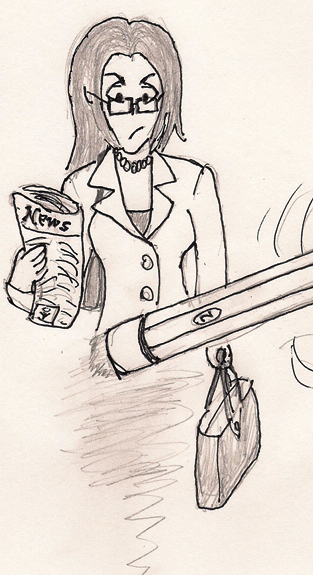
At the Crossroads and Other Mixed Metaphors: Intersectionality

This essay, as I mentioned yesterday, got an A (which is the highest grade my professor will bestow as he doesn’t believe in A+s for one reason or another). The ‘question’ I had to answer was really more of an essay unto itself but here it is:

This essay has three parts, which should be integrated into a single essay, and not answered separately.

  1. Explain the concept of intersectionality. You should discuss at least race, class, gender, and sexuality, but you may also discuss other aspects of social inequality we’ve talked about in class. This section should focus on Crenshaw and the Combahee River Collective, but you may use other texts as well.  Do not just quote a definition here, explain the concept in your own words and in detail.
  2. Discuss one or two particular historical events, periods, or issues in the context of an intersectional analysis of multiple axes of oppression. Use at least two readings not including Crenshaw. How does your choice demonstrate some of the subthemes used in Crenshaw’s piece (over- or under-inclusion, structural subordination, etc.)?
  3. Evaluate the concept of intersectionality as it applies to feminist analysis. What does it add to, complicate, or perhaps take away from analyses based only on gender?

My answer to this is as follows and I hope it provides at least a mildly interesting read:

In the many turns that various feminist and liberationist theory has undergone in recent years, one of the most significant has been the move towards what is now commonly known as intersectionality.  In brief it is a lens of analysis that openly seeks to ask how multiple types of oppression can act on a person, group of people, or on a given event, and considers various types of oppression as a confluence of influence rather than as fully discrete entities. Intersectionality, then, is a concept that elucidates on the often complex reality of peoples’ experiences with various systems of domination; whether sexist, racist, homo/transphobic, ableist, and so on, intersectionality promotes the belief that bigotry can take more than one form simultaneously. Thus something can be both racist and sexist, and intersectionality is syncretic rather than zero sum. It holds that such considerations add to understanding, rather than take something away from someone. Intersectionality adds a great deal to feminist analysis, as well as various other emancipatory epistemologies for the very  good reason that it is best able to reflect the multilayered realities of lived experience that many people; it also provides a means to identify strategies that can truly ameliorate oppressive conditions in our society by actually understanding what the problem is for the first time. Kimberlé Crenshaw and many other theorists like her, as well as liberation movements like black feminism and gay lib all laid the groundwork for understanding that people can be affected by more than one type of oppression simultaneously and that the unique positions thus created were worth understanding on their own terms.

Kimberlé Crenshaw’s ‘Traffic at the Crossroads: Multiple Oppressions’ is a brief but illuminating overview of the simple reality that you cannot understand oppression without considering its many starting points.[1] She argues cogently that immigrant women, black men, and women of colour, to name a few examples, all face different types of unique oppression that are a product of all of their backgrounds. What happens to them is often not just racist, or not just sexist, but is best understood as being influenced by several types of discriminatory ideologies. For example, she says that US immigration laws that require non-resident spouses to stay married for two years in order to become permanent residents discriminate heavily against immigrant women who suffer abuse and must choose between staying with a batterer or losing their best hope of citizenship and the privileges that come with that. She holds that both anti-immigrant sentiment and sexism are acting upon immigrant victims of domestic violence and you cannot fully understand the causes of their predicament without examining both axes of oppression, and any others that may be relevant to her situation as well. Angela Davis makes very similar arguments in ‘Women, Race, and Class’- a book which is predicated on a very powerful metanarrative of intersectionality- when she points out that slavery in the United States cannot be fully understood without examining the specific ways in which black women were abused both because they were women and because they were black slaves.[2]

Davis challenges very strongly what Crenshaw might call the ‘over inclusion’ of black women in the broader category of black people; in other words their struggles are understood through a racialised context that considers the brutal racism of slavery, but not understood as being equally gendered in the specific case of black women. They would not only be beaten, whipped, and mutilated (many were disfigured, or tortured by having their teeth pulled) as black men were, but also raped and sexually assaulted. Davis shows that abusive white slave masters, who were not only white but also male, would routinely try to stifle black women’s resistance to their brutal subjugation by raping them. It is a terror that echoes with a terrifying scream throughout history- the attempts by men to use rape to silence or break women who resist or otherwise are not in their ‘place.’ Davis enjoins us to understand that the rape of black women was racist as well as sexist, however. It was a crime often legitimised by a deeply white supremacist idea that held black women were animals who could be treated as less than human, and who ‘asked for it’, giving the classic rape apologist rejoinder a racist twist that imbues black women with an essential quality of needing to be raped or otherwise used as a sexual object. The over inclusion of black women in the consideration of slavery, however, elides most of this. It erases the pregnant black women who were whipped in ditches specially dug for them (rather than against a tree) so that the master’s lash was less likely to damage the ‘valuable property’ in the black woman’s uterus. It erases the black women who found themselves mutilated or lashed until their backs ran red with blood for resisting a slave master’s sexual advances, or those of his son who was considered equally entitled to ‘have’ a black woman as a sexual object. All of these utter atrocities were visited on black women because they were not just women, or because they were black but because they were black women. Intersectionality holds that white supremacy and male supremacy must be considered together for a proper understanding to be had of black women slaves’ particular subordination and their resistance to it, which was often very vociferous and active.

The Combahee River Collective’s “A Black Feminist Statement”  provides another powerful illumination of intersectional analysis’ strength.[3] Their very name symbolises it; it is so named in honour of an 1863 guerrilla action by Harriet Tubman who, in Port Royal, South Carolina, led an insurrection that freed more than 750 slaves and remains the first military action recorded in American history that was led by a woman. Just as black women were oppressed in ways that have to be uniquely understood, so too did they rebel and resist in ways that we would do well to understand on their own terms. Carrying on that spirit of a particularly black female resistance to all forms of tyranny and oppression, the Combahee River Collective put forth a manifesto that outlined their commitment to principles that were fully cognisant of the uniqueness of both their subject position, and that of others who stood at Crenshaw’s crossroads. There is much that is worth quoting, but its fundamental thesis which defines the theme of the entire paper is perhaps the most evocative: “Black women have always embodied, if only in their physical manifestation, an adversary stance to white male rule and have actively resisted its inroads upon them and their communities in both dramatic and subtle ways.” In this is contained much of the gist of intersectionality, as well as one very important point hitherto undiscussed: personal perspective becomes expertise in this understanding. Thus the Black Feminist Statement recognises that black women know the myriad complexities of their experience with oppression simply by having lived it and that this knowledge is both worthy and factual. Forming an activist coalition that worked on multiple axes of oppression was, in their words a means to “develop a politics that was anti-racist, unlike those of white women, and anti-sexist, unlike those of Black and white men.” In other words, a way out of the zero sum traps of single subject position identity politics. Such things forced black women (and many other people besides, whether it was disabled women, working class women, immigrant women, queer and trans people who came from any number of backgrounds, or various subjugated men) to choose one avenue of resistance over another, which was an incomplete solution to their problems at best.

The Combahee River Collective’s famous statement emerged in a critical historical period in the midst of which a new feminism was rapidly emerging and evolving with alacrity. It was a time during which Second Wave feminism evolved out of the white male dominated New Left, and during which many different feminisms quickly grew out of that Second Wave as different groups of people realised that univocal dominance of white cis women from the middle classes left them and their unique experiences with sexism unregarded. This manifesto and many documents like it, including anthologies like This Bridge Called My Back, were part of a vital historical moment in which women of colour drew strength from multiple emancipatory ideologies and put the most modern twist on them. The purpose of this maelstrom of theorising was to, as the Collective put it, know what was really happening in their lives, and this required something that went beyond understanding, say, patriarchy or capitalism as the ultimate oppression, and understanding their liberation not “as an adjunct to someone else’s” but as a virtue and dignity in its own right. Embodied in this is a rejection of demands made on them by others, such as lesbian separatists who insist that women should build communities away from men. Such a position may have currency with the experience of white women, who need no solidarity with white men against any kind of racism, but it is an impossible and even ridiculous thing to suggest to black women, even those who identify as lesbians, because they need each other in the struggle against white supremacy. On the same token, says the Collective, they also stand against patriarchal expression within their communities and struggle with black men on the issue of sexism. This double consciousness is an example of intersectional thinking that holds many understandings together simultaneously to describe a complex position in society.

In their critique of lesbian separatism they affirm the idea that even white women’s oppression may not have a single source, i.e. patriarchy, but come from multiple locations. Put another way, what we consider patriarchy is a broad socio-political framework engendered by multiple intersecting ideologies about race, class, gender, and sexuality. To again return to Crenshaw’s ideas about oppression, the women of the Combahee River Collective believe that lesbian separatists (who were mostly white) underincluded women of colour and poor women in their analysis of sexism and patriarchy in society, as well as the men who did not benefit from what sociologist Raewyn Connell calls the ‘patriarchal dividend.’ Her own analysis of men at the margins of society finds that their own oppressive behaviour, while certainly patriarchal, cannot be understood without attention to the class position they occupied and just why it was that they were ‘marginal’ relative to more privileged men and women.[4] What this under-inclusion serves to do is to render invisible the intricate and deeper effects of what is now called Kyriarchy (a term used to describe the overarching system of interactive oppressions). This under-inclusion holds that women are oppressed- an undeniable fact- and yet refuses to grapple with those women whose class, race, sexuality,  gender identity, or disability oppresses them, seeing the only antagonists as raceless, classless men. This analysis will never reach a full understanding of sexism, never mind anything else.

Thus it is that the question of what intersectionality does for feminism is addressed at a stroke. It is not only convenient or useful, it is absolutely vital and essential that an intersectional perspective is considered. This paper has focused primarily on the illuminating examples of black feminist theory and experience, but intersectional analysis also sheds much light on the experiences of a great many people who feminism has left behind. Transgender women for example occupy numerous crossroads in various societies around the world. Trans women of colour have a shockingly high rate of HIV infection; trans women sex workers face very deep dual stigmas- both of being trans and of being sex workers; trans people who are poor have a hard time actualising their gender identity which is often gated by a patriarchal psychiatric profession and through various other arenas that cost money to access. Trans people of colour also face many other distinct issues besides, wherein they have a relationship with gender that is already complex, but complicated further by the consideration of the racial oppression they experience. For example, while many trans men who meet societal expectations for male behaviour acquire certain privileges, black trans men move into the category of being black men which is a highly stigmatised subject position in American society and acquire all the stereotypes and risks associated therewith.[5] The discussions could go on endlessly.

Yet, they do not, at least not in academic circles. Because trans people are rarely understood as people with unique experiences due to their trans-ness, their experiences with sexism, racism, classism and so on remain poorly understood, and if regarded at all are usually overincluded, by the broader cis population. In everything I have outlined in this paragraph lies the reasons that intersectional analysis brings a lot to feminism. Yes, it most definitely complicates and in some cases destroys the thesis that gender alone can provide a sufficient lens for understanding our society. But that is most definitely a good thing when one considers the fact that while we are all gendered, that is not the sum total of all our lives, necessarily. To truly solve a problem, one must identify in full what that problem is. Intersectionality offers feminists and many liberationists the opportunity to return to the real world and know it for the first time through the eyes of their sisters, brothers, and siblings in struggle.

What intersectionality adds to the understanding of gender is that how we do gender is vastly differentiated throughout various groups in various societies. To know gender as a powerfully active force in our lives is to hold one of the great keys to knowledge of our world. But gender is not a skeleton key. The lock that bars our consciousness requires many keys, which requires not just a multifarious understanding that includes the now well-worn subjectivities of race and class in addition to gender, but also a multilayered understanding of gender itself that does not over-privilege or universalise the gendered experiences of white women as being indicative of all women everywhere. It would even hold that womanhood is not the only thing worth understanding in this context. Masculinity in its various forms is also worth taking into deep consideration, as are transgender and genderqueer genders and sexualities. Transsexual peoples’ gender can be very binary and thus similar to the subject position of most white feminist women, or it can be more complicated. But in any case, the specific textures of simply being trans in this society make it stand out, and intersectional analysis allows for that. Thus what intersectionality brings to gender is perhaps the most sophisticated understanding of it to date. Such knowledge can only be manna from heaven for anyone interested in gender liberation.


[1] Sisterhood is Forever, by Robin Morgan, ed., p. 43. Traffic at the Crossroads: Multiple Oppressions, by Kimberlé Crenshaw.

[2] Davis, Angela Y., Women, Race, & Class, 1983, p. 5-30.

[3] Anzaldua, Gloria, et al., This Bridge Called My Back: Writings by Radical Women of Colour, 1981, p. 210, A Black Feminist Statement by the Combahee River Collective.

[4] Connell, Raewyn, Masculinities, 1995, p. 114.

[5] http://www.colorlines.com/archives/2008/01/becoming_a_black_man.html

Lost in Trans-lation: A Journal of Women’s Studies, Part IV

So, it has been a while since a preface was put on one of these. I should provide some more background on what’s happening in class and what the environment is in which these essays are being written. First and foremost I should talk about the grades as well as what has been going on in class. A lot of my writing for class makes no bones about trans issues and what I will post today is quite blistering in that respect. My teacher also knows I’m a trans woman since I outed myself to him. What my writing and my commentary in class has done, much to my surprise, was prompt my professor to devote a couple of class days to transgender issues specifically, the first of which was this evening. It went quite well, I have to say. I also got the grade back for my first essay, which I will post tomorrow. It was an A. All the articles you’ve seen posted since Part I have received perfect scores (10 out 10 on the grading scale he uses for these journal entries) and this one was no exception- he actually thanked me for taking the time to write it.

This is all, in various ways, monumental. It means the world that in the very bastion of feminist theorising where once stood transphobic cis women who used their perches to rain fire down upon their sisters and brothers of trans experience that I am now so openly accepted and finding my trans perspective acknowledged, embraced, and graded highly. It also is quite telling that by speaking out, by refusing to be silent, my professor owned up to what he himself described as his privileged oversight of trans issues in the syllabus and bits of transphobia in some of the readings, which have already been explained at some length in this space and in the class itself. By speaking out, I made my voice heard and ensured that all of the other students were given more education on trans issues than they would’ve otherwise had. It’s a tiny step, but it’s still something from which I take a good deal of hope.

The class tonight was relatively good. I was more than a little disheartened when the professor had to write the names of two trans writers we were reading today (Jamison Green and Susan Stryker) with the respectively appropriate ‘he’ and ‘she’ pronouns beside them because people kept misgendering Mr. Green even as they seemed to agree with a lot of what he was saying. Nevertheless, when I came out to the class it appeared to be well received and a good discussion was had to which I unashamedly contributed. I had often spoken up about trans issues throughout the course (and many other things besides, I should hasten to add) but often from a third person perspective. Today I was able to say “I” and “we”- that was powerful and it felt good, it felt right.

It gave it a bit of a twisting dagger effect when I spoke of trans chasers who over idealised trans women as somehow more docile and submissive to male power than cis women, to which I said “and I often think ‘well, you haven’t met me, brother.’ ” I got a few smiles and laughs for that, and that was the power of the positive seizure of my identity as a trans woman in a public space.

So, that’s where things stand. Matters are going very well in class, both academically and socially. What follows is a piece whose fire was born directly of the readings it cites and is something whose boundaries fall far outside the walls of my classroom. It was a piece that surprised even me as I was writing as it carried me to many places I didn’t fully expect. It details one of the realisations I’ve had recently- that more than my gender has changed. My outlook and my politics have changed, quite powerfully and radically. From my transition came second thoughts about my culture and my place in it, what it meant to be Latina rather than Latino among so many other things. It’s a piece that I think fits in fairly well with my autobiographical entries and it charts an element of transition that most people don’t think of when they imagine a transsexual or transgender transition. Without further ado, here’s entry #4 of 5 in our ongoing series:


In No Turning Back this week Estelle Friedman explored women in art in broad strokes overviews that provided a good smattering of information on the subject, and she began with the seemingly unrelated issue of language in regards to sex and gender in society. Along with Laurel Richardson in her thoughtful essay “Gender Stereotypes in the English Language” it provides a formidable introduction to the subject of linguistic politics. We often understand language as being value neutral and simply reflective of the realities we are surrounded by. The points made by both Richardson and Freedman illustrate that language often reinforces cultural subordination and social stereotypes. The pseudogeneric “man” is perhaps the best example and is quickly used by both academics to buttress their arguments. The widespread idea, weakened now but still powerful, that both men and women can be presumed to be included under “mankind” and the generic “he” and “his” is illustrative of how men are still socially perceived to be the default sex, the unmodified human, whereas women must be specifically marked- whether it be through the use of suffixes or titles like Mrs. that construct the woman in relation to a man in her life, or in relation to men in general. The backlash against efforts to change this language as so much “political correctness” is evidence of the fact that in some quarters this language is still deeply cherished.

I feel Freedman deserves credit also for shining a light on the fact that linguistic questions are not just a preoccupation of western or white feminism, but have also long been understandable concerns of non English speakers with their own languages. One of the best parts of No Turning Back, I feel, is that Freedman does more than most of her contemporaries to at least introduce readers to feminism as it has been expressed globally, and by women of all races throughout the last two hundred years. Although her narrative on non-Americans feels like a “oh and these people did this too” at times, it feels much more expansive and insightful than most histories of feminism and definitely introduces even to experienced activists events and issues they may not have known about.

On the subject of elevating historically unheard voices, we turn now to Gloria Anzaldua’s powerful Speaking in Tongues: A Letter to Third World Women Writers, which in many ways I felt was speaking to a part of my soul that I had long suppressed. I’ve owned This Bridge Called My Back for a couple of months now and each reading feel as if it reawakens and reinvigorates something I had trained myself to suppress. I was once ashamed to be Puerto Rican and very much an apologist for white privilege. “White liberalism” was a concept I only began to understand in the last two years but it was something I had lived for many years before that. This is the backdrop to my very personal response to Speaking in Tongues and indeed much of Bridge as well. Many of the articles are united by a sense that has stalked me all my life, a sense of being caught between worlds and running between consciousnesses, a never ending struggle to reconcile different worlds I inhabit, and being the titular bridge that people use to understand others different from them. What it meant to be a writer and a thinker in the midst of that also preoccupies many of Bridge’s authors. I always found myself- and still find myself- struggling to hold together my academic bend and lived reality, doing everything I can to let the latter inform the former, rather than letting those from on high tell me how I should articulate my vision. That struggle is, in part, at the core of Anzaldua’s Tongues piece. For me I have tried to pull together the white milieux I have often inhabited with my Puerto Rican heritage, and the fact that I was socialised male with the reality that I was female, and all the myriad complexities of gender that come with simply being a trans woman. The battles great and small, the little daily negotiations, the stray hair on my wrist, the croak of my voice, the fear walking down the street. This is what fills my pen even as I write my most turgid academic prose, and when I read Gloria Anzaldua’s piece for the first time I felt like she was describing some of the conflicts I felt as I tried to do so. I do not want to sell out, to be la Vendida, I do not want to forget where I came from; indeed I put a grinding halt to my decade long effort to do so, not coincidentally after I came out and understood oppression for the first time.

As I read Tongues I found it suffused with the same passion and glorious rage that often guided each stroke of my own hand, each thrust of my finger on the keyboard, and my soul sang out once more as I felt acknowledged in reading this. She was talking to me, I thought. Here is, at last, a powerful, intellectual feminist activist who knew where I came from and could scold me for not taking more pride in it. Here is someone who knew the streets I walked down, who knew my abuela’s voice, my father’s abuse, who knew the symphony of a subway train, and the hot summers of the inner city. I had the same feeling when I read earlier pieces in this anthology, including “…And Even Fidel Can’t Change That!” by Aurora Levin Morales whose words still haunt me for how true they rang with me. She too was a precocious and intelligent Puerto Rican girl from the South Bronx who was all too keenly aware of the gossamer thin line between her and the many people around her who “didn’t make it”- who fell into poverty, drugs, and prison, who was keenly aware that luck saved her from that. Not her intellect or her skill, sheer good fortune at having a father who could access the middle class saved her. Morales made me confront the fact that I knew exactly the same thing, and I nearly  wept because I knew in my heart- knew beyond knowing- that it was true.

Anzaldua enjoins us… enjoined me… to reach inside and find that part of myself that I had buried, that had denied the fact that I was Latina, that even whispered to me in words dripping with temptation to use and abuse my passing privilege to forget I was a transsexual woman, to leave behind my brothers and sisters because I had a shot at power, at conditional privilege. I know now I would rather listen to her and the benefit of her hard won wisdom. She exhorts us to cast aside pseudo-objectivity, that ‘point of view from nowhere’ that Donna Haraway rightly identified as something that obscures reality and silences voices that do not conform to those who get to decide what objectivity actually is. Gloria Anzaldua does not just entreat us to consider an alternative, but openly cheers us on to embrace our deeper voices, our emotions, our passions, and above all our actual lives. She reclaims the lived life as a site of epistemology without equal for both Third World women and all marginalised peoples. In that oppression, she seems to say, we can find the strength to propel past its strictures and dare to raise our voices, dare to be heard, and dare above all to be real and true to ourselves as we speak.

Being trans is a lengthy and ongoing exercise in being true to one’s self. I came out as a woman in perhaps the ultimate exercise in doing so; it was a fundamental rejection of conformity, knowing all the challenges I would face and the immense privileges I would be conceding, I did it because truth to who I was mattered above all else. I know now, in no small part due to writers I admire like Gloria Anzaldua, that once that great act of magic is performed, there is no stopping it. It is a gale force storm you summon, whose wind changes everything you thought you knew. I had felt that all that would change when I came out was my gender. I didn’t know my writing would go with it. What fills my pen now, what makes the swirls appear on my page is something altogether different that Gloria Anzaldua pinned down perfectly in this piece. It is the accessing of a rich, powerful anger that arises from both experience and a potent, perspicuous sense of justice.

It is hard for me, if not impossible, to remain “objective” when speaking about Bridge and that is altogether fitting. This is what Cherrie Moraga and Gloria Anzaldua wanted, I believe. That emotional reaction that can only come from a woman of colour seeing their faces shimmer in the reflection of their blood red words. Many of these authors spoke to me and identified parts of my soul that make up the woman I am. La mujer de color that I am now proud to say I am. They know my struggles with my words, with “unlearning the esoteric bullshit and pseudo-intellectualising” that I picked up from years of schooling and reading the New York Times. What I got from that was not that I should break up my often ponderous writing style, because that multisyllabic pattern is very much my own. I will always be the geeky woman. But I will no longer be simpering or an apologist. I will no longer deny myself the power and the fuel I need to write with potency and meaning. I embarked on that project long ago when I first came out, and the difference showed, the new self awareness showed. What I have written, the words that flew from my fingers, powered by Katherine-who-is-trans, by I who said from the beginning I would not be ashamed of being trans, has moved people to tears, has inspired them, has helped other trans women come out, has comforted the afflicted and afflicted the comfortable…

That is power that makes known to me the visceral veracity behind Anzaldua’s words.  It was how I knew what she said was utterly true even as I read the words for the first time. I knew my strength came from taking power from the truth of my life, my self-knowledge, and my experience. Not from trying to regurgitate a cis-friendly, cis-centric perspective on my life. As I go forward I will try to relearn and recapture what I had denied myself of my Latina heritage, which will take more time. But coming out, I find, is a journey that never ends.

That is what I got from Speaking in Tongues. I hope I do Gloria’s spirit proud.

Lost in Trans-lation: A Journal of Women’s Studies, Part III

The early chapters of Angela Davis’s Women, Race, and Class were palpably powerful and forthright in their analysis of black women’s enslavement and empowerment in 19th Century America. These twin, interwoven narratives tell a story whose importance demands one’s attention. For my own part her vivid descriptions of the horrors visited on black women in the institution of slavery caused me to pause in my reading, staring at the page before finally closing my eyes for a moment, offering some feeble form of remembrance for the women whose stories she brought to life. They were not just passive recipients of abuse, however, but active agents in their liberation. Brave resistance seemed to meet, blow for blow, every whip, cruel word, sexual advance, balled fist or backbreaking labour that these women’s masters could bring to bear or muster.

In this lies the point of Professor Davis’  narrative. This point is twofold: one, it is meant to elucidate on the gendered realities facing black women in the institution of slavery, and two it is meant to show that black women are best understood as oppressed but also as very active in resisting that oppression (which is why she spares no harsh words in criticising Harriet Beecher Stowe’s Uncle Tom’s Cabin for its portrayal of a passive black female slave who was somehow oblivious to slavery’s horrors until her masters threatened to take her children away). The next few chapters expand on her analysis of  that resistance from multiple angles. She looks at the early participation of black women in the broader struggle for women’s rights, how black women problematised a universalist concept of womanhood early on, and how some radical white women saw the struggle against racism as one with the struggle against sexism.

The crucial realisation for me was that in her lengthy narrative, suffused with many compelling excerpts from primary source material and personal testimony from men and women of the time, was a very different story about the abolitionist movement and the fight for women’s rights than what I had been taught growing up. She immediately takes a torch to the idea that the women’s movement only began at Seneca Falls and demonstrates quite convincingly that the foundations of feminism had deeper roots than even that. Many American students know Susan B. Anthony, and a smaller but still significant number will have heard the name Elizabeth Cady Stanton. Yet not even Microsoft Word recognises the names of Sarah and Angelina Grimke, two radical white women who were literally bullied and forced into an all too premature retirement from their forceful oratory that spoke passionately for the liberation of blacks as well as women in America. Few people would associate Frederick Douglass with the women’s rights movement, despite the pivotal, almost keystone-like role he played in the suffrage movement’s heady early days. His article “Why I Became a Women’s Rights Man” can be found in a few latter day feminist theory anthologies. But neither his face nor Sojourner Truth’s made it to the back of a US quarter.

The prominent figures in Davis’ history are certainly altered. Stanton and Anthony, while praised for their foresight in some areas, find their flaws and personal racism writ large in the story woven by Professor Davis, and contrasted very unfavourably with heroines whose names are shadowed beneath the sands of our dominant historical narratives: the Grimke sisters, Frances Dana Gage, Myrtilla Miner, and Prudence Crandall. It is curious that the names of these white women are lost to history while the two whose racist demons plagued the early women’s movement have now become forever synonymous with it. Angela Davis’ historiography does much to correct this imbalance. In my own mind, Anthony and Stanton did well. I have a good friend who has made it her mission to unearth some of the more radical writings of Elizabeth Cady Stanton from academic obscurity and I wish her well in this endeavour. She- like myself- is conscious of Stanton’s racism but also of her more intellectual contributions which have been elided even as she and Susan B. Anthony have been valorized as suffragette scions. Nevertheless, their failures would be drawn into sharper relief by the examples set out by Angela Davis. Proof that it was possible for white bourgeois women to overcome their racism and stand astride the artificial divisions that so ensnared those in Anthony and Stanton’s milieu.

Yet even more important was Davis’ elevation of previously unheard black women’s voices in the movement for Black liberation and for women’s rights.  Ida B. Wells and Frances E.W. Harper were two women of letters who are not often associated with the various rights struggles of the time, but their acumen was no less keen than that of the white luminaries that history better remembers. Sojourner Truth, to whom I will return, also lent a voice of unparalleled conviction to these interlocked causes of freedom. The crux of the story Angela Davis tells in these chapters is how racism would come to divide the fragile alliance made between black liberationists and early feminists, particularly over the acrimonious debate that followed black men being given the franchise but women (white and black) being left behind. Davis’ analysis is penetrating; not only does she condemn the outright racism that underlay many of Elizabeth Cady Stanton’s claims about black inferiority, but also the liberal ideology that held the vote as an end in itself. Suffrage, she claimed, was not the sole determinant of freedom or citizenship, and it was hardly a panacea. The ardour with which some bourgeois white women fought for it, however, indicated that they did indeed see that as one of the only obstacles to their full actualisation as citizens. Davis critiques this view and points out the plain fallacy of Anthony and Stanton’s view that black men were now somehow ahead of white women in the post Civil War era. Yes, she argues, they had the vote, and precious little else. Indeed, in a few short years, even that solitary right would be denied them by the force of Jim Crow.

In the midst of the maelstrom that defined the progressive politics of this age came Sojourner Truth’s famous “Ain’t I a Woman” speech. Davis describes it in hortatory terms and in my own estimation it deserves every word of praise the scholar can muster for it. Truth’s words echo down the decades and centuries to follow as a rallying cry for all women who find themselves at a crossroads of oppression in their lives. Native women, transgender women, queer women, labouring and working class women would all take up the clarion call of Truth’s blunt challenge to not only male supremacy, but also to white cis female racism and classism (and later, trans and homophobia). It was a double bladed sword she thrust and parried at those who would presume to rob her of her dignity. In a timeless evisceration of the classic patriarchal argument that uses imposed chivalry to justify women’s subordination, she deftly remarked that she had never been the recipient of such chivalrous acts and had indeed been made to labour as hard as any man with no special treatment; the dainty artifice attached to upper class white womanhood was utterly foreign to her- and to many other women besides. Like a lightning strike on a dark night she illuminated with stark clarity a great truth hidden in plain sight: black women were living proof of the fact that women could work on a par with men, that chivalry was not necessary, that strength of all sorts was as much a woman’s lot as nurturing was. In the terrible conditions foisted on women of colour and immigrant women lay the grand contradiction of the emerging industrial patriarchy: the myth that women were weak dominated a society that was in great measure held up by women’s hard labour.

To this day we still live with the myth that men were the only ones whose labour was exploited in this time, and that the industrial economy of unsafe hard labour was the sole province of men. While it was often conceived of as such, and reified through popular imagery of the white housewife and mother, the reality was far more complex and embodied in the muscle that Sojourner Truth bore to the audience gathered in Akron as she enjoined them to answer her timeless question. In laying bare these complexities and stark but unregarded realities, Davis continues the legacy of powerful orators like Truth who, as later folks might say, tell it like it is.

Lost in Trans-lation: A Journal of Women’s Studies, Part II

Here follows part two of the amazing epic story, nominated for six Golden Raspberries, and a Grammy for Best Kazoo Solo: Lost in Trans-Lation. The witty title of this series will, I hope, reflect, what focus on trans issues I can provide in the context of our readings. But as you’ll see today, save for one cisfail at the end, there wasn’t much discussion this time around. That said, the connections that exist between all three of these readings: biology utilised to buttress discrimination, power and privilege, and neo-bigotry disguised as liberalism all bear heavily on transgender people in our daily lives and are part of understanding our particular social locality.

There is also the fact that while quotas may not exist for affirmative action, this blog has a quota for a certain number of trans-puns per year. So, bear with me on that. Now, without further ado, the curtain rises on our gallant heroine going way past the page limit of her homework assignment…

The New York Times article “Do Races Differ? Not Really, Genes Show” is an interesting overview of contemporary genetics and the view increasingly common among researchers that race is nearly a wholly political rather than biological question. Clearly, race matters tremendously and as a subject remains one of the critical fulcra on which our histories and cultures remain precariously balanced, and yet race has precious little biological basis: we are far more alike than we are different, in other words. Thus it’s clear, from the statements of many of the scientists in the article and the results of recent research that what makes race matter is entirely social; such power as race has was given entirely by us, particularly by the group of “us” that has historically held more power along racial lines.

The reification of racial distinction was bound to enlist the nascent science of biology in its social legitimation process in the 19th Century, just as the reification of sex/gender differences was doing precisely the same thing. Dr. J. Philippe Rushton’s views on the subject of race are, certainly, very disturbing and seem to chase cultural stereotypes rather than any kind of objective facts, but while many today might balk at his ideas, they defined what was collectively understood to be science for generations. The pseudoscience behind Social Darwinism and Phrenology had great influence on the minds of the powerful for a very long time. The changes now afoot that Times reporter Natalie Angier documents are, in many ways, the result of political struggle as much as new science. Biologist Anne Fausto-Sterling has spoken at length about how science is often shaped by the culture, rather than the inverse.

When the prevailing political winds legitimise overt sexism and racism, science is marshalled in its service and used to justify and reify its existence (“women are naturally more weak or more nurturing, thus they should do x, y, and z” and so on). But in the post-1960s era, overt racism has become more passé and more taboo than it has ever been in the West. This hardly means that bigotry is gone, simply that it has taken another form, which will be discussed shortly vis a vis the third article. But this evolution has seen science follow along to catch up with the culture and at last recognise what people for many centuries have known- that what divides us is of our own doing, largely.

Peggy McIntosh’s “White Privilege and Male Privilege” is another well traveled read in gender studies classrooms and with good reason. She delineates with clarity what, exactly, white privilege is and can look like with a carefully numbered list of privileges great and small. Her ‘invisible knapsack’ metaphor has passed into common use in academic and activist circles along with her list format, which has been reproduced many times over for several groups. In seeing Ms. McIntosh’s name writ large in textbook after textbook it is hard not to see the veracity of point number nine: “If I want to, I can be pretty sure of finding a publisher for this piece on white privilege.” Indeed, she has found several dozen and a kind of immortality in gender studies departments right around the country. There is a certain irony, perhaps not lost on Professor McIntosh, in the fact that the leading paper on white privilege has been written by a white woman. That metanalysis is very material to Professor McIntosh’s point, however, which is that simply put opportunities are not equal.

She may well come under fire from whites for her statements, but there is no doubt that her writing will not reflect badly on her as a white person, nor be seen as selfishness. She herself makes that point in her list. Her ideas will be disagreed with, but she will not be seen as an envoy of whiteness by most of her critics, many of whom are also likely to be of her racial group. If a black author had written this, however, she/he/ze would be more than likely to be accused of bitterness, “reverse racism,” or otherwise simply being too selfish. This ties into her thirtieth point: “If I declare there is a racial issue at hand, or there isn’t [one], my race will lend me more credibility for either position than a person of colour will have.” Among whites (and others as well, frankly) she may be seen as more credible precisely because she is white. This is, in and of itself, another privilege. Despite the fact that she has little to no direct experience of racial antagonism, she becomes an authority on it precisely because she isn’t discriminated against. Hegemonic thinking in our culture presumes victims of discrimination to be “biased” and “angry” rather than, say, experts on the experience with something to teach.

What is compelling to consider is how many of these things tie into male privilege as well. Men will have an easier time finding publishers, men will be taken more seriously when discussing matters of gender, and so on. Men will be construed as less biased on the matter of discrimination against women, whereas women speaking out against sexism will be seen as selfish or otherwise partisan. Membership in a historically marginalised group can often be intuited by seeing if the person’s attempts at reclaiming their dignity are met with cries of group bias. It’s a curious projection of institutional racism, sexism, and so on, that many whites, men, cis people, able bodied people et cetera presume a binary, zero sum system when regarding the progress of marginalised groups. If women gain, men must lose and women will only ever look out for other women whilst trampling on men. Substitute ‘women’ and ‘men’ for any two groups and you’ll have a pretty accurate picture of the dominant view of racial and sexual progress.  This is, in large part, down to privilege. The idea that women and minorities should be content with what they have and not dare to dream for more, lest they ‘take something away’ from the dominant groups who have reified their worthiness of that dominance in several ways.

She also identifies small ways in which we reinforce popular cultural ideas about race, such as the fact that bandages are often a colour more closely approximating white skin colour, or that “flesh” as a colour is conspicuously similar to white European flesh whereas darker tones are never called that. She also testifies to white normativity; as mentioned earlier she explicates how she is not viewed as a representative of her race. She may well be viewed as a spokesperson for her sex, which relates to male privilege, but not for white people as a whole. Thus anything she does that is culturally unacceptable for her class, be it showing up late, being unkempt, talking with her mouth full, having a particular ‘bearing’ or body odour, and on will simply not make people stereotype whites in a certain way.

Time and again I have seen and heard from whites who say that many blacks or Latina/os “are like that” because they met a handful that fit a certain stereotype. This segues beautifully into the final piece, which is Eduardo Bonilla-Silva’s “Colour-Blind Racism.” This piece makes many very critical and important points and speaks to what I meant earlier about the evolution of racist practise in our society. It has gone from being largely overt (a la segregation and explicitly enabled legal discrimination) to covert (nominally equal under the law but not in social practise and elided with neologisms and circumlocutions like ‘political correctness’ and ‘reverse racism’). Professor Bonilla-Silva goes through several ways in which modern racism is executed in a way that grants plausible deniability to its speaker. Instead of appealing to an overtly racist ideology, he says, they instead appeal to the seemingly liberating ideology of liberalism- everyone is free, justice is blind, equal opportunity for those willing to work, and so on. Many white racists use anti-racist language in demeaning minorities now such as saying that affirmative action is racist against whites and does not involve choosing the best person for the job, implying quite firmly that a white man is usually going to be best and that no racism or sexism ever undergirds such choices in hiring.

There is a tremendous amount to be gleaned from Professor Bonilla-Silva’s opus here: the idea that racism can be unconscious, the idea that the ‘lone bigot’ is not the most important or significant reproducer of racist ideology, the idea that there is a ‘New Racism’ that is more subtle and no less pernicious than its predecessor, and more and more. Stephen Colbert, in his satirical character of a conservative cable pundit, often proclaims “I don’t see race!” which is a conscious and often very funny send up of the very mentality that Professor Bonilla-Silva is describing here- which is the fact that colour blindness is simply an excuse to use liberal means to rationalise one’s racist ideas. Put another way, as a scholar of race has said, to be “colour blind” in our society means to be blind to only one colour: white. Thus the obvious privilege exercised by whites is ignored, despite their ubiquitous over-representation in the media, in government, big business, higher education, good neighbourhoods, and so on, whites are more likely to believe everyone is racially equal because the law says they are. This type of racism is not as overt, conscious, or maliciously intended as, say, the racism of the Klan. But the intent and the consciousness are largely irrelevant. The outcome of this collective exercise in delusion is to perpetuate the marginalisation of several million people.

What was especially striking from the interviews of white Americans that Professor Bonilla-Silva conducted was how many respondents seemed both defensive and stuttering, as if grasping very hard for words, their minds in overdrive as they clearly tried to express a racist thought (“all blacks are lazy” et al.) without actually being blunt about it. This is the age of circuitous racism that dances merrily around its subject but does not engage with it directly. Misconceptions about affirmative action also abound. The idea that it’s the law of the land, for example, or the idea that there are quotas (a popular word among several of the professor’s interview subjects), or the idea that affirmative action meant hiring inferior candidates due to race (something I consider another projection of internalised racism/sexism: a privileged person can only imagine the inverse of what is already happening- in this case, that underqualified white men get good jobs or get into good schools all the time by dint of their racial and sexual privileges. Yet this causes precious little outcry among these so called liberal-minded people, even when such incompetence leads to disaster, as has happened in the Middle East and with our financial markets).

Professor Bonilla-Silva’s description of the ‘elastic wall’ created by this kinder, gentler racism is very apt. It allows for the new reification of racism to account for people like, say, Oprah who remains everyone’s favourite black success story (“She makes more money than I will in a lifetime, how can you say blacks are still oppressed!?”). It’s a definition that allows for exceptions, to prevent cognitive dissonance, while still enabling you to say “but most minorities are thus and so.” As mentioned earlier, many of these whites extrapolate from experience with a few black citizens to stereotype the entire group as lazy wastrels who are only holding themselves back. This is what is meant by a marginalised person always being made to represent and be responsible for the image of their group in a way that privileged people simply aren’t.

A final note, however, must be made. From Professor Bonilla-Silva’s description of one of his interview subjects: “Thus Henrietta, a transsexual schoolteacher in his fifties, answered…” It was beyond disappointing to see transphobia rearing up again. All of the other interview subjects were described as men or women, but Henrietta becomes “a transsexual” full stop, and is quite apparently misgendered. It is important to consider her words along the other racist statements made by the other white interviewees naturally, but no person’s immorality should excuse transphobia. Like the new racism, transphobia is very often a subtle exercise in the reinforcing power of hegemonic ideas and language. Like Judith Lorber, Eduardo Bonilla-Silva is in a position to know better.

Lost in Trans-lation: A Journal of Women’s Studies, Part I

This evening I started an introductory Women and Gender Studies class which I’m taking over the Summer to both help me catch up and get me a headstart on one of my two major tracks. I am very excited, of course, and I had a good evening in the first class today. I was also very pleased to see that I had done several of the readings on the course syllabus, and was able to confidently explain a lot of things to my classmates during our group session, so I’m in a very good position to make this a breezy month.

One of our regular assignments is to write a weekly journal entry on our readings. What follows is the first entry, hot off the presses and emailed to my professor moments ago. The class is designed to emphasise the voices of women of colour and other groups that have been traditionally marginalised from feminist and activist discourse, and in that spirit I’m bringing the trans perspective in as well. The following entry will, I hope, set the tone of my participation for the next month (and provides convenient blog material!). Where it is relevant, I will always try to provide a ‘trans response’ to material that directly or indirectly bears on us, or excludes us. I also hope this will provide a bit of background for those interested in gender studies and the ideas, debates, and theories percolating within.

Enjoy.

Judith Lorber’s ‘Night to His Day’ is a foundational text in the women and gender studies canon, and has been included in countless anthologies usually as an introductory overview of a feminist theory of gender and its socially constructed nature, as well as its ramifications. It is not a wholly inaccurate view, either. For instance her analysis of stratification has, for me, the ring of truth; the nature of privileged groups of people and how they are often understood implicitly to be the neutral or default group. As she says “white is not ordinarily thought of as a race, middle class as a class, or men as a gender. The characteristics of these categories define the Other as that which lacks the valuable qualities the dominants exhibit.” As will be explored later in the readings, such is inscribed in the marrow of our very language- the pseudogeneric ‘man,’ mankind, and so on.

Where Man and Human are synonymous, in other words, it is indicative of how- in the case of gender- men are understood as the default neutral category of humanity. Where people are distinguished by their signified group, be it people of colour, women, transgender people, the poor, and so on, what it is they are ‘marked’ with is often a stereotype. Usually it is a negative one, but other stereotypes (with multiple intersecting meanings) can be seen in other ways. The placement of white women on the storied pedestal, for instance, or the stereotype that all black men are adept at sports, or all Asian people are skilled at maths and engineering. These represent signified characteristics that are assumed to be inherent to these groups, where as the generic cisgendered white man has no such stereotypes attached to him. This connects to Orientalism and other forms of exoticisation very easily.

Lorber also speaks of “doing gender” which is a very critical concept. We often think of gender as something one has or that one is. We use the terms sex and gender interchangeably, helped along by infinite government and corporate forms that use each term to basically mean the same thing: do you have a penis or a vagina? The number of assumptions such a binary question is lardered with are myriad beyond words and well beyond the scope of this brief essay. Suffice it to say, that complexity is bespoke when one says that gender is something you do rather than something you are. Lorber’s exploration of the mental process she went through as she tried to ‘gender’ a baby she espied on the New York City Subway is part of an excellent introduction to her work, as it speaks to something all of us do on a daily basis, myself included, often without thinking. The never ending drive to put people into category A or category B. That is what makes her failure further along in the text so incredibly frustrating for me, personally.

In this day and age when one speaks of the complexity of gender, its performance and its socially constructed nature, those of any degree of sophistication will invariably bring transgender people into the discussion and often, in my view, cackhandedly. While the theoretical model sketches out broad truths, some of which I have hitherto elucidated, I feel it too often tries to force trans people into its framework in a way heedless of their actual experiences. For example, when she says “Billy Tipton, a woman, lived most of her life as a man. She died recently at seventy four…” she is erasing, and dare I say gleefully trampling on Mr. Tipton’s knowledge of himself as a man. Putting him in the category of “female transvestites” erases his experience in a flagrantly transphobic way. His whole life and career, his clearly expressed sexual and gender identity, none of that was enough to dissuade Ms. Lorber from misgendering and erasing him so that he could fitted into her theoretical paradigm. Furthermore, her entire discussion of “female transvestites” is very historically suspect and constitutes wilful appropriation of transgender history. We simply do not know how many of these people were actually trans men, how many were butch lesbians, how many didn’t truly identify with either prescribed gender, and so on.

For me, it makes it extremely difficult to take seriously her academic sincerity when she then says “genders, therefore, are not attached to a biological substratum.” This is absolutely true, and it is an idea that is well understood throughout modern gender studies. Yet despite her saying this, she still feels the need to access that mythic substratum when discussing Mr. Tipton and his life. Her entire phraseology in that section implies a falsity to his identity, leads readers to think “he’s really a woman” and treats elements of his life- being a father, a husband, ‘one of the boys’ with his musical partners- as mere artifice exercised by his sartorial choices (which is, after all, what transvestite refers to).

This fundamental failure on her part spoils an otherwise good piece and illustrates how trans people remain a blind spot in cis dominated gender studies.

The second reading, Marilyn Frye’s Oppression, is another pathbreaking reading in gender studies courses because it illustrates at some length what is meant by the term “oppression” which appears so often in left wing politics, emancipatory academia, and social justice movements. Frye’s accomplishments with this piece are twofold. One, she illustrates how when a marginalised person points out some oppressive act (like, say, a single act of employment discrimination or a single act of sexual harassment) they are not saying they are oppressed because this one isolated event befell them. Their claim to oppression relies on this recent material event as an example of one thing among many that disadvantages them. An example of the systemic nature of oppression that allows things like this to happen. Ms. Frye compares them to bars in a bird cage. One by itself, if focused on and analysed in the absence of all the other bars, does not seem to an outsider to be ‘oppressive’- which is why rather than focusing on one instance of oppression and navel-gazing at it, attempting to rationalise or excuse it, one has to pull back and see that it is not the only bar preventing the marginalised from spreading their wings.

Her second accomplishment is making a powerful statement against the ‘definition creep’ of the word oppression. Some people who do not belong to historically disadvantaged groups cite instances of hardship, tragedy, or suffering in their lives as if to claim that because they don’t have it easy either, they are also oppressed and therefore some cosmic balance of oppressions occurs and through such alchemy, white men are no longer privileged. Frye distinguishes oppression by saying that the occurrence of an unfortunate event is not in and of itself oppression. It has to be part of a system that is attacking you because of who you are. White men are very rarely explicitly discriminated against for being white men. Virtually no one is discriminated against simply for being cis. Able bodied people are not singled out for bigoted jokes, scrutiny, pity, or discrimination. But women are, people of colour are, transgender people certainly are, and disabled people are. Therein lies the difference.

Her illustration of double binds also provides a useful distinguishing characteristic of oppression. In her words, such moulds, immobilises, and reduces; it creates the ‘press’ in oppression. The “networks of forces and barriers” that surround various oppressed groups are of great significance. The difference between a cis white man and a transgender woman of colour is that many people feel entitled to decide whether the latter has a right to live, for no reason other than the fact of her gender identity. It is still a disturbing reality that many cis people, commenting on a news story about the murder of a trans woman by a boyfriend or other male antagonist, try to rationalise it by saying that it is completely understandable that a man would want to kill a woman who’s “really a man.”

In this lies the reason Ms. Lorber’s critical failure is so disturbing. Her casual misgendering and appropriation, even if she never holds a knife in her hand, helps perpetuate the very system of oppression that enacts that double bind on transgender people and puts their lives at risk. In a curious way, it helps illustrate Frye’s concept of oppression as pervasive, binding, and institutional, and how that sort of thing is broadly distinguished from non-oppressive tragedy and situational suffering. The entitlement to the bodies of women, be they pregnant women, disabled women,  fat women, or trans women, is something cis white men qua cis white men do not have to confront regularly or en masse as a group.

Through The Looking Glass

<<EDIT: As of this afternoon Blizzard has officially backed down and will no longer move forward with their scheme to force players to use their real life names on the forums. This is, of course, a tremendous victory. One suspects that major media outlets talking about the “row” or “huge outcry” opposed to this idea finally moved their executives to give way. However, significant as this is, Real ID remains and some of the architectural issues I allude to below remain.>>

Yesterday I wrote at some length about my strident opposition to Blizzard’s absurd RealID scheme, something I’ve called the single worst idea I have ever seen implemented in the history of online gaming. I am rarely one to speak without qualifiers, but this surely merits it. The threat posed to women is very real. I myself was stalked in WoW, but it wasn’t nearly as bad as it could’ve been because it didn’t bleed into real life; he didn’t know my name, nor where to begin with finding out personal info about me. Others I’ve known have not been so lucky. Curiously I’ve actually heard people use that as an argument for RealID. It is often phrased as “well, if it happens already, then what’s the big deal?”

I am personally quite flabbergasted at this line of reasoning. It’s happening already so let’s just make it easier?

I have a few more ideas for Blizzard to consider.

  • Has a female player had an abortion? If so, why not note it in their RealID friends’ list? Never know who might be interested! Who wouldn’t want a tank that could endure that kind of real life drama and ponderous decisionmaking? Just send the clinic records to Blizzard’s billing department and remember, it has to include your full name and Social Security number if possible.
  • Had to declare bankruptcy in the last ten years? Probably, considering the economy! Well, don’t you think it’d be fair to let everyone know? After all, if you’re bad with money, people selling to you in the Trade District of Stormwind really ought to know this before setting you up on an instalment plan for that uber enchantment or Blacksmithing item. Just mail the court documents to Blizzard billing so no one can accuse you of being a dirty dirty liar.
  • Photographic avatars containing pictures of genitalia. You know, just to make sure you aren’t misrepresenting yourself! Send two colour photos of your naughty bits and your birth certificate.
  • Posting peoples’ addresses is a surefire way to really get them to network with others. Their guildies will absolutely love knowing where to send flowers and cards to their favourite DPSer or healer. It saves you the trouble of opening up a private chat window to someone you trust and having to type it out every single time! Just send Blizz Billing a copy of your bank statement and a utility bill.

To be perfectly honest, I wouldn’t be surprised if something vaguely along these lines wasn’t already in the offing. I could go on with the snark, really. Many more links could serve as elucidating examples of why this is unequivocally bad. Even the demographic of young white cis men have something to fear. Men can get stalked too. And more than one has already been killed over in-game disputes that have spilled over into real life. Men and women in professional positions want to very much keep work and play separate. Trans men and women, non-binary identified people, all manner of LGBTQ people, might not want their online personae associated with a real name. Countless people have exes they’d rather not hear from again.

The list of grievances goes on. But the ultimate question is why is this happening at all?

The answer appears to be: Facebook.

But it isn’t just the deal outlined there that’s troubling, it’s the fundamental philosophy behind it. Yesterday I expressed my extreme scepticism at Blizzard’s troll-beating rationale for this forum change and I have not been dissuaded from this view. They know as well as anyone that the WoW forum’s are 4chan’s rectum but they’ve had six years to do something about it, over which time not even the most incremental of changes have occurred, other than cosmetic ones. Threats made against the lives of their own employees did not move them to engage in stricter moderation. This latest, sweeping change of the forums has much more to do with the upper echelons of Blizzard-Activision wanting to cash in on the new social networking boom.

Some have said that because it’s optional and not fully integrated, it’s the quintessential “not a big deal.” I disagree and here’s why:

“6. Real ID is optional.

Only the illusion is optional. Your real name is linked to your toons and already exposed via addons even if you never opt-in or use the Real ID feature. You can test this by running the following:

/run for i=1,100 do if BNIsSelf(i)then BNSendWhisper(i,”RealID whisper from yourself..”);break end end

While this only displays your own real name, it does demonstrate the the connection has already been made, without your approval. And that it could be accessible to a third-party addon developer. When Blizzard merges accounts with Facebook (their next move), will the connections to Facebook friends already be pre-established, even if you don’t opt in? If so, how will Blizzard/Facebook use that information?”

Thus it’s quite clear that Blizzard “has plans,” as they say. The architecture is already there for an expansion of this service and it is indeed ‘fully integrated’ at this point.  To be quite honest I do indeed wonder if Bobby Kotick dreams of players running around with their real names over their characters’ heads rather than an in-game handle. It no longer seems so far-fetched to think so.

This is not why I and many other gamers play online games. If we want Facebook we will go to Facebook. If we want Twitter, or Beebo, or MySpace, we will use those sites. It’s ironic, really. It’s the same criticism I’ve often levelled at newer MMOs that aped World of Warcraft rather than forged their own original direction. Of them I often said “if I wanted to play WoW, I’d go to WoW.” Well, it seems WoW is no longer content with just being WoW.

The gaming experience is about separation from real life, letting your dreams and fantasies take flight, however simple or elaborate they might be. It’s about relaxing in an engaged way and losing yourself in the mystery of another world. I still remember the first time I ran my characters through Shadowglen, how vivid and inviting the misty forests of this world were and how far away the cares of the real one was. That separation is a prerequisite of whatever sort of fun you wish to have in these games, be it roleplaying- as I often did, raiding, PVP combat, or simple grinding and trading. You leave the real world behind for a few hours and immerse yourself in a bath of fantasy.

Now the executives at Blizzard-Activision want to destroy one of the crucial pillars of what makes an online game what it is. There is, of course, a philosophy behind this and it is expressed very neatly here:

“[Zuckerberg] disagrees with the notion that people have different identities. To him, the idea that someone is different at work than at home, than at a rock concert, is dishonest. Says Kirkpatrick, “He believes that he will live a better life personally, and all of us will be more honest, and ultimately it will be better for the world if we dispense with that belief.” ”

Mr. Zuckerberg can kindly stick a goose up his arse and I’ll explain why using my usual flawless logic.

My own personal history. I had to be a different person in World of Warcraft than who I was expected to be in the physical world. For the sake of my own sanity and to prevent me from self harm; the ability to free myself of the pervasive and all consuming lie that my life once was can not be overvalued in how precious it was. Were these two sides of my being fundamentally part of who I was? Two spheres of the same whole? Yes, absolutely. But the difference in their prevalence at that point in my life was stark. Each side of me had a context that I could not shake. I could not let the woman I was burst forth back in 2006, I wasn’t ready and the consequences would’ve been disastrous. But in a controlled way, I could begin building a prototypical new me through my roleplaying and writing online, including in places like WoW.

There was no “dishonesty” there. There was a lot I hadn’t figured out at that time. Did you know everything about yourself when you were 19? I didn’t think so. Part of the long and winding road to self-understanding went through World of Warcraft for me.

Secondly, it is very much true a person can present different sides or shards of themselves in different social environments. It’s not necessarily dishonesty that compels this. It could be a person’s taste, or desire, to let different parts of themselves show at different times. When I speak in class or to gatherings of professors, I am magisterial, professional and my voice is leaden with argent verbiage. When I’m speaking to my friends I… sometimes do exactly the same thing. But other times I curse and laugh mellifluously and make dirty jokes and talk about geese and peoples’ butts as well as poop jokes!

Mr. Zuckerberg, no one has the right to make those worlds overlap except yours truly.

You do not get to arrogantly decide in your creepily paternalistic manner that we’d all be simply better off if we just accepted that our “real names” and photos define who we are and that we only have one dimension to our beings. I’m sure that’s an attractive bit of ideological pabulum for a lazy business philosopher but from where I’m sitting and from the perspective of the many people I’ve known and loved, it is more than a little bit of self-entitled bullshit.

No one decides what to do with the multiple sides of our personalities or phases of our lives but us. If we want to create a completely different persona for ourselves in an online game, we should be able to as long as we’re somehow helping pay the bills for the maintenance of said game.

Trans women I’ve spoken to and heard from already have been frantically calling Blizzard and being compelled to, of all things, mail in court orders and birth certificates. An online game goes from being fun fantasy to feeling like the Department of Motor Vehicles. We move from a game where your identity is entirely self determined, and the numbers and names of your ‘real’ self are kept under lock and key beneath an impenetrable veil of secrecy… to a game where your juridical, state-sanctioned identity is shackled to you like a ball and chain, even when you’re trying to escape.

Mr. Zuckerberg does not seem to have reckoned with the fact that the name and photo associated with one’s legal ‘identity’ is not the identity a person may most identify with.

We have to draw a line in the sand somewhere. Already we live in a world where your state-sanctioned identity stalks you at every turn, where a social insurance number is the only thing standing between you and a powerful individual knowing who you are, where you live, what you buy, what you eat, how many haemorrhoids  you have, when you went to school, the names of your loved ones, friends, and children, the value of your house, how much money is in your bank account… we are part of one big happy digital family now in an information civilisation. And now, at long last, a state identity is being forced on us in the one place we could escape from all that and possibly enjoy the unique pleasure of being known as someone else entirely, for reasons entirely innocent rather than “dishonest,” related to joy and peace rather than a desire to deceive. A desire to relax and forget the stresses of the ID number world.

This is what I meant yesterday when I said the implications went far beyond WoW.

I use Facebook primarily to stay in touch with a particular set of people and because my campus organisation needs me there. But I am not for one moment enamoured of its ideology, nor the fact that it is infecting what should rightly have been the polar opposite of that ideology. Perhaps most important of all, however, for Mr. Zuckerberg to understand: Facebook represents one aspect of peoples’ social lives, not their totality. Facebook is not the ultimate truth of who we are, it is not the Ur chat text of our lives, it’s one dimension that serves a variety of purposes for different people.

When I first played Neverwinter Nights multiplayer, the closest I came to an online game before I played WoW, what stunned me was the fact that I could choose my name. In a time when I was so loathing my given name, and the life I lead, the freedom to determine all of this information on a whim and not have to show this ID or that stamped form or this application signed and stamped in triplicate was amazing beyond words. “I can do that?” was my first thought. It planted the seed in my heart that would enable to me to change myself in the real world. But each time I made a new character and started afresh in a world where no one knew me by that horrid old name I was once cursed with, I flew.

I don’t want others to be denied the opportunity to experience that. If this all sounds dire it’s simply because events move forward. Things look bad now and they could very well get worse over time. More online game spaces may think this is just the bee’s knees and get on the social network bandwagon.

The good news is that these broad implications appear to have been intuited by the wider media. (BBC, MSNBC, CBC, ABC News, and more). We might be through the looking glass but we don’t have to stay there.

World of Warshaft

As I alluded to in my recent autobiographical posts, I was once a WoW gamer. Ahh, those were the days. I still miss those days, in fact! Which was why I was considering going back and firing up the ol’ Priestess so I could kick arse at raid healing again. I’m still in touch with plenty of WoW gamers, so my fingers remain ever so delicately situated on the pulse of that ageing but still powerful online gaming behemoth, including those times when it accelerates from WoW’s neverending and oh-so-entertaining drama.

Most in-game drama blow ups- this class getting nerfed, PVP being changed thus and so, raid gear altered in such and such a way-  is geeky wonk of the nerdiest kind. But Blizzard has recently decided to inaugurate a change that raises important philosophical questions in spaces far beyond the alluring vistas of Azeroth. Real ID.

“Recently, we introduced our new Real ID feature – http://www.battle.net/realid/ , a new way to stay connected with your friends on the new Battle.net. Today, we wanted to give you a heads up about our plans for Real ID on our official forums, discuss the design philosophy behind the changes we’re making, and give you a first look at some of the new features we’re adding to the forums to help improve the quality of conversations and make the forums an even more enjoyable place for players to visit.

The first and most significant change is that in the near future, anyone posting or replying to a post on official Blizzard forums will be doing so using their Real ID — that is, their real-life first and last name — with the option to also display the name of their primary in-game character alongside it. These changes will go into effect on all StarCraft II forums with the launch of the new community site prior to the July 27 release of the game, with the World of Warcraft site and forums following suit near the launch of Cataclysm. Certain classic forums, including the classic Battle.net forums, will remain unchanged.”

As I reread those words on one particularly slow and sweltering afternoon I turned them over in my mind thinking this must be some belated April Fool’s joke. They’d force people to post their real names as a condition of writing on the forums? There must be some caveat to this. Surely they meant the reverse? Posting the name of your WoW character with the option of showing your real name? But, nope. They’re deadly serious.

Ostensibly, this is to ‘clean up’ the forums but I find this logic to be entirely spurious. I’m intimately familiar with how much of a cesspool the WoW forums can be. I myself have called it the Internet’s Sphincter. Yet the solution to the problem, such as it was, would be greater and stricter moderation, as well as commonsense alterations that would make it less easy to troll the forums. Mind you, I’d miss all those Level 1 Troll troll accounts named Ipwnyou or somesuch. They gave WoW a certain zest, like a punch in the stomach that makes you vomit. But it’d be worthwhile to compel users to have only one forum account, rather than one account per in-game character, to avoid this Draconian nonsense.

We’ll leave aside the fact that Real ID bears exactly the same name as the US Government’s years long initiative to harmonise American state IDs and integrate national records, the same policy that now empowers all employers to rifle through their employees’ Social Security records (and outing transgender people who can’t yet change their gender markers at the SSA).

A very eloquent friend of mine who goes by the name Silverdawn in WoW, had this to add:

“As if WoW players weren’t already notorious for being almost completely off the fucking leash and prone to wildly inappropriate responses to trivia such as…oh, losing a drop to a hunter or having your class nerfed, which really totally hasn’t resulted in players lashing out with death threats to developers or yelling at their friends and getting piss-drunk because Warlocks deal 6% less damage now. Yeah, this is a community that’s always been fantastically well-behaved and couldn’t *possibly* misuse access to another player’s real life information.”

I really couldn’t have said it better. This change will not erase the ugly social forces that exist on the forums, merely displace them. Stalking happens in World of Warcraft already. It’s a fact of life for us- us primarily being women- and now Blizzard is proposing forum changes that would make it even easier for someone to have access to your personal information?

Some players and a few apologists for the idea have offered several- well, basically two- defences.

It’s your choice! Don’t use the forums, then!

My problem with this idea is manifold. The choice is a highly coerced one. “Use this service that you may like, but expose yourself naked to the world… or just stay silent” is not much of a choice. The concept of ‘choice’ is oft abused by those who pretend that a choice made with a gun to one’s head has not been in some way influenced.

The other problem I have is that those who this change won’t hurt will disproportionately be male and cis. Transgender people who have not yet changed their names legally cannot have their RealID name altered by Blizzard. This has already been confirmed after one trans friend of mine tried to do so. This change requires a court order, something normally reserved for banks, and government issued IDs. Now a trans person needs a court order to protect their privacy in a video game? Give me a break. “Just don’t use the forums”- and what? Add another thing to the already lengthy list of cis privileges?

Women as a whole are also going to be given the short end of the stick with this. I’ve known in my time several women who played as men to avoid unwanted attention. This blows them out of the water. Such a scenario could also expose transgender men. Finally, it gives potential stalkers a good headstart on information that could be used to track down their targets. The excuse of “well, don’t use the forums!”… It reeks of the same “well, just don’t go outside!” nonsense from people whose privileges render them incapable of understanding a life perspective different from their own. One shouldn’t intentionally make something like that less safe if it can be helped.

While the current system definitely does not keep everyone perfectly safe, the anonymity it affords is still much better than what the proposed alternative is.

This is not a choice, it is a heavily coerced choice.

Don’t rub your transgender whatsit it in our faces!

I couldn’t agree more. That’s exactly why this is a lousy idea. It ‘rubs my transgender’ in random people’s faces without me having any control over it. Well, not me personally; I have the privilege of owning several copies of Blizzard’s precious court order. But many of my brothers and sisters just ain’t that lucky, period. There’s no ethical reason that they should have to pay a price for this when they are just trying to play a silly amusing roleplaying game.

It’s the same logic I’ve used against people who’ve whined about trans people changing their ID gender markers: if you don’t want me to “rub it in your face” then let me have an ID that does not call attention to my assigned sex at birth, ‘kay? You’ll never know the difference!

It is, at heart, a privacy issue. I speak of the specific concerns for women, cis and trans, because they’ve been given short shrift in much of the (perfectly justified) outrage on this issue. But this is something that affects everyone who plays the game. Fundamentally you should be given an uncoerced choice in whether or not you broadcast your name and other information in such an environment as WoW. It isn’t like Facebook where you create an account and then invite only your friends and family, with a good deal of control over how much strangers can see (for now, at least).

There is, also, for those of us geeks who combine our love for theory with our love for high fantasy, a philosophical dimension to all of this. To quote more from what Silverdawn said to me earlier:

“You know what bothers me? It’s that a gaming company as brilliant as Blizzard–this is, by the way, why I blame Activision–has completely betrayed its own belief in the great power of the personal character. It is the projection into the avatar, not the representation of the physical, gross self, that inspires the most passionate socialization with the greatest longevity.”

That distinction is critical. It’s very much a defining feature of roleplaying games, not just of the Internet as a whole. My own reply to this, as ever, wove personal experience into it:

“Well, for me… Quinnae and Qera were my looking glasses into life as woman. Though them, people knew me as one, and I knew myself as a woman for the first time. It was not just the struggles and the joys of the game itself, but the literary personality that emerged in the forums- the young woman whose eloquent barbs undressed the most macho of bloviators with grace that befit the Night Elf she played.

Even when a select few people were told I was “a guy” by me in confidence, the persona that Quinnae enabled me to explore and develop held me in good stead.

Had this RealID thing been in place back then, I’m not saying I’d never have come out, but WoW made the process a lot easier, the self-exploration much easier- because it did so neatly cleave between the real and the unreal while simulteanously weaving them together. The balance of that contradiction provided the netherspace in which I flourished. A place where I could move in semi-real social circles as a woman with consequences similar to the real world, but a fantasy realm surreal enough that accomodated as many masques and guises as a Harlequin ball.

Feminist scholar Hilary Rose spoke of what she called the ‘laboratory of dreams’ when discussing science fiction, and its ability to envision new social worlds that a reader could lose themselves in- daring to imagine a better future. Or a worse one.

And for me roleplaying always was that laboratory in which my own dreams were forged, even if I never quite knew it.”

For many people it never was “just a game.” Their right to privacy and- dare I call such a thing a right- their right to flights of fantasy ought to be respected. One of the greatest things about MMOs was the fact that your real life identifying markers were required only for the credit card that the folks at billing needed to see and that was that. It was all utterly and blissfully invisible to everyone you played with, night in and night out. Once upon a time, Blizzard banned people for revealing personal information about players.

If you can’t beat ‘em, join ‘em, I guess, eh?

From the Chrysalis

Not terribly long ago I wrote about the fool’s errand of trying to somehow empirically prove one’s gender or sexual identity and likened the very endeavour to castles in the air. As a metaphor, it’s not perfect, but damn does it sound good. It made for a great companion graphic, to boot. But the ultimate question is one I will return to today: How do I know I’m on the right path? How do I know transition is right for me?

Their union contract requires them to appear periodically, no matter how meaningless or random.

As I’m so fond of saying, the proof is in the pudding. I’m simply a good deal more happy and fulfilled now. However, as of today, there is yet more lurking in the pudding that is just plain delicious. For the first semester ever in my college career I’ve pulled straight As, including two A+s. What does this have to do with transition? Prior to me coming out I all but flunked my way into an unofficial leave of absence from college, including simply letting the courses run the clock without withdrawing, thus earning me the equivalent of three F grades at the time. I was so lethargic that rising from bed every day at an appointed hour was an impossible dream, so sapped of energy that I nether knew nor cared how to declare a major, so blah that I could scarcely put pen to paper for anything worthwhile.

This past spring semester, however? In Classical Sociological Theory I got no grade below 100, quite literally. My teacher adored me, as did the other students. In Political Sociology I turned in my first term paper under my new legal name. It was christened with a grade of 97. In Astronomy my lowest score was a 99; extra credit on every exam ensured I got over 100% on all the others. To say nothing of all the extracurricular reading; the nonfiction books and textbooks purchased and read purely for fun. So my final grades should come as no surprise. And yet I am nearly moved to tears when I think on it- how close I was to ending my life sometimes, how I wretched away from the future like a vampire facing sunlight, how I feared the passing of each day. All within fairly recent memory. I never knew what it was like to feel “normal” or truly productive. I never knew what it was like to feel exhausted after a day’s labour one truly cared about.

Now I do.

Scientifically speaking, I cannot explain this. But I shouldn’t have to. The proof is there. I’ve always been a good student, managing a B average before gender dysphoria really kicked in. But this year I was the class genius girl. I polevaulted over challenges I’d have walked away from two years ago. Not only that, but I participated in clubs for the first time. I joined the Women’s Rights Coalition and as of next semester will be an officer therein. I hung out with people for lunch instead of eating alone. The lists of firsts go on.

Being trans over this period was its own experience as well, one fraught with complicated political implications which I am still trying to navigate. Before signing up to become a Women & Gender Studies major I went to the department chairs and very forthrightly asked them about their views on trans people, their assessment of transphobia in the department, oh and by the way I’m a trans woman myself, so do please go on. Inside I was rattling like a leaf but I retained my composure and a posture to match my professional dress, feeling every inch the equal of the department chair who sat across from me. Ready for conflict I was much surprised at the conciliatory tone she took and emphasised that transphobia would be verboten under her watch. Outlining the steps the school had taken, at the urging of the then-Women’s Studies Program, to make the policies of the campus trans affirmative, she also said if I had any trouble with the professors to see her or the other department chair personally.

I declared my major that same day.

The same sense of history compelled me to out myself to the Women’s Rights Coalition at the first meeting I attended. The subject was about body image and everyone discussed their complex relationships with their self image and what they see in the media, how they were raised, and so on. The other women told great stories, and when it was my turn I spoke from the well of passion I had as a trans woman. I spoke of how body image was a perpetual double bind, how appearing conventionally feminine could be a matter of life and death, and yet was a source of political consternation. Eventually, having spoken so passionately about the numerous issues trans women confront with regards to our bodies, I came out. Everyone seemed surprised, and yet I won plaudits and thanks from everyone there. I wasn’t treated any differently from what I could tell, and I’d become fast friends with two people from the organisation, receiving two big hugs at the end of that very afternoon.

I went for the pizza and stayed for the feminism; what I got was perhaps the best that such gatherings could offer, the tiniest glimpse of what that Better World ™ might look like.

Another trans woman I met that semester who is also becoming a good friend commented to me that I always seemed to be very aggressive and forward about my identity, and that I was quite brave for coming out as often as I did. “Brave or stupid,” I thought to myself balefully, knowing full well the all-or-nothing gambles I was taking at a very fragile point in my academic career. I told her that I did it because I couldn’t live with the Schrodinger-like uncertainty about whether or not certain groups I’d work with at college were transphobic in an overt way. But also, it was a desire to march with my spear thrust forward so to speak, to demonstrate that I wouldn’t be easily cowed and that I took some measure of pride in this. It was born of the hope that I would challenge some people’s perceptions if they were on the fence about trans issues.

Yet even then, for all of my supposed bravery, I knew I chose well those places I came out. Small groups that I knew were likely not to harbour overt ignorance in a school whose reputation for liberalism I knew well. I knew from the beginning that this didn’t mean I could take a positive welcome for granted, but I knew the odds were on my side.

Much harder was coming out in class, which I never did.

I knew that if I came out there I was taking a much much greater risk. I still remember one day in Theory when I was discussing the nature of intersecting oppression for the benefit of the class, many of whom seemed unfamiliar with the concept. I was usually very dry and academic in outlining basic sociological concepts, but on occasion I meshed in some personal experience and this was one such time. I came out as an “LGBT person” and yet as my sentence reached its culmination where I’d specify which letter there described me I paused and said “…I’m a lesbian.”

It still bothers me to this day that I felt that was a much safer corner of my identity to wave before the class, rather than the much more integral and vital trans element of who I am. The sense that I feared risking the good will of the other students, especially the women who praised my intellect and opinions, and who talked to me after class. The sense that I’d be seen as a “crossdresser” or a man in a skirt. For all the oppression and marginalisation lesbians face, it felt much safer to declare my allegiance to the L than the T.

This was the apogee of a struggle I had all semester. I knew my professors and the students thought highly of me. Here was this sharply dressed, eloquent young woman who could practically be teaching the class, wouldn’t it be awesome if I said “oh, and I’m a transgender woman”-  and challenge any stereotypes they might’ve had? Could I not have been a good example? Did I value passing for cis more than I did potentially helping other trans people by standing up and saying “Yes I am”?

These are the wages of marginalisation, of course. Why should I have that responsibility? Why should I feel that tension between my personal safety, reputation, and the need to advocate for my community? At the end of the day I know my safety has to come first, and that was what I chose. But I couldn’t deny that I also enjoyed the good graces and opinions of those around me. A taste of what could very well have been cis privilege.

I suppose that’s why I always felt more comfortable in the Women’s Rights Coalition, even as I dominated my sociology classes. Because I was out there, yet still one of the women. I was a friend and colleague. A receiver of hugs and soon to be taker of club attendance.

That’s the way it should be, I know, and mundane or simple as it may seem it’s something I cherish a great deal precisely for its rarity as an oasis of compassion.  A place where I can just be me for a little while and the entangling politics of my personal identity and its considerations can be checked at the door, even as I discuss weighty issues for all women, cis and trans alike. I do not feel the brand of outsider, nor the gag that holds back me naming myself as a trans woman. I can say “as a trans woman” as easily as “as a woman” and that feels wonderful.

I still get a little shiver each time I say “as a woman”, as if I’m keenly aware of how quickly that could be taken away from me, how fragile and tenuous it still is. Yet, at the end of the day, this semester is proof that I can and will make it. One way or another people will know trans women kick ass rather hard. Contrary to the assertions of privileged complainers, antifeminsts and transphobes, my activism and awareness has made me only more determined to succeed- as opposed to, say, just sitting around complaining, which is their fantasy about what people like me do. If this semester is any indication, I’m not going to let any barrier hold me back.

The various considerations I outlined here will be my constant companion, of course, and I will find ways to navigate these jagged shoals. One way or another I’ll be doing it as a fucking awesome female.

Invisible Women

Visibility matters. To be sure it carries with it various risks; to be known is certainly not always to be loved. For example the type of visibility transsexual women “enjoy” in society is of perhaps the lowest order; stereotyped, parodied, and exploited- this is what our visibility in the mainstream media usually accounts for. Which is why it’s all the more frustrating to take note of where we are not visible. Recently various trans and women’s websites have been blowing the lid off of a particularly egregious episode of appropriation. By now most people have heard of the beleaguered and persecuted “gay couple” in Malawi who have just been sentenced to prison terms in an inhuman miscarriage of justice. What far fewer people know, however, is that they are not quite a gay couple per se. Indeed, one half of that couple understands herself quite firmly as a female.

Questioning Transphobia among others have taken a look at this issue, and as per usual Skip The Makeup has an excellent overview of the problematic media coverage. It is erasure writ large. I will not rehash (much) the details nor the criticism of why so much of the coverage has been, at best, condescending, borderline racist, and erasing when others have done this so well. What’ll concern me this afternoon is responding to the criticisms of people who feel that the trans community is making a mountain out of a molehill. Many, including within the cis LGB community, have suggested that it doesn’t really matter how Tiwonge Chimbalanga identifies or what her life experience is, and that what matters is that folks care about two people being persecuted for loving one another.

It’s a seductive argument, certainly, and adheres to the ever enticing liberal equalism that asserts difference only gets in the way.

The problem is that those same people- especially the cis gays and queers among them- would not let this excuse wash if some other human rights issue that got wide press omitted the fact that one of the people being attacked, maligned or disenfranchised was gay, and this would be a perfectly valid response. Why? Because explicating how various forms of discrimination operate and bear on a case like this is elucidating; it highlights the struggles of groups of people to those who might otherwise be inclined to believe that discrimination is a thing of the past. If something bad happens to a member of your community, wanting to raise hell about it is a natural reaction.

Secondly, it ought to be obvious why it “matters”: because Tiwonge Chimbalanga says she’s a woman and bloody well lives as one. Does it not strike these people, especially the cis LGB folks among them, as more than a little rude and disingenuous to simply ignore that and condescendingly wave her off? That is really what is at issue here with the media coverage, including the New York Times’ cringe inducing speculation that society had repressed Tiwonge into merely being deluded about being a woman. It smacks of the same cis LGB attempt to colonise and claim trans people as merely extremely gay individuals, regardless of what we say about ourselves. Or the attempts by those same people, and some particularly tone-deaf feminists, to cis man’s burden us by asserting that our identification merely marks us as particularly battered victims of the gender binary.

The perpetuation of such beliefs, the privileged right to define us, are the consequences of this kind of erasure.

The other response to this critique- that quibbling over identity is a mug’s game- is twofold.

  • For one, the uncomfortable question has to be asked: Would this case have courted such international outrage had Tiwonge been identified as a transgender or intersex woman from the start?
  • Two, to consider the difference between being publicly regarded as a man as opposed to a woman, a mere ‘quibble’ over labels for transgender people is to display a rather saddening lack of empathy. It is pretty damn important to us.

Another argument I’ve heard floated is from some savvy liberals who say that these distinctions are a western invention and that by imposing the label of trans on Tiwonge, we are the ones erasing her. This is what I call ‘hipster privilege’, left wing constructions of privileged statements that use emancipatory language to express marginalising ideas (you can also file feminist transphobia under this). Everything I’ve read from trans activists and feminists who’ve called out this erasure has been based on Tiwonge Chimbalanga’s own expression of her identity as quoted many times over (and then usually redacted by many mainstream media organisations). I’m not imposing this on her. She, time and again, has called herself a woman.

Now let’s look at a different sort  of erasure for a moment, and how this type of erasure has a very bad habit of silencing women in the most patriarchal ways possible.

In Australia much brouhaha has been ginned up by conservative whites- mostly men- in power and in the media who are seeking to ban the burqa, a ban which mainly targets religious dress like the face-covering niqab. Recently a Sydney talkback radio programme on station 3AW hosted a rather roudy roundtable debate on the matter. Most of the callers were openly hostile, one woman brazenly declaring herself a racist, another bemoaning the loss of “Australian culture,” we’ve been here before, these shades of Islamophobia and racism are nothing new.

What was rather interesting was what happened when a Muslim woman and community representative, Sherene Hassan, who is the VP of the Muslim Council of Victoria, was called in to participate in the debate with three white men in the studio. She would be on the phone, speaking with presenter Darren James, and the two panellists, liberal Nick McCallum, and right winger John Michael Howson. At least that’s what was supposed to happen. After being kept on hold for over twenty minutes Ms. Hassan was finally told that she was not wanted on the show as Mr. Howson refused to speak to her. Whatever perspective she had to offer, as a  Muslim woman professional and community activist, was effectively silenced.

What was Howson’s justification for this?

“Well it was another propagandist coming on. We know what we’re going to get… I’ll tell you what it is Nick. They are well skilled propagandists who come on at a moment’s notice with their rote and we’ll get the same thing.”

You really do have to listen to the recording to hear the sneering behind these words.

And so, there you have it. Three white men hosting a debate to a primarily white audience, ginning up racial resentment, taking calls primarily from said white audience, all about a political issue that surrounds a law which if passed explicitly targets Muslim women. But an actual Muslim woman’s opinion on the matter? Shut down from that discussion. Mr. Howson does not seem to think very highly of his listeners’ ability to take it. An actual Muslim woman becomes a “propagandist” unlike the ostensibly neutral Mr. Howson who knows what’s best for women of colour.

This is the real problem with erasure: it compels people from minority groups to stay out of these debates, even in ostensible democracies and free presses, and to let the dominant group hash out their future. The charity of white liberals like Mr. McCallum must be relied upon and obstacles are thrown in our way if we try to stand up for our own rights.

The erasure of Tiwonge Chimbalanga’s identity has a similar effect in marginalising and silencing trans voices, including that of Ms. Chimbalanga’s herself, despite the pretensions of so many to care about what happens to her.  For the New York Times, BBC, and countless cis LGB activists to say they know her identity better than her (and that’s okay anyway because they’re trying to save her) has particularly colonialist overtones that can’t help but marginalise. Trans people need positive visibility and above all our voices must be heard, not second guessed, buried on page A12 followed by a challenge to our self-knowledge, but heard.

Respect need not be mutually exclusive with advocacy.

Gender Identity Dismissal

Political conflict is one of the oldest human games and it never goes out of style chiefly because it’s perpetually self renewing. It’s not a coincidence that the only remotely funny things on Saturday Night Live these days are skits mocking contemporary media and politics. It has an odd quality of breaching new boundaries and regurgitating themes that are centuries old at the same time. Its almost addicting, sport like quality is what drew me into many seemingly pointless arguments on the Internet lately about transgender issues. Yet as I reflect on what happened and what I took away from these debates, I’ve begun to realise that there is, at least for me, some benefit to them. After all, what better crucible to thrash and grind one’s own ideas in than one where they are constantly under assault? Like a planetessimal being shaped and hewn by the random bombardments of an infant solar system, one’s ideas may emerge pockmarked and flawed, yet simultaneously fully formed.

So it is here.

The first conclusion I’ve come to after these many often heated discourses with conservative and anti-feminist men, as well as browsing through this week’s right  wing media is this: the diagnosis of Gender Identity Disorder can no longer do this community any good.

Far from validating us or lending us the touch of Scientific Truth what I have found in the crossfire is a fundamental truth: GID stigmatises and marginalises us. It devalues our words and erases our experiences. It empowers people in white coats to speak for us, our preternatural and perpetual custodians without whose validation we do not exist- no matter how loud, urgent, and insistent our existence may be.

Not long ago when discussing the many foibles of the so-called Men’s Rights movement through the lens of a particularly transphobic article I discussed the phenomenon of the Cis Man’s Burden, which is the cultural belief that trans people are little better than deluded children and that it is the noble duty of a self-respecting cis man (and less often, woman) to do what is best for us and cure us of our mental illness. We do not love ourselves, they say. We don’t love our bodies. Not like they do.

Yet time and again when I have encountered these hideously frustrating sirens of cis supremacy (and often, male supremacy), the slightest scratch tears away the smiling masque to reveal a snarling visage that denies you angrily and recoils in terror at your ‘mutilating’ ways. To claim the smallest bit of the terra firma of your own soul angers them greatly. Visions of hacked off penises fill their minds, and the men among them squeeze their legs together in fear at the thought of what we do.

Never mind protest after protest from our lips; the million and one voices raised up to both allay their fears and assert ourselves.

“That’s not how surgery works.”

“Not every trans person gets SRS.”

“My body, my choice.”

“My relationship with my penis is complicated.”

“But I love my body, why can’t you?”

Tears, joy, anguish, love, fear, rise up like a symphony they will not hear. Cannot hear. Why?

Because to them we are disordered and “Look!” they say “Here in this here DSM is the proof! This isn’t politics, it’s a fact! Gender Identity Disorder! You’re sick!”

Time after time I see it elevated high in an already cis-centric discourse- that simplistic reading of the DSM’s deeply flawed and conceptually troubled diagnosis for trans people. Even the psychiatrists who support the diagnosis would say that reading it as a mental illness is not an apt way of regarding it. But then who can blame the threatened layperson for grabbing onto the D in GID like a solid rock in a roiling tempest of gender uncertainty?

And who really rises to challenge this in the media but the precious few independent trans voices we possess in this community? Who, unchaperoned by some doctor or “expert”, regularly shatters the cis discourse and defiantly insists on existing before the eyes of millions?

This past week I have seen the Washington Times, that sure bastion of white male privilege and cultural conservatism, articulate just that dismissive thought on our mental states when they deemed fit to opine on the upcoming ENDA legislation:

“Similar problems abound in this bill, which treats a conscious decision to choose a new or different sexual identity as if it were an inherent, unavoidable condition. But it’s not. It’s actually a psychological disorder, officially listed as such by the current American Psychiatric Association’s Diagnostic and Statistical Manual of Mental Disorders. Our children and our co-workers should not be forced by law to be held hostage to such disorders, nor should employers be forced to have psychologically troubled persons as the public face of their businesses.”

Those words in black and white, words I know in my heart are believed passionately not just by conservatives but by many cis people on the left who hate us or simply do not know better, were the final angrily hammered nails in the coffin of my own naivete about GID.

I had long been in the camp that argued we needed this diagnosis to access health care, and that the movement to end it was dominated largely by white and economically privileged trans people who were not sparing sufficient thought for those who would suffer the most from a revocation of this diagnosis. Part of me still believes that, and I’ll return to that very important issue in a moment.

But let’s look at the reality presently. GID already fails to grant many of us needed healthcare. Advice on how to secure black market hormones abounds precisely because of this systemic problem. Most insurance refuses to cover it, most states in the US have laws explicitly banning Medicaid from covering transgender care.

And what do we get in return? “Proof” that we are a mentally ill community of ‘self mutilators’ and disordered penis-hackers (as always the transmisogynist discourse ensures little to no regard for trans men’s issues. It is the trans woman that is the fixture of cis anxiety, owing to the patriarchal nature of our present culture). In exchange for empowering psychiatrists to speak for us, judge us, control us, and in exchange for a diagnosis which supposedly proves beyond our own sense of knowing that we’re correct about ourselves, we have to accept that people will always see us as mentally ill.

At this juncture I wade into the territory of ableism and the discourse thereof which I’m certainly a good deal less qualified to speak about as I’m coming from a position of privilege. We shouldn’t live in a society where a person can be marginalised by labelling them as “mentally ill,” nor one where anyone is stigmatised as ‘disordered’ and thus ‘abnormal’ and subject to dehumanising or degrading treatment. I hope my effort to undo this diagnosis does not appear ableist. Rather what I want to do is shatter it so that trans people themselves can gain a needed boost in shaping the dialogues around our lives; dialogues that are less medicalised and more humanised. In other words revoking the right of privileged scientists to name us as “other” against our will.

As to the matter of transgender healthcare, Callen-Lorde Community Health Centre, a place near and dear to my own heart, recently had this to say about a new and improved diagnosis for GID which I had initially approved of, called “Gender Incongruence.”

We appreciate the APA’s proposed “Gender Incongruence”(GI) diagnosis is an effort intended to de-stigmatize gender non-conformity and improve transgender-identified people’s access to mental health care. We agree with the intention behind this effort; however, we endorse an alternative viewpoint, based on our years of collective practice knowledge. We believe GI will continue to inappropriately pathologize gender non-conformity, maintain barriers to medically necessary health care, and lend justification to gender based stigmatization and discrimination.”

While Helen Boyd’s beliefs and my own do not always coexist happily, I support her signing onto the Callen-Lorde letter. After many debates I’ve come to realise that what has happened with GID is not simply a matter of misunderstanding or lack of education. It’s, perhaps, the intended effect. To keep us marginalised in a little box where we’re perpetually under the purview (and control) of a patriarchal psychiatric establishment. What I hear time and again from trans people who have found sympathetic doctors and therapists is that those who didn’t give a toss about the diagnosis or the DSM were the best. They treated them as people that were trying to grow and change in accordance with who they knew themselves to be.

By contrast the horror stories I’ve heard have come from trans people who dealt with doctors and psychs for whom the DSM was a bible, whose printed text spoke louder than the voices of their patients and could never be challenged. These doctors were not terribly big on seeing their patients as people. Access to healthcare was restricted all the same, GID or no GID. A trans woman I know in Minnesota, unable to work due to disability, is beholden to the lone psychiatrist in her area who refuses to let her take hormones until her deeply conservative parents agree to the treatment, despite having a GID diagnosis.

She’s 24 years old.

The fact of the matter is that this diagnosis is a sham. Clinging to it is to accept the idea that without psychiatry and the men in white coats we are nothing. It is to accept their whispered warnings of worse things to come if we leave their loveless embrace.

But to steal a phrase from old-guard socialism, the truth is that we have nothing to lose but our chains.

From the Callen-Lorde letter once more:

An inappropriate pathway to transgender-specific medical care: There is legitimate community concern that removal of a mental health diagnosis would limit access to transgender-specific medical care. While a minority has succeeded in using the legal system or in fulfilling their insurer’s requirements for coverage to access care, the majority of people needing transgender-specific medical care are denied coverage. GI maintains these barriers to care. Medical interventions are better substantiated by the use of medical diagnoses, not psychiatric diagnoses. Access to transgender-specific, medically necessary care can be directly and more effectively addressed by utilization of a revised medical diagnosis in the International Classification of Diseases (ICD). The psychiatric needs of transgender people are better addressed by existing psychiatric diagnoses.”

I’m very much inclined to agree. The path to healthcare must be sustained by the agency of the trans person themselves and individual diagnoses tailored to who they are and what their needs are, not a one size fits all lie that stigmatises more than it saves. Already in Britain the GID diagnosis is becoming obsolete as the NHS pledges to provide care with or without it.

Love, not masculinist pseudoscience, is what will ensure we get the care we need. How we will get there, however, is also an important matter. It will not simply ‘happen’ once the diagnosis goes away. We’ll have to fight, we’ll have to build new frameworks of meaning and come up with new theories to give intelligible form to our experiences. It certainly won’t be an easy task but I’m ready to do my part. Many activists, unregarded and forgotten, even by other members of their own community, have already toiled on these issues. I have faith that a post-GID world can be a better one for trans people of all classes.

The fundamental, bedrock truth is and always has been that gender dysphoria was never really about us per se. It’s actually not that different from what a cis LGBQ person might feel in a conservative environment prior to knowing there are others like them out there and people who will love them: the oppressive sense that you ‘know’ you’ll never fit in, never be what your parents want you to be, the fear of losing friends, family, loved ones, status, and one’s sense of place. That does not arise from a discrete condition one may label a ‘disorder.’ It’s an understandable sense of fear, self-loathing, and depression that arises from feeling that to be your true self will make society hate you.

This is what gender dysphoria is.

Yet no matter how many times I explain this, men thrust their fingers angrily at the DSM and hearken to its supposed objectivity, and the alleged scientific truth it brings.

But I know better.

I know my own heart, my body, my spirit, and my life.

I am not sick.

I am not disordered.

I am a trans woman and I’m not going anywhere.

I need no chaperone, no white coated man or woman to act as a walking, talking identity card.

I need only to be.