Sex: F. Love, The State

There’s a stinging duality to validation-by-document.
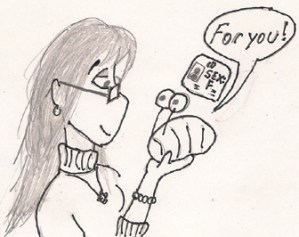
If only it were that easy.

On the one hand, when I hold a letter from my doctor, or a state ID that affirms I am female and has my proper, womanly name in all its glory, I feel empowered. I feel alive. I feel validated. I was taken seriously enough for those official categories of consideration to be changed, for the State to smile on me in its own strange, distant way and favour me with the constructs of a ‘legal name’ and ‘ID’ that act as the keys to getting me seen in society as I want to be seen. That doctor’s letter affirmed that I was indeed gender dysphoric, that I was truly a woman whose ‘psychological gender predominated over her physical/birth gender.” Those affirmations made my heart sing.

They also make it sink sometimes.

Because I know that I should never need any of those things to ‘prove’ myself to anyone ever. I remember how I held up the Greatest Doctor’s Note Ever to my father and told him “See?” Yet simultaneously I felt hurt that he needed to see something like that before he even began to consider what I was telling him about who I really am. That it took someone affixing their meandering signature to a form letter who happened to have the letters M and D after his name to get my father to think ‘this might be real.’

It’s a problem a lot of trans people experience- the fact that our word has never been good enough to anyone. Every out-group has a problem with elites speaking for them. But few out-groups are as truly de-voiced as trans people. It is truly rare that you see one of us on television, or openly writing in a newspaper, telling the world about our experiences. Telling the world who we are. Telling the world why.

There are, mercifully, more and more books written by trans men and trans women alike breaching major publishing thresholds, but there is still so much more work to be done.

It lies in the fact that so very often we’re forced to rely on men in white coats to validate us and our existence. To stand beside us and say “In my considered opinion as a professional, this person is telling the truth about her whole life and experience that I have had but the faintest and most tangential glimpse into.” Ever implicit in this is of course the idea that they know us better than we know ourselves, and I have always loathed this. It took years of introspection to get the certainty and courage I needed to come out, as well as meeting a very unlikely person (If ya’ll are nice I might tell you that story someday). It constantly gives the broader public the impression that we need to be spoken for and diagnosed by people who know better- and who will always know better. Cisgendered men and women who posit themselves as trans experts, primarily as a career advancing move, but who are fawned on by colleagues and the members of the press that deign to occasionally give our issues some space in the news.

The lovely lie that drifts through the coverage is, of course, that these people know us so well because they’ve seen us and done research on us. All very official and sciencey.

Well, here’s my research:

It took a lot of deeply personal effort to shine a light on the darkest recesses of my mind, putting my education to work so that it might elucidate some mysteries I once sheltered deep in my mind’s shadow. To think beyond what I was taught and consider all possibilities. To learn, slowly but surely, why society made us do and believe certain things, why I was raised as I was, and what lay beyond those carefully drawn boundaries.

These words belie the years of effort, and pain. Pain from not knowing why I hated myself, why I sometimes wanted to just curl up and die, why despite my theoretically bright academic future I dreaded becoming an adult male, why I squirmed with self-loathing whenever I was in a relationship with someone. Through all of that I did not know what the hell was wrong with me, even as I worked tirelessly and assiduously to find out what. Having shed much of my Catholic socialisation I was unafraid to consider the possibilities others would’ve had me shun, but even as I flirted with being trans I was smart enough to know how hard this all was, the risk it would be, the expense, the additional pain, the upheaval…

Getting over that took even more time.

It took meeting other trans people to really get my head around what went into all of this and whether this would be my path as well. In all of that sharing was intimacy, love, angst, anger. A cacophanous chorus of issues crashing against one another as I tried to find meaning in every precious new note I heard. There was experimenting in secret, lying to myself about what it was, roleplaying as women in online games, living vicariously through other women. Everything was trying to get out, faster than I could identify and neatly categorise it with confidence in its accuracy. I was at war with myself and didn’t even realise it until fairly recently. What’s more, I had to clean up a tremendous mess in my mind to uncover the truth; untangling my true feelings from what I was socialised to feel. (More on that next time.)

If this is not a deeply personal journey that isn’t entirely about self-knowing then nothing could ever possibly be.

So to be gainsaid by people who demand documentary proof is infuriating in a way that inspires passion I’d hitherto not known I had. In places where I am not known as a person, it is certainly nice to produce ID that matches my gender identity. It greases the wheels, it makes life easier for everyone involved. That doesn’t bust my chops so much. It’s the doctor’s letter that conflicts me the most.

This touches on a massive landmine in the trans community, of course: the pathologising of our beings. Are we truly disordered? To the point where a ‘professional’ diagnosis and examination are required, and placed well ahead of what we think, feel, experience, and know? I don’t purport to know the answer to this question. I’m not naïve enough to think my feelings or experiences are universal among trans people. We’re not all alike; in us is reflected the infinite diversity of the human race.

But to be honest I never felt truly disordered. My anxiety was a manufactured product of socialisation, of being raised to “know” I was a male, that females were this other species, and that never the twain shall meet. It took a lot of self-educating, digging, and assorted chiselling to get away from that. My angst sprung from the fact that no one ever told me that I might actually be a woman. Such was impossible, of course. We all “know” this.

Any good sociologist will tell you in a heartbeat that psychologists and psychiatrists perform incredibly needed scientific functions, and then whisper under their breath that they’re just agents of socialisation at the end of the day. Like the police officer, the parent, the clergyman, the schoolteacher, the psychiatrist enforces the commonly agreed upon norms and mores of our society. They have more objective science to work with, but there are an embarrassing number of psychiatric grey areas that reflect less science and more social attitudes that they take it upon themselves to enforce.

It really is this obvious sometimes.

I find it ironic to consider that if I was or am disordered it’s merely because society comes down hard on people who do what I do. Which, truthfully, is a disorder that has nothing to do with being a transsexual woman. It has to do with being sad. It has to do with feeling alone; feeling like you can’t trust anyone out there for fear of what they’d do to you if they ever found you out. All of that fear and self-loathing is caused by the pervasive sense that society will not accept me and that as a consequence I will not know love or have friends. I know now that I can have both. But in the years I was struggling with myself, there weren’t exactly big friendly signs telling me that’d be the case.

This has less to do with me being trans than it does with me violating a social norm, and in my particular case a lot to do with the fact that my existence is an affirmation of femininity and its virtues. My willing pursuit of it is a big no-no in a Patriarchy. (The flipside for trans men is that bigots will see them as “women who don’t know their place”- again it all filters back to the broader sexism that afflicts our society.)

But when you look at all of this and examine it thoroughly you see that trans as a discrete state of being has little to do with this. In my own experience it’s felt almost peripheral.

When I had to show that letter to my father, even to the clerks at the Department of Motor Vehicles, I felt a bit defeated. Despite everything I’d been through, the only person I’d end up proving myself to was… well, myself. To everyone else who, by dint of a record on the state computer, or because they saw me grow up, thinks I’m male… I have to prove myself somehow- and my words, however eloquent, are not good enough. There’s no denying that Doctor’s Note makes it a hell of lot easier and more official. Nothing like taking advantage of peoples’ infinite trust of men in white coats to make you hate socially assigned roles in this comical pageant of life a little more.

I just wish that certain people would take me at my word when I talk about my experience.
I’m With You

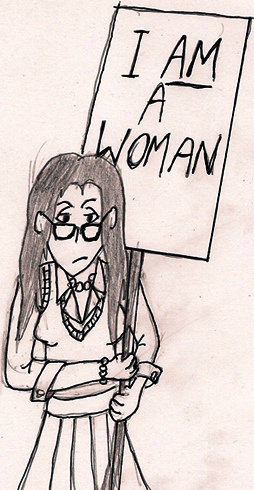
I Am A WomanHaving been inducted into the Femmisphere by my good friend over at FemmEssay it is perhaps worth meditating once again on the unicorniness of the whole Nuclear Unicorn thing. So let’s get down and funky with it while I drop some serious verbal groove.

Or funk. Or whatever. The point is that as the convenient illustration to the left shows, I am a woman. But we wouldn’t be here if it were that simple. I think that if I had to give a piece of advice to transsexual people who were just coming out, one that would be regarded as a rare gem of insight, it would have to be a warning, I am sad to say. We expect our enemies to come from the religious right and from the social conservative movement, and we are often reminded of why we must always be wary of them. But a trans person also must look over the left shoulder as some of our worst enemies are unabashed liberals.

That’s been very hard for me to swallow, without question. My own ideological commitments, as the rest of this journal has heretofore shown, are quite liberal. My heart beats Left and I ain’t ashamed to say it. But I know that self identified liberals will try to convince me I’m a male for various reasons, when it suits their needs. At best you might get some diversity obsessed tosser who gleefully tells you “Wow, you almost look like a real woman!” and tote you around to prove how tolerant they are. Most cuttingly, however, some feminists will simply deny me. That’s been the bitterest pill of all.

For years I always found myself sympathizing with other women and never quite getting the doodz who were supposed to be my comrades in arms. Whenever the cry of “pfah, women!” went up, I raised my glass only halfheartedly, knowing that something was wrong with my participation in this exercise of social separation. It was only in the last couple of years that I at last accepted I’d been pitching for the wrong team. It doesn’t mean that my feminism didn’t burn me hard in the past, however. Many male colleagues and acquaintances were made just a little uncomfortable at how I guilted them for their crass, casual sexism.

My own father struggled vainly for years to get me to come around to his entitled view of the world, to teach me to “love women” in the way that he did. He often got angry at me for not catcalling with him, often noted that I’d not leer at attractive women when we were out in public, and even berated me for fancying girls at school who he deemed unattractive. He certainly wasn’t the only one who attempted to socialize me in this way. Against him and all others I argued vehemently and with a passion that I never knew was so deeply personal.

I thought I was being a feminist male. I never quite knew that it was my own dignity I was defending against the tireless objectification of people like my father. But my own dignity it was.

What some radical feminists don’t quite get is that I am a victim of misogyny, just as they are, and that our beloved Patriarchy is no gentler on me than it is with them. It is at times even worse for one very good reason: Men will act out their worst misogynist fantasies on trans women.

For you see, we exist in that cosy netherspace of looking and sounding like women but, you know, not being women- according to them. When I first came out my father tried to grope me, in perverse fascination at my growing breasts, called me a “whore”, and demanded that I do “what a woman is supposed to do” if I’m so intent on being one which was, of course, cooking for him and cleaning up after him.

He explicitly said that’s what a woman was supposed to do. He never had the balls to say this to my mother (who looked at him aghast as he said it), but to me, a woman who was fighting against his perceptions for her femininity, he was more than comfortable saying and doing all of those things. He wants to treat women this way, he just feels constrained. I provide him with a convenient target to act out his sexist fantasies upon since I’m kind of like a woman but not a “real woman.”

Make no mistake, if this is transphobia it exists only as a subset of pure, unadulterated misogyny.

I have often said that when it comes to violence and bias against trans women it is not the fact that we’re ‘gender deviant’ that gets us attacked, but what gender we are deviating towards that earns the ire of people like my father. That is something that should alarm all women.

Should feminists be in the business of carrying water for patriarchs? I can think of no greater insult to our movement.

The mainline of their argument is unironically used essentialism. I am not a woman, nor can I ever be one, because I was born with a penis.

Let’s examine this for a hot second: Feminists have long railed against this society’s phallocentrism, and against a myriad of sexist presumptions dressed in the gown of science (think Freud’s Penis Envy), and long condemned the asinine acculturated idea that the penis carries with it any sort of innate power and entitlement, and that because we build world-ending bombs in their shape is no validation of the notion.

So how can one of their number suddenly turn around and deny me my womanhood on exactly the same basis as my father? Look at everything he’s said and done. If you bristled you did so rightly. Yet in denying my womanhood some radical feminists would say, verbatim, what my father has said: my little estrogenised cock is more important than everything else about my personhood, my life, my experiences, my personality, and the rest of my body.

What really gets me sighing and holding my head is when some of those same people come along and say that even a trans woman who’s had bottom surgery is still a man because they used to be penis-havers. I never thought I’d see the day when a feminist let the ghost of a penis define another woman. How sexist men must howl with self-satisfied laughter. They’re getting feminists of all people to do their dirty work for them, lock, stock, and two smoking barrels full of bullshit.

How could a feminist imbue that blasted organ with so much power in a way that is not at all different from how patriarchal men have done it for years? Treating it as an immutable birthright in whose veins is the essential privilege of manhood; this is radioactive water that I as a woman will not carry. No woman should. Our dignity should not permit it.

I am something that makes many men uncomfortable and with very good reason. I call into question the immutability of sex and gender; I call into question any innate concept of manhood’s superiority. I can do this with well reasoned arguments, but I call this pap and nonsense into question by merely existing.

If you want further proof of how misogyny has for so long stabbed us and tried to define us, you need look no further than that great gleaming edifice of purported objectivity: Psychiatry. Consider the following: as more and more trans people started coming out and going to therapists to be allowed to start hormone treatment and get the permissions we needed to transition, the world was rapidly changing around us all. The 60s were upon us and feminism was once again bursting through the dam.

When presented with a trans woman most male psychiatrists treated us with derision even as they allowed us to pass through their gates to access what we needed to transition. They stressed as they did so, however, that in order to be “real women” we had to be demure.  That’s right, if you were in any way assertive, they pegged you as a male. You also had to love makeup and pretty dresses. If you didn’t, you weren’t a “true transsexual.” You had to be the perfect fembot in order to convince them you were truly gender dysphoric and thus worthy of their help.

Maybe we can’t change all those radical women burning their bras, they thought, but we can have control over these very vulnerable women right here in our offices. Let’s make them into our image of what being a woman should be.

If that doesn’t come from sexism, where does it come from?

Many therapists these days have become more progressive, but others still cling to these ideas, like the notorious gender clinic in Toronto, at the Canadian Centre for Addiction and Mental Health. In a recent Atlantic Monthly article (one I have severe problems with) I was reading that discussed how trans people are coming out at increasingly younger ages, for ‘balance’ Hanna Rosin went there to interview the head doctor, Dr. Zucker, whose practises should raise wailing alarms in feminist circles of all stripes.

He purports to be able to “cure” us if we’re identified at a young age and get us to act in line with the organs with which we were born if we ‘act up.’ How did he do this with one ‘little boy who wanted to be a girl’?

Well, see for yourself:

They boxed up all of John’s girl-toys and videos and replaced them with neutral ones. Whenever John cried for his girl-toys, they would ask him, “Do you think playing with those would make you feel better about being a boy?” and then would distract him with an offer to ride bikes or take a walk. They turned their house into a 1950s kitchen-sink drama, intended to inculcate respect for patriarchy, in the crudest and simplest terms: “Boys don’t wear pink, they wear blue,” they would tell him, or “Daddy is smarter than Mommy—ask him.” If John called for Mommy in the middle of the night, Daddy went, every time.

This is the tip of the iceberg. Now think long and hard about this and this “curing” process. If the words “flagrant misogyny” aren’t flashing through your head in big, unfriendly red letters I don’t know what else to tell you.

Look at how trans women are treated in the psychiatric realm, among other things, see what is used to attack us, to other us, to un-person us. Every single time it’s a slight permutation of an argument used against women as a whole. Zucker wanted those parents to condition their child to hate women and to see his mother as a subordinate inferior. Is this how some radfems want trans women to be erased?

Do they want to drag womanhood through a very muddy gutter just to get rid of us? Or might there be more to all of this than a mere knobbly bag of flesh?

Do we really want to reduce womanhood to that thing? Do we want to say that trans women’s inability to bear children or menstruate invalidates us, backhandedly saying that’s all that really makes a woman? Note very carefully that innumerable patriarchal men reduce us to baby making machines. Is that water you want to carry for even five seconds?

This above all, however: We’re in this together, sisters. In our sisterhood there will always be a power no words can break and that misogyny cannot hope to breach.