The Academic Superheroine: A Review of “My So-Called Secret Identity”

cat_cover_text
The frontspiece for the comic featuring our heroine, Catherine Abigail Daniels. (This cover, above, is the work of Sarah Zaidan; all subsequent artwork featured in this article is by Susan Shore)

My So Called Secret Identity, the product of writer Will Brooker and artists Sarah Zaidan and Susan Shore, is a comic that seems to blossom out of the implied fissures left by the mainstream comic genre. While its protagonist, Catherine Abigail Daniels, is remarkable for being a non-sexualised star who presents an image of womanhood rarely seen in comic books, she is no less interesting for the fact that she is one of the “little people” in her superheroic city. The big superheroes and villains of Gloria City would be the focus of any other comic; here they are relegated to the background, flying far above the very richly detailed urban world that Cat lives in. “Gloria City is a theater where these big figures fight, posture, pose and self-promote. And if you’re not in a costume and a mask, you’re just little people,” as the promotional summary says.

The story is set to tell the tale of Cat’s intervention into that theatrical landscape, and how she becomes a costumed heroine in her own right. The perspective shift here is dramatically enticing; I can hardly wait to see how this story develops.

Cat is a character I truly empathised with, and not just because we’re both pursuing PhDs or share (roughly) the same name. The way she moves through Gloria City is an interesting sight in and of itself; it reminds me of my marrow-deep relationship with New York in its manifold rhythms and beats, its light shows, its high and low art, and the scattered constellation of shops, parks, cafes, and corners that are my homes away from home. With an economy of words and a wealth of images, the observational Cat gave me quite a lot to see myself in. Her loving descriptions of bookstore stacks remind me very much of my own literary rhapsodising.

Those powers of observation are part of what Cat’s superpower is meant to be. As one of the creators, Will Brooker, said in an interview with Nerd Span, “It’s the way she can find the links between things, recognise the dynamic and the relationships between the people and places in her world, and realise how they relate to history, theory, politics, institutions and power. Just remembering stuff is impressive, but that isn’t really Cat’s skill. She links things up. She makes connections nobody else has seen, and interprets what those connections mean.” In other words, Cat’s superpower is that she has a sociological imagination. Please excuse me while I swoon.

Her struggles include militating with the oppressive supervillainy that hangs over Gloria City, yes—the first comic literally opens with a bang—but also with quotidian sexism brilliantly and economically sketched on a single comic page that could usefully serve as a definition of ‘microagression.’ She is told she ought to be less academically forthright and confident, constantly made to feel little and ‘modest,’ and thus it feels like quite a stirring victory when she confidently confesses what her superpower is: “To put it simply… I’m really, really goddamn smart.”

Cat DanielsHaving read through the first issue, posted for free on their website, I must say that this comic—Cat’s life, aspirations, and story—really speak to me. Her struggles at university, for instance, put me in the mind of a recent debacle involving a male professor of mine. Relatable characters are hard enough to come by, but one that actually reflects the textures of a real woman’s life as lived, and then proceeds to spin that tale into fantasy escapism, is truly priceless.

The groundwork is laid in this first issue for the action to come; you get a sense of Cat, Gloria City, and the terrorism that wracks it. It’s not hard to see where this comic is potentially going, and what is hinted at is quite enticing indeed. Can Cat subvert the ‘theatre’ of Gloria City’s superheroes and villains, and perhaps become a true heroine for the “little people”? I’d really, really like to find out.

The comic’s funding scheme, which solicits PayPal donations from the readership, is no less interesting:

Here’s where the money will go:

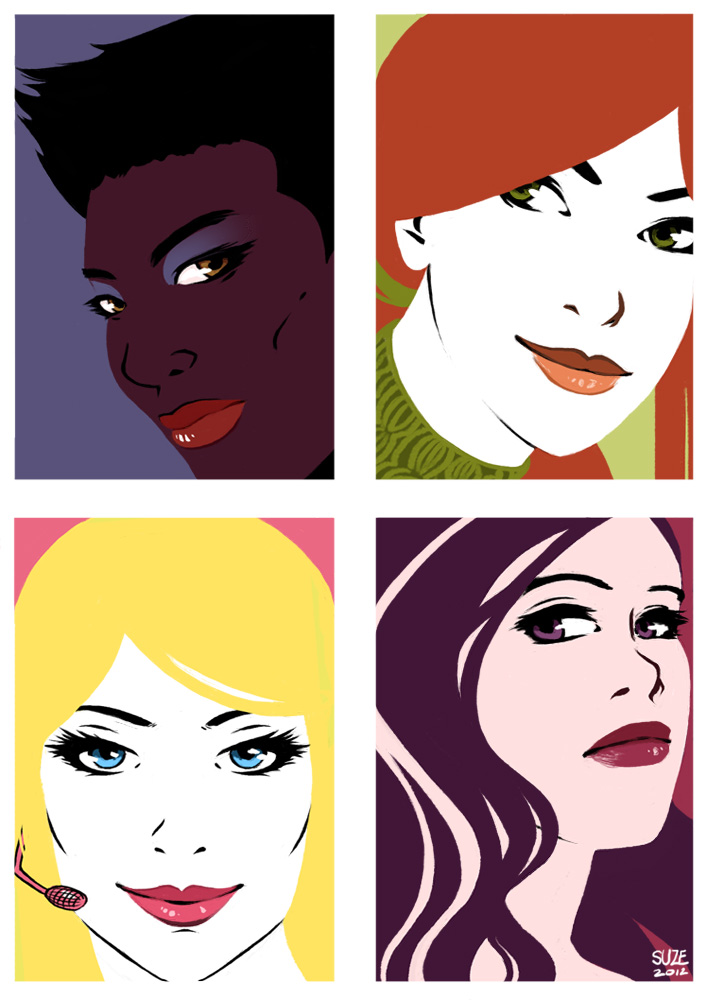
$700 pays Suze for an entire episode (22 pages) of beautiful black and white line art

$400 pays Sarah for the painted covers, the painted interior colour, and the mind-blowing montage sequences

$100 pays Lindsay to update the website with new costume designs and character sketches in Cat’s Lookbook, each issue

That’s $1,200 per issue. We’re rounding it up to $1,300 because we want to make a donation from each issue to a relevant women’s charity.

For issue 2, we are giving to A Way Out, which reaches out to and supports vulnerable women and their families. Rather than offer a single lump sum, MSCSI will make a regular monthly donation as a partner. How much we can give, and how many charities we can work with, depends on the success of this project. The author, Will Brooker, takes no money at all from your donation, and writes this comic free of charge.
headshots_4square

Combining social justice with fantasy superheroic justice; how can I say no? This project is in its infancy, but one hopes that this is the beginning of a beautiful saga. It isn’t often that I see a woman character I can really relate to in comics, least of all one who is the focus of the comic itself. Mainstream comics have had a few decent women characters here and there, but it’s rare that they take centre stage. One gets the sense that once Cat gets her superheroine druthers on no one will be able to steal the spotlight from her.

My So-Called Secret Identity, or MSCSI as the cool kids call it, seems to be the latest example of insurrectionist art that is pushing back against popular lies in mainstream cultural industries. Indie game designers are pushing boundaries without budgets, bending genres and showing us that, yes Virginia, feminine women can be badass video game stars. Increasingly, comic and webcomic artists are showing the way forward by doing much the same with their medium.
Why We Wag

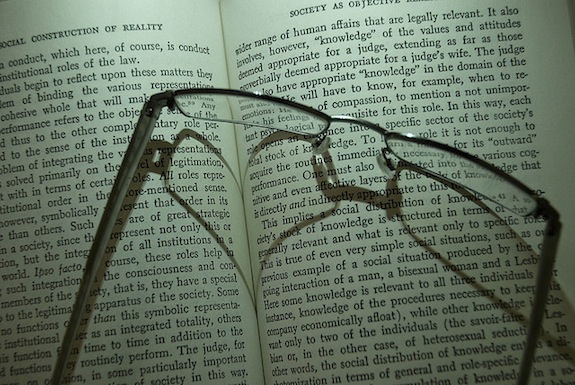
Glasses resting atop an open copy of The Social Construction of Reality
One of my favourite books, incidentally.

“The best thing for being sad,” replied Merlin, beginning to puff and blow, “is to learn something. That’s the only thing that never fails. You may grow old and trembling in your anatomies, you may lie awake at night listening to the disorder of your veins, you may miss your only love, you may see the world about you devastated by evil…, or know your honour trampled in the sewers of baser minds. There is only one thing for it then — to learn. Learn why the world wags and what wags it. That is the only thing which the mind can never exhaust, never alienate, never be tortured by, never fear or distrust, and never dream of regretting. Learning is the only thing for you. Look what a lot of things there are to learn.”

~Merlin, from The Once and Future King by T.H. White

I am often asked why I study sociology, and invariably the question is often freighted with the ponderous addition of “how are you going to make money?” I have employment in my field, and I intend to remain employed here: nothing is going to change my will to keep doing sociology and the deeper in I go, the longer and thicker my roots in social science’s soil become. Will I ever make a fortune? No, but that is not the gold that I got into this profession to find. The real mother-lode is the answer to the question of “why?”

In the midst of yet another right wing politician attacking the liberal arts model of education, it’s worth reflecting on the question, why it glitters; and why we, in Merlin’s word, wag.

North Carolina’s governor Pat McCrory said Tuesday, “If you want to take gender studies that’s fine. Go to a private school, and take it. But I don’t want to subsidize that if that’s not going to get someone a job.” The prevalence of such noxious opinions alone recommends the courage of anyone taking a cultural studies course, minor, or major; it is not enough, it seems, to confront all the quotidian challenges of college life, one must also deal with the slings and arrows of people who think your intellectual pursuits worthless.

Yet beyond this it also misunderstands the raison d’etre for liberal education. It provides you with lenses of perspective that enhance whatever one sets her mind to: to have a grasp of gender studies is to understand the dynamics of your workplace and be more productive in it. A better co-worker, a better human resources manager, a better supervisor, union leader (uh oh), and so on. This happens because liberal education is about expanding your horizons beyond the realm of your individual capabilities and recognising what it means to live in a society—a place where you are not alone, where you share rights, responsibilities, and a fate, with countless others whom you’ve never met, and do not know. That is intimidating, but learning history, philosophy, social science, and the arts, gives you handles on that vast world, and it gives you a place to begin. Somewhere to situate yourself, in other words, and a way of engaging with your fellow citizens as citizens; when you speak the common language of music, have a grasp of structures of discrimination, know the history of another culture, know a foreign language, or connect on an intimate level with an intellectual sub-universe you’d never known had existed before, that cosmopolitan ethic allows you to be and do more in whatever job you happen to choose.

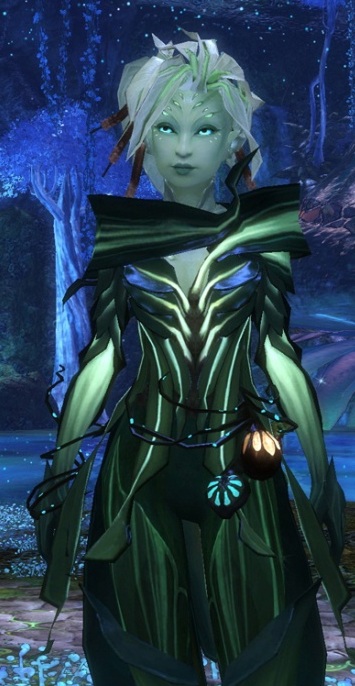
Green skinned, plant like woman from Guild Wars 2 wearing leafy clothing, with bedraggled, short white hair
Learning about mythology helps you make some of your own– and yes, you can get paid for that.

In the world of video games, this is starkly evident. Ree Soesbee, with a Master’s in English, and a PhD in mythological studies, is one of the most talented people in game design. On top of everything else, she is a classically trained musician and speaks three languages. She’s also a brilliant writer and helped design the much lauded Sylvari race in Guild Wars 2, which many including myself have praised as a brilliantly original addition to the canon of high fantasy. Perhaps governor McCrory does not think this valuable work, but it is work, it does pay, and it has made countless people happy. Academic perspective, at its best, is a magnificently refractive prism that turns the light of learning into a rainbow that we can all admire. Great art, great writing, great research, add to the magnificent polychromatic tapestry that any culture might produce, and they give us the tools to both enjoy and understand our world. The Sylvari, for instance, are not only a fun addition to a video game, but in their uniquely written biology and culture, are also an interesting mirror in which to meditate about our received notions concerning gender and sexuality: something whose urgency in our very real world should be more than apparent.

Democratic citizenship requires that sort of meditation because it insists we participate in the governance of our society. It is why we cannot simply be together alone, islands adrift aimlessly in a sea of mass democracy, but active and thoughtful people who know whereof they speak and know a bit about the wagging of this world. Liberal education provides the tools and context to make sense of this world’s variegated meanings, to know why the world is the way it is, what its history is, what its anthropology is, what our psychologies are, what the theologies of its constituent religions may be, what the sociology of your street corner is; those scraps of knowledge are lenses that give every citizen a spyglass that extends the boundaries of the world and makes them smarter voters and smarter people.

There is a hunger for that knowledge, too. I’ve long refused to believe that these are the peas and carrots of our lifelong intellectual repast. Throughout my years learning and doing sociology I’ve met strangers on buses, trains, in airport bars, and parties who, upon hearing I’m a sociologist, immediately lean in conspiratorially and ask bashfully if I can explain why humans do x.  Sometimes it’s simple: why do people lie? Other times it’s more complicated: why are the Israelis and Palestinians fighting? Sometimes it’s middling: why are people religious? But the point is, the questions bother them, and they want to know the answers. Time and again, in social science and gender studies classrooms I see students get swept up in the discussion as their taken-for-granted worlds are scattered to the four winds of intellectual inquiry. They are not always comfortable, but they do not shrink either. They’re interested, they want to know; they know there is more in heaven and earth than is dreamt of in McCrory’s non-philosophy and they want to hear all about it.

The danger of McCrory’s vision, of the world he imagines, is that it is more plastic and static than a Lego town (which at least has the imaginative dreaming McCrory denies the importance of). Not only does he, as a matter of pure economics, get the order of operations wrong (technical training or no, the jobs simply aren’t there, and the cause has much more to do with the failings of capitalism than the number of students taking African American History or Kantian Philosophy), but he also seems to think that the social world we have, with its history, politics, and economics, simply fell out of the sky. His vision of America is equally static, and that myopia emerges in his lambasting of learning Swahili; he seems to forget, or simply not know, that we have large communities of Swahili speakers in the United States.

For McCrory, it seems, we are the way we are because that’s the way we are, the end. It’s as frightening a view as saying that we should not try to understand the majesty of the night sky or the deeps of the ocean—that we should accept that they exist and move on to more important things (whatever those are). Yet our world, our social world, the universe we as humans created with our imaginations—for good and ill—has a history, has a sociology, has a psychology; it’s a story worth knowing, worth debating, and worth living with as a citizen. As a human being. We cannot let it lie because, if we’re going to talk about jobs, there is a ton of work to be done here.

If McCrory wants to create jobs, perhaps he could find a way of paying the armies of students in his state who are working to end poverty, volunteering at domestic violence shelters, churches, family planning clinics, trade unions, or who are teaching and tutoring for free, or who are working to end homelessness, give dignity to jobless and wounded veterans, protect and enrich the lives of the LGBT community, getting people registered to vote and driving them to the polling stations, supporting the incarcerated; this is all labour of the hardest sort. I am surrounded by people who practically give of their flesh to labour at doing the right thing in this country—who organise communities into actively participating citizens who can police their own streets, help their kin, support their children, build their homes; it’s the hard work of using the law to help people, not hurt people; the hard work of creating a “citizenship” that is about democratic participation, not your immigration status.

All of this is work, and every iota of it has benefited from engagement with this world’s great ideas, great literature, great art, and great science. An understanding of sociology not only benefits me at my day job, it follows me into my volunteer work. It helps me do both to the best of my ability. Understanding at least the first elements of how and why the world works as it does helps me to be a part of this democracy in a way that, I hope, benefits more people than just myself, and makes “We the People” a reality, not merely a slogan.

Forgive me if it’s elitist to think we might all benefit from knowing why this world wags.