Daughter of Zero Queens: Roleplaying as Resistance


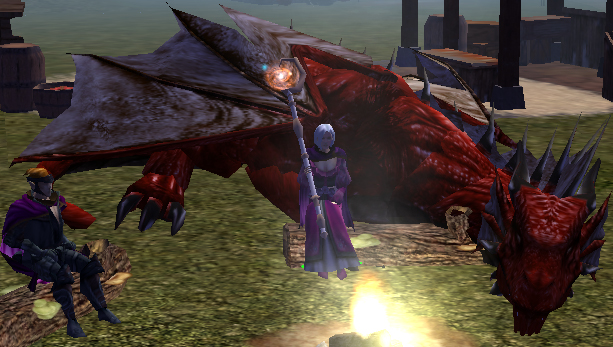
My Cleric of Lastai, Liera- in purple with the staff- sitting 'round a fire with her friends. Yes, including the dragon.

Picture it: a World of Warcraft RPPvP server, 2006. A good friend of mine takes up a wager with a female friend of his to test a “theory”- at least it was nothing but a theory to him, at that time. She had often sparred with him about the idea that women were treated differently in online gaming and he was more than a little sceptical. If this were about treatment in, say, the workplace or the home environment or out in the street, this back and forth might have gone on forever. But this woman had a solution that only a game like WoW made available to her. She made a bit of a wager with my friend: roll up a female character, play her, roleplay (RP) her if you like, and don’t tell anyone you’re a man in real life.

My friend agreed, being the adventurous sort and an avid RPer to boot, and went forward. To this day he still tells me how his experiences over the course of the next month completely changed how he understood the treatment of women in games like this. He found himself flirted with, harassed, the target of other unwanted advances, as well as finding out why chivalrous acts could be construed as condescending or suspicious. He even discovered that in an RP guild he was fought over by some of the male officers in a way that culminated in theatrics that eventually sundered the guild.

In his own words:

“Guys used to hit on you randomly asking for ERP [cybersex] and then if you actually interact on an equal level they think you like them, and if you turn down their advances it’s rage quit time.”

Certainly not every person will have the same experiences or reactions, but what always fascinated me was how easy it was for him to suddenly see through the eyes of a woman in society because of WoW. This is but one of many possibilities offered by roleplaying that could represent revolutionary breakthroughs in how we all understand society and the lives of our fellow human beings.

For me personally, as I have alluded to many times, being able to roleplay as a woman gave me an education similar to my friend’s but also enabled me to simply be myself. Unlike my friend, I expected to be treated differently and sometimes unpleasantly, but I also took in the joy of simply affirming one’s womanhood. In those days I would publicly lie and say that I roleplayed as women to simply express my “feminine side” and what not. I didn’t want to admit to others what I increasingly knew in the most guarded recesses of my mind: that I roleplayed as a woman in part because I was one and had no other way to express my gender. Being a woman was and is awesome to me because being myself is awesome.

Roleplaying means many things to many people. For some, simply playing a single player game as a fictional character constitutes RP. For others, it means consciously and directly acting out that character’s fantasy existence through constructing backstory and plot around them, and engaging in actions and dialogue that would be “in-character” for them. In either case, though, I have come to discover that roleplaying allows an incredible amount of agency to be invested in the player and provides a gilded road that can bypass the often problematic stories and imagery that adorn many games. You may find yourself surrounded by images of women who seem to exist to only cater to hetero male fantasy, but your female character does not have to be that. Indeed she can actively rebel against it, or any number of other ideas that predominate in the game’s setting. In that lies the power of RP.

Indeed, for a long time my women characters were explicitly designed to be strong and confident, never defined in terms of the men around them, but as their equal partners in the game world. When I played Neverwinter Nights I played a Cleric of a sensual goddess. But I did not do so explicitly for sexual reasons. Most of the time she wore conservative robes, but her revealing outfits were reserved for religious festivals and rituals where the sex had a meaning beyond eye candy, as rituals that honoured the sacred act of lovemaking. Whether matronly or overtly sexual she was not simply an archetype but a complex woman who owned her body, her sexuality, and her entire self. I even RPed her journey from worshipping a more conservative god of healing to worshiping this goddess of love as one of self discovery and assertion of herself.

There was more to her still, of course. She was a wise woman (Wisdom score of 30!) who came to the aid of many characters who were having one problem or another and quickly developed a reputation as a kindhearted counsellor. Her crises of faith were born of deep introspection on her part, and as she was middle aged they were part of a “mid life crisis” of sorts. The compelling interactions she had with other RP characters made her reassess who she really was. On the flip side she also loved hard liquor and was never afraid of having a good time with the people she shared her village with, unafraid of partying after a hard day’s battle.

I could go on, but the essence of this is that in the midst of this Dungeons & Dragons environment I wove an interesting female character who could articulate sexual struggles, religion, and the social location of womanhood and still be fun to play. Some of the people I played with were not exactly radically-minded. Some were quite conservative in real life. Yet the character was loved. Strong, complex women are not “political”- they’re just damn fun and interesting.
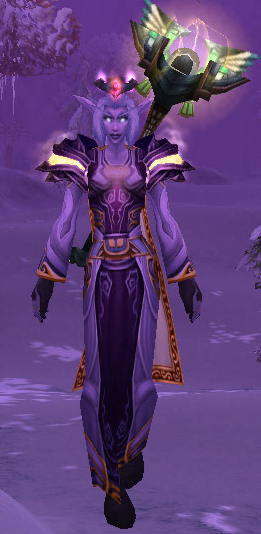
The namesake for this screen name, Quinnae, floating courtesy of her Levitation spell; one of many benefits to being a Priestess of Elune, along with great dental.

On the subject of religion I should relate more personal insights. I often play as characters with some religious grounding, which is ironic considering my history (and I’ll get to that in a moment); Priests or Clerics, Paladins and Druids are often my primary roleplaying characters. On my shelf right now, side by side (perhaps very appropriately) with my gender studies and sociology textbook collection are my many hardbound D&D manuals, a good chunk of which are about the fantasy religions of various settings.

When I was young I grew up with a conservative Catholic father who took “God the Father” a little too seriously. Through his faith he buttressed unchecked patriarchal authority, the subordination of women, and even quite a bit of racism (particularly Islamophobia). It’s no surprise homophobia and transphobia also came to him through his idea of God, and when I came out I faced a fusillade of assaults from him that included saying I was violating God’s will by transitioning and that my “devil reading” had made this happen. I’ll not belabour these descriptions any longer as this should paint a sufficient picture of why, for a long time, I hated religion and looked down my nose at people of faith.

That hatred existed in the midst of my RP life, of course, which began in 2005. But I figured my characters were just fiction, as were their goddesses and gods, and it was all “just a game.” Yet over time, especially as I got into playing my Cleric and reading the more in-depth compendiums about pantheons in D&D I began to realise that faith as a central organising principle in one’s life was something that could be very positive. I was very much blinkered by my self-centered perspective and yet, almost as if against my will, my own characters pulled me out of it. My Cleric was a woman whose faith taught her that love was love, no matter what form it came in, to name an example. Her goddess was a symbol of that conviction in openness, love, and the idea that pleasure in moderation was utterly sacred rather than profane. I came to understand that my father’s Catholicism was not the only form faith had to take.

Faith could evoke metaphors for beauty rather than self-abnegation.

I do not credit RP with all of these realisations, of course. A Christian woman I know and love in Canada, and who happens to be married to another woman, was a huge support in my life as I was coming out and indeed a second mother to me. She’s just been ordained in the United Church of Canada. She and her pagan priestess daughter above all deserve credit for showing me what faith can be.

And yet I also know that roleplaying was what initially opened my mind to what they would eventually teach me. As I looked through the guidebooks and found gods and goddesses for all sorts of things, and vastly different descriptions of all manner of churches, temples, lyceums, and groves for worship I came to realise that what faith was, what it could be, was not limited to bitter, closeminded evil. The Richard Dawkins style of white atheism that I had flirted with up to that point withered under that slowly blossoming realisation. The characters that I would so lovingly roleplay, from my NWN Cleric to my WoW Priest, would chart lives of faith that were not built on hate, or on othering, but on self-empowerment and a sense of social justice that infused their many actions in the game world, whether it was cleansing a den of undead or battling the Lich King or healing the wounded behind enemy lines their faith gave them the power to do what was right and resist oppression or the temptation to oppress.

Had I never been given the opportunity to roleplay religious characters I might’ve gone right on keeping my privileged assumptions about how people of faith were “irrational” and “weak minded.”

The title of my piece is a reference to the Marion Zimmer Bradley book I’m reading at the moment, Lady of Avalon,  where one of the protagonists is known as the “Son of a Hundred Kings,” a messianic figure in the classic fantasy tradition, the chosen one whose coming was foretold by prophecy, et cetera et cetera. My characters on the other hand are not built on that notion of exaltation above all others. They are the daughters of no queens or goddesses, but ordinary women called on to both do exciting things and simply muddle their way through life. They, like quite a few good RP characters I’ve come across in my time, don’t require a legacy or a prophecy to make them interesting.

Roleplaying is not just about slaying dragons or annihilating evil old gods who threaten the world, it’s about capturing the aspects of ordinary life that can make us all who we are. I love those little details. The first Paladin I ever made, Zoe, was a notoriously messy eater . My Priestess, Quinnae, is a brilliant artist and still plays with stuffed animals. My WoW Paladin, Sera, carries wine and fine cheese with her everywhere. Some come from backgrounds of privilege, like Sera, others like Zoe never knew anything but nomadic lives. But all of these little flourishes help them come to life and they evoke depth that is sometimes, or even oftentimes, lacking in the bigger characters written into the canon of all of these games.

When I RP I have no overtly political goal in mind. I never did, I never will. Certainly when I RPed as women I never expected to undergo a transgender transition in real life, or for my views about religion to change. But the effects were there all the same. Even in this fictional space I could be truer to myself than I was, at the time, allowed to be in the “real world.” Despite it all being “just a game” my knowledge of the experience of many women in society was deepened long before I came out (and it was deepened and widened much further).  I had often held a traditionally liberal view that women sometimes had a rougher time of things but it was an academic knowledge held from a distance. Playing WoW, even three years before I came into my own as a woman in the real world, made that knowledge experiential, rather than abstract.

When Gary Gygax first worked with his partners and wrote up what would become the first edition of the Dungeonmaster’s Guide I am certain he never dreamed that his game could promise salvation and comfort to transgender people who could afford to play, and yet there it is as a very positive unintended consequence. The great benefit of roleplaying worlds is that they allow people to transcend boundaries and move in social realms as someone completely different. I haven’t even talked about how one can come to a better understanding of racism or classism through RP.

But above all it allows you to take control in the face of a gaming world that is sometimes or even oftentimes hostile to women, people with disabilities, LGBT people, or people of colour. It allows you to dare to be the character that many developers don’t write, to be the character you want to see in a fantasy realm. It’s a fascinating realisation of Gandhi’s old aphorism: “be the change you want to see in the world.”

I roleplay that change.

Lost In Trans-lation: The Final Chapter/Reckoning/Cliche something-or-other

I’ll not preface this essay with very much, only to say that it is a swan song for the last month and an interesting opportunity that I seized to neatly tie up and summarise my academic and- dare I say- personal journey over the course of the class. My final grade in the course was an A and so was my grade for this essay.

The question I’m answering here is, basically, what did I learn over the course of the last month and how did the readings challenge (or not challenge) me and the views I held when I walked in. My response is as follows:

I walked into the class having done a good half of the assigned reading and with a fair amount of foreground knowledge of both emancipatory politics in general and feminism specifically- both its virtues and its foibles- as well as already being familiar with concepts like intersectionality, epistemological or materials hierarchies, disability studies, pivoting the centre, and many others to boot. Yet I also knew I was going to learn something new, even if it could not be organised in the neat black and white text of printed readings, it would be there etched into my memory. The first thing I ultimately found in the course was a sense of arrival at a new plateau of my own awareness, a realisation of how far I had come and how far I might have to go. While I had already learned many of the basic ideas and issues the class had gone over, they were drawn into relief by the contributions of others to the course material and by the readings I had not studied before, or by re-reading old favourites with a fresh vision. But above all it was the sense that my story, as it were, had value and meaning. As I told the class, I am often leery of alluding to my male past and claiming it gives me some additional knowledge simply because I do not enjoy reminding people that I am a transgender person, and because I fear it undermines my stated gender identity, but I did it anyway because I felt inspired by readings like Gloria Anzaldua’s Letter to Third World Women which rekindled in me a sense of pride in who I was that I had forgotten. For so long I cursed the circumstances of my birth that I felt had made me fall short of the normative standard of ‘white cis woman’- now I embrace them as making me the woman I am. Not normative, but whole. True to herself. That truth is an enunciated one, one that came from speaking up. Several readings enabled me to do that and gave me the impetus to not only tell the class “Yes, I am a transsexual woman” but also that my past gave me insight into the nature of male privilege. I spoke more about my history as a man in front of more people than I ever had before. I put my shit on the paper, yes, but I also had to cast it to the air before eyes I could see looking back at me. A few of the readings helped to make that possible but it was also the context in which these readings were assigned and analysed that helped.

To name a few examples, deconstructing Judith Lorber’s Night to His Day provided me with a platform to criticise something I’d noticed almost a year earlier, which was the subtle cissexist bend of Professor Lorber’s writing. That was a positive assertion of my identity, not only because I was using my trans female experience as something worthwhile and as a site that could produce truth and knowledge, but also simply because I critiqued it on feminist grounds. I queered feminism and the opportunity to do in a setting that was not Internet-based was riveting and satisfying. I had long since read Judith Lorber’s piece, but what it did for me this time around was open up possibilities of active resistance wherein I could make plain my own ideas and my own experience. That was the experience that told me Judith Lorber’s analysis of gender construction as a process was fundamentally correct, the experience that told me I did exactly the same thing she did on the Subway (gendering babies based on subtle cues added by the parents), as well as the experience that told me in no uncertain terms that her misgendering of Billy Tipton and her flagrant appropriation of trans identities undercut the very point that she was making. Where she had attempted to show there was nothing inevitable about gender, she turned and around and resorted to a conveniently reified binary that took a hatchet to the positively asserted gender identities of the people she used to support her argument. It was one of the first of many things that reminded me of one very important thing: how I know what I know is valuable and meaningful. What’s more, it is not something meant to idle like a gilded trophy or curio on a coffee table, a static conversation piece. It is something that had to be deployed, had to be written, had to be spoken aloud.

To that end, Gloria Anzaldua, a writer I already admired, tipped the balance for me. I had long since taken up her charge to write. Writing is a huge part of who I am, my ideological and physical transition has been blogged and analysed by me in a wide variety of ways. I spoke of my experience and wove elegant tapestries with words that others might know where I stood. Like Paula Gunn Allen I seemed to say “Where I come from is like this.” I cannot speak of Ms. Anzaldua alone, however, because the power of what she said is only amplified by the chorus of women whose voices rose in unison with hers in This Bridge Called My Back. While there were no trans women in that anthology I nevertheless felt a deep and abiding connection with the women who wrote in it. As I often say, being trans is about complex relationships. These women spoke to a great many complicated relationships- with religion, with family, with their culture and the hegemonic culture, with sexuality, with feminism. All of these were issues I shared, and all of them were things that Gloria Anzaldua said must be committed to paper loudly and furiously, riding roughshod over those who would say- directly or tacitly- that what these complicated women had to say had no academic or literary value, or at best would be a ghettoised form of literature for idle curiosities and nothing more. What she did for me personally was to remind me powerfully that even though I was not part of certain privileged classes, my voice had value. Trans women in particular are rarely taken seriously. Cis men may (quietly) seek out our dancing, our sexuality, or stereotype us as savants of gender, while others may think of us as walking comedy routines and nothing more. What Gloria Anzaldua and several other writers impressed upon me was the idea that this was not my destiny. She is not alone in this, of course. Many trans women writers, from Julia Serano to Susan Stryker to Andrea James to Raewyn Connell made that clear to me as well. But Gloria Anzaldua was, unlike the aforementioned women, also a woman of colour who knew about where I came from as a Latina, not just as a woman of trans experience. I cannot overstate how much it meant to me to see writers talking about the Bronx, about the Spanish language, and their intimate experiences with life in a barrio or in a Latino family. Even those who were not Latino also spoke of experiences and tensions that mirrored my own. Unlike, say, Gloria Steinem, I felt as if I could talk to these women and they’d immediately know where I came from and why it mattered.

I had been reading Bridge before I even registered for the class, and thus the resonance of those powerful and radical words was already thrumming deep within me. What the readings and class added was a space in which I could engage in a new form of self-assertion. I had already been writing for anonymous internet readers, but class afforded me a space in which I could also use my experience to teach, and to take a firm stand against dominant cissexist ideas. Encountering Gloria Anzaldua in the readings was just fuel for an already brightly burning fire, I suppose. But I always kept her close to my heart when I spoke because I knew that like her I was refusing to be silenced, refusing to be pigeonholed, and refusing to comport my words to dominant standards of acceptable discourse. I might frame my radicalism and the essence of myself in academic terms- what she called esoteric bullshit- but I make no bones about the fact that that is what it is. It is who I am, writ passionately in florid prose. I would not erase myself and say that I could adequately talk about sex and gender without referencing my trans-ness. I would not silence myself and say that my unique personal history was not of great importance or was not elucidating.

In another way many of the readings were a walk down memory lane, revisiting my initial journey through feminist ideology and canon, and the rapid process of self-awakening it involved. Marilyn Frye’s Oppression was an early reading of mine that helped to shape my views about oppression as an interconnected system, and as something that was not confined to one problem or issue, but rather was found in how that problem was actually linked intimately to a web of unjust actions and impositions. Her birdcage metaphor long ago crystallised for me the perfect definition of confinement, wherein focusing on just one bar occasions incredulous thoughts about how such could confine anything, taking that needed long step back to apprehend the whole cage to which that bar is connected reveals the reason for being trapped. Sojourner Truth’s timeless Ain’t I a Woman? was as evocative to me now as it was when I first read it. Her words were a righteous injunction against the racism in the suffrage and abolitionist movements, but also provided such tireless muster to the countless women like myself who never want for occasions to remind others that we are indeed included under that generic term “woman.” My experiences are dismissed by those who wish to claim that I am not a woman, or at best some lesser form of woman whose identity is tolerated at the pleasure of those whose genders are too privileged to question. But Sojourner Truth always impelled me to ask her endlessly echoing question bluntly and insistently. As she eviscerated the white male supremacist stereotypes that had bound her, and took to task the women who were handmaidens of those ideals, she provided hope for women many generations after her. Resistance is always possible, she seems to say. My experiences do matter, she enjoins. This too had a formative influence on me and I smiled as I revisited it in concert with my classmates.

But there was also another shift that the readings drew into a very vibrant definition which was embodied in several readings like Professor Bonilla-Silva’s Colour Blind Racism and of course Angela Davis’ gripping Women, Race, and Class. I was very receptive to these readings because the groundwork had already been laid, so to speak, but what they did was to give voice to musings I had been having as well as ideas that were slowly beginning to coalesce in my mind. Angela Davis’ elegantly stated radicalism drove many points home for me such as how slavery was not just about race, how the myth of the black male rapist serviced sexist and racist systems, how the suffrage movement was a home to both radical revolutionaries and selfish conservatives, among many other things. What struck me one night as I was excitedly telling my mother all that I had learned from her about various tragic episodes in American history and how they related to white supremacy was her response to all of this. She told me with a smile that I never used to talk like that and that I would just as often criticise her for saying negative things about white people. It made me step back and realise that in my younger years, right up until fairly recently even, I had been a dutiful handmaiden for white privilege and adopting many of the very same vapid arguments that Eduardo Bonilla-Silva so deftly dissects with regards to “colour blindness.” My mother reminded me how much I had changed and joked that she had to get used to it. My reply to her seemed weave various ideas from class into its warp and weft. I told her that she was right and that I apologised for questioning her experiences in the past, and apologised for dismissing her experience and her life growing up as invalid or arbitrarily “in the past” and no longer relevant. I told her that above all her life taught her as much if not more than I was learning in class, and that what she knew and could summon from her memory had great value even if it was not signified with a piece of paper signed in calligraphy.

A note must also be spared for Michael Kimmel’s Masculinity as Homophobia whose simple and I would argue misleading title belies Kimmel’s more complex and interesting points, such as that masculinity is racialised as well as simply gendered and that homophobia is often part of attempts to ‘prove’ ones adherence to true manliness. Kimmel is much closer to the academic feminist mainstream whose writing is more ‘professional’ and geared towards a style that is (mostly) impersonal and attempting to present theory in a magisterial voice, and thus lacked the deep resonance that, say, Nellie Wong or Gloria Anzaldua could sing with. Nevertheless Kimmel does draw on a little experience (like the silly games he and other boys would play) to make his points about how masculinity is constructed in a complex series of oppositions, and he reminded me that my lived experience as a male in society is valuable too and shouldn’t undermine me. This is an element of my thinking that is definitely a work in progress but over the last three months or so I have begun to seriously ‘revisit’ manhood and particularly that which I was socialised to express and pretended to for many years. It is, in a way, part of a long term project in which I try to undo my internalised transphobia and make peace with who I was rather than simply adopt a scorched earth approach to the matter. I have read with eagerness progressive work and theory on manhood in society and while the reflection of myself in such was far dimmer and distant for various reasons, I still slowly (and am continuing, slowly) came to realise that I should think just as critically about who I was as I do about who I am, and to accept that as a valuable standpoint as well. I often point out that I do not claim the same standing as a cis or a trans man when it comes to manhood. Being a pre-transition trans woman is indeed its own subjective experience that I do not intend to overinclude in discussions of masculinity. But what Professor Kimmel’s piece reminded me of was the fact that I had a lived experience in the subject position of ‘young man’- even if it was forced, false, and unasked for, things happened and I experienced life through something approximating that subjectivity. This is not a small matter nor something I should ever overlook. Sorting out its meaning will likely take me to many more distant places than what Professor Kimmel explored but gender scholars like him who think analytically about manhood have helped me realise that I could do the same.

In many of these recollections of where the various readings took me I often make a point of saying that I already had some grounding in the material and in the ideas presented. Certainly this class has not radically changed my life. I and the people I love did that. What it did do, however, was provide a temporary but powerful focus in the midst of that transition. The class and the readings therein were part of a continual flow with no easily defined beginning or end. It would be easy to say that I was one way before I walked into class and another after the semester finished. But it would also be lazy, deeply inaccurate, and uninteresting I feel. At least in my own case since it is patently untrue. But these readings were, nevertheless, significant for me. At this phase of my journey through life, this class was something I needed to be a part of. Through the prior semester I had scrupulously kept silent about being trans, selectively stealthing while I was in all four of my classes because I feared losing the goodwill of teachers and students alike, and because I value being understood as a woman. This class was my opportunity to at last stand up and speak out. In many of the readings the contextualising that occurred in class also helped to bring them to life in a way that I did not quite experience in reading them alone in my room or on the train as I so often did in the past. Furthermore, I actually found myself reflected in some of the readings, old and new, which is always a unique and uniquely wonderful experience. Finding yourself in a reading is like seeing through a spyglass and apprehending your refracted face, knowing it for the first time; then you see past it and find the whole world magnified afresh.  That was how I felt as I tore through This Bridge Called My Back, for sure. Talking about it in class somehow only made those voices louder and more insistent to me, a firm reminder to never forget Gloria Anzaldua’s words and to never stop writing. If there is one thing that the readings prompted me to do for various reasons- be it to boost their signals, to challenge or critique them, or to speak passionately about their effects on me- it is to put my shit on the paper.