Theory is Yours: A Brief Archaeology of Trans Feminist Awesome

This post will appear as a crosspost on QT very shortly and was addressed chiefly to its audience, and thus the ‘this space’ term refers to Questioning Transphobia. Otherwise, enjoy!

In looking out at the vast, expansive canon of gender studies literature, and in light of even the most superficial analysis of its myriad failings it is easy to feel dispirited by what it has to offer trans people. It is all too easy to understand the instinct to abandon both queer and gender studies as a privileged exercise in neo-pathology, the postmodern turn of the same ideologies that guided the hegemonic psychiatrists of decades past. One could find yet more examples, of course.

Judith Lorber, someone readers of my blog may remember my past disagreements with, had this to say in 1994 about trans people: “[trans folk do not challenge the gender order because] their goal is to be feminine women and masculine men” (Lorber 1994, 20). Yet again we find the tireless obsession with attributing a politics to identity in the simplest possible terms, yet again we find the clutching of pearls with regard to the innate, literal body politic of trans people. It might perhaps be too obvious to tell Professor Lorber that for all of her elegant theorising about the socially constructed nature of gender she cannot bring herself to describe trans people by their proper pronouns (for example calling Renee Richards “he” and Billy Tipton “she”) nor to belabour the questionable hypocrisy of being unable to break out of the role of arbiter even as she derides the imposition of gender schema upon people.

However, to simply shine more light on the white cis women of gender academia and call them to the carpet for their tacit transphobia does a disservice to the armies of trans folk that have devoted their not inconsiderable intellectual, emotional, and spiritual energy to challenging these things since before I even drew breath.

Continue reading

Lost in Trans-Lation II: Attack of the Bad Puns

What follows is another journal entry, as the really bad title might well have clued you in to. This one is a brief analysis of Virginia Woolf’s A Room of One’s Own. Needless to say, I loved the book, and equally needless to say I found a means of relating some trans issues to it. The entire thing is nowhere near as deep and comprehensive as I would have liked. There are a multitude of ways to read those 120 pages that comprise Ms. Woolf’s most famous feminist work. For instance I did not get to expound much on my idea that the Internet allows countless people from a variety of backgrounds, including otherwise very marginalised ones, to have a vast and endlessly interesting room of their own. The proliferation of blogs has created innumerable platforms that are both very personal and very public- perhaps transcending the firm dichotomy between them- for people like sex workers, trans folk, radical activists across the various spectra, people with disabilities, the impoverished, and more. It is, certainly, a point I should have dwelled on.

It is a great shame that a feminist blog named after Woolf’s book is a hive of transphobia, but excepting the corrupted allusion that it represents the growth of the Internet and the infinite number of ‘rooms’ it has created has advanced the cause of social justice like no other.

I should also not have to belabour the point of a certain significance that accrues to a simple fact: I’m getting perfect scores on these essays that routinely mention trans people in a positive light, and that routinely critiques (and indeed, more often than not, trashes) our opponents, feminist and otherwise. Where among other professors this might occasion deeply undesirable battles, I find myself supported at every turn by both my professor and others in the department. Comments where my professor expresses mirth at my witty eviscerations of transphobes are more common than not. It is also worth mentioning that the room of my own this blog represents, and the larger salons of our own that websites like Questioning Transphobia embody, are what helped me hone my skills to not only speak in my own voice as a woman who is trans, but to do so well.

With that, I raise my coffee mug to Virginia Woolf and pray that I am doing her proud. She exhorted us, with passion and verve, to write and add our wisdom to the libraries of the world. Goddess knows I’m now trying to do my part.

Continue reading

I Am Whoever You Say I Am

In the long march into academia one naturally becomes intimately acquainted with the geeky and esoteric minutiae of whatever discipline one has chosen for their career. Over the last two years I’ve found myself up to my eyeballs in gender studies text and find it utterly fascinating. I’m often seen scurrying to and fro with a book or two tucked under my arm and my desk is covered in all manner of books appertaining to my passions. But importantly, when you are trans-anything and delving into the wild and woolly world of gender studies you have to be ready for the fact that there will be lots and lots of highly credentialed, intellectual academics theorising about you who do not know what the hell they’re talking about.

This occupational hazard is, to put it bluntly, both annoying and the reason I’m doing the sociology of gender in the first place. The only way this is going to be truly fixed is when we start writing the theory and we start conducting the research, casting our eyes not just on this wild and strange tribe of “transgender” but also on cis people whose views are far more powerful in shaping how our fractioned community is gendered and understood. What I’m looking at today is a particular strain of thought that is increasingly common in Third Wave feminist theorising; it is ostensibly trans positive but ends up being highly fetishising, stereotypical, and ultimately transphobic. It stands in contrast to that Janice Raymond school of theorising that constructs us purely in terms of an outsider, an enemy who constitutes a patriarchal invasion-cum-Body Snatchers. This vision instead sees us (or some of us) as ‘useful’- we have utility in the quest of certain cis feminists to smash the gender binary. Yet what unites both of these seemingly oppositional philosophies is that they are theories formed by cis people about us, relative to their gender ideology, and that construct us as ‘other.’

There are a few major currents in this new feminist theory that merit deconstruction and they will likely be familiar to most readers in one way or another:

Continue reading

Lost in Trans-Lation II: This Time It’s Personal…er

So begins Episode II of the Lost in Trans-Lation saga. I realise this is, in many ways, a terrible title whose badness is compounded by the fact that it’s yet another bad ‘trans’ pun (and don’t worry, there’s more where that come from) but it’s grown on me and I’m going to keep it around for its humour value. I’m in a new Women and Gender Studies class with the same professor giving the same weekly journal writing assignments, and so I felt that like any badly named movie it needed a sequel. The sequel no one was waiting for. (Rejected titles include Lost in Trans-Lation II: The Two Ivory Towers; Lost in Trans-Lation II: Revenge of the Poststructuralists; Lost in Trans-Lation II: Return of Marilyn Frye. Lost in Trans-Lation II: The Identitarian Menace. Look, do you know how hard it is to make jokes out of words like ‘ethnomethodology’? Give me a break!)

Onto more serious things. In this space I clearly devote an extensive amount of energy to trans issues. In the near future I will write my thoughts on the etiology of transgender and I think that this journal entry I’d written that reviews Anne Fausto-Sterling’s Sexing the Body is a very good place to start that might give my readers some insight into the intellectual underpinnings of the opinions I’ll soon be expressing. Dr. Fausto-Sterling presents a very compelling view of biology, its relation to politics, and the project of sexual dimorphism, with profound implications for how we understand transgender and transsexual people.

It would be difficult to overstate just how vital Anne Fausto-Sterling’s work should be to any discussion of sex and gender, particularly in its ponderous neurological and biological contexts. Her earlier book, Myths of Gender, explored the myriad of problems with simplistic biological explanations for gendered phenomena in society, but Sexing the Body’s implications reach further. She proposes a radically new means of understanding sex and gender. I would not simply say she has proposed a new ‘system’- rather she challenges the need for a system at all, and trading heavily on the examples of intersex people demonstrates the radical implications of it and the need for a vision of sex and gender the centralises the individual rather than privileges the preservation of already-existing groups. In the opening chapter, Duelling Dualisms, she uses illuminating examples that highlight the seemingly arbitrary nature of our present ‘two party system’ as she wryly calls it later in the book, focusing on the topic of Olympic sex testing. While this work was penned in 2000, the very contemporary example of Caster Semenya demonstrates the ongoing, painful relevance of the Olympic examples and the absurdities contained in its assumptions. From a Nazi athlete who disguised himself as a woman in the Olympics for easy gold medals, and then lost to three actual women, to a Spanish runner who found herself under vicious attack after an Olympics sex test identified her as “male” Sterling brings to life a complex issue that we do not often think about. What does it say about our world when we have powerful people sitting in a “femininity control head office”?

Sterling paints a picture of a gender system that is as much enforced as it is naturally occurring, and one that treats exceptions to it not only as curiosities, but even as things to be utterly annihilated, denied, and erased. Such language may seem extreme, but it is hard to look at the surgical alteration of intersex infants in any other way. Her chapter Should There Be Only Two Sexes? demonstrates powerfully why these surgeries appear to be more in the interest of preserving a social ideal than in the welfare of any given child. She demonstrates that while intersex people without surgically altered bodies lead productive lives, including lives that are active sexually, those who undergo the surgery face mixed results and the doctors themselves admit that the goal of such surgeries is merely a cosmetic effect. Virtually no attention is paid to the psychological health of the child or to their future sexuality, which is often irretrievably harmed by the surgery.

I have often said that this failure to treat intersex children properly is best described by one of Anne Fausto-Sterling’s best turns of phrase wherein she says such surgeries constitute “the literal social construction of sex”; contained in those words is the essence of the very problem that intersex people and transgender people are confronted with. Sterling points out that many of our sexual woes are essentially conceptual problems. We find ourselves unable to break out of dualistic thinking on the subject: sex and gender, male and female, nature and nurture. She argues convincingly for a vision that regards the connections between mind and body, as well as body and society, as a Mobius strip where there is a simple but elegant continuity between the two ‘sides.’ This stands in a long line of feminist thinking that has sought to challenge dualism as a destructive idea that necessarily flows from (and thereby reinforces in dialectic fashion) systems of domination and subordination. Starhawk spends much time challenging dualistic thinking in both religious and secular life, arguing that it promotes the idea that one end of the polar split is good and the other evil, a metaphor that plays out on countless aspects of ordinary life with disastrous consequences. Sterling takes this conceptual vision and suggests that we reunite concepts previously held to be opposites, echoing my own long standing injunction “can’t it be both?”

Another problem, as I already alluded to, is that such dualistic cleavages invariably create hierarchies. Quoting Judith Butler, Sterling asks “Why […] has the idea of materiality come to signify that which is irreducible, that which can support construction but cannot be itself constructed?” This echoes my past thoughts about the long shadow Karl Marx’s base/superstructure paradigm has cast on the sciences. Even feminists would come to see it as salvation, allowing them to argue that yes, while biological sex is natural, real, and unchangeable, gender was constructed and malleable, thus social change was possible. It is a compromise argument that has left feminism the poorer and painted it into a corner as it still fights on numerous fronts against biological determinism. Sex is accorded the status of timeless reality, that which simply is, while gender is conceptually granted the possibility of some flexibility but is still seen as an outgrowth of sex’s foundation.

In addition to this, however, she proposes an equally interesting idea that has much merit as well. She holds that homosexuality and heterosexuality are themselves constructed and are predicated on a reinforced binary sex/gender system that only came into full force with the rationalisation of the 19th Century.  She argues that our culture presumes that when a middle aged person comes out as gay that they are revealing something that has been cosmically true all along and invalidates years of prior heterosexual activity. The truth, she says, is more complex and the idea that one is exclusively hetero or exclusively straight (and sometimes bi) is a scientific fabrication enforced by powerful social norms that ensure a general degree of conformity and compliance. Certainly this is true to a great extent. Many gay/queer people who come out later in life feel as if they have been living a lie. It is not to say, however, that heterosexual acts might never have occurred to them in a more tolerant society, only that the stifling burden of compulsory heteronormativity limited their options to a ‘straight’ presentation. That is most certainly living a lie. But does it mean that there is a “gay gene”? Both Fausto-Sterling and I are sceptical.

In Should There Be Only Two Sexes? Sterling makes a brief reference to transsexual and transgender history that is interesting and does ring of some accuracy, but suffers enormously from its brevity. My concern is that readers new to the subject may walk away with a somewhat skewed view of this history. She briefly mentions but does not go into detail about just how powerful medical and psychiatric professionals were in determining the gender presentations of trans people. There can and should be no mistake: trans people, women especially, were a highly vulnerable population that many psychiatrists took advantage of to enforce the most rigid gender norms possible. To the extent many such trans people enacted, and perhaps even internalised, this performance it is assuredly the fault of the psychiatric establishment, not of transgender women, that there was a “reinforcement of a two gender system.” She does also muddy the streams when it comes to the transsexual/transgender distinction, incorrectly making transsexuals seem conservative, and transgender people more inherently liberal or gender fluid. I identify as transsexual but I am certainly no gender conservative, and may even fall into the category of people she says do not surgically alter their bodies but identify as women. She also says something that I agree with, when she says “permanently assuming a transsexual identity that is neither male nor female in the traditional sense.” She is correct, certainly. I identify as a trans woman, maintaining the firm double-thought of that identity and resisting any artificial bifurcation of it. I am not a broken woman in need of correction or fixing. Sterling touches on a debate in the transgender community: some feel comfortable referring to being trans as a “birth defect” or saying “I’m just a woman, not trans-anything” while others like myself consider her transness to be an inextricable part of her identity that cannot be excised and should instead be a matter of pride. I distinctly remember when I first read this book my great disappointment that Sterling did not spend more time on trans people as we are- and I do not think she’d deny this for a second- quite helpful to her general argument. But as I have just pointed out, it is very difficult to summarise the complex politics of identity in the trans community. Perhaps she was avoiding a minefield after all?

Sterling’s photo of a much younger version of herself still makes me smile very broadly. It reminds me quite a bit of myself at her age, endlessly fascinated with test tubes and the other trappings of the great scientist, saving the world through mixing brightly coloured chemicals. I imagine that had I been raised as a cis girl I might’ve been given a similar epitaph “In memory of Katie, who liked space rocks better than boys.” The point she makes about innate inclination versus environment, and how it cannot be resolved or intuited as being convincingly one or the other is a good one. There may well be no way of knowing for sure if she truly was born to be a scientist. After all, the science I decided to pursue after many years of faithfully stealing my mother’s food colouring to better enhance the sciencey look of my fake chemistry sets was, of course, social science. How did she end up a biologist and me an aspiring sociologist? The resolution that she proposes for understanding how these things happen is a sound one, and her flair for apt visual metaphors continues into the final words of the book: a matryoshka doll. For her the famous Russian nesting doll symbolises the various layers of sex and gender, interconnected, each interesting by itself, but only fully intelligible and complete as part of a larger, continuous whole. Each layer- history, society and culture, the mind’s psyche, the physiological organism and so on- shapes gender. How much? That depends on the individual. Individual body, personal history, personal relationship with significant others and society, personal biology. It all adds up to a unique individual. This is the frightening answer that many people do not want to face up to- it fails to offer the silver bullet much desired of those who want an easy and simple gender order.

But it does have the benefit of being correct.

Their Eyes Were Watching Goddess

“Three years after graduation, in an apple orchard in Sonoma, a friend of mine (who comes from an Italian working class family) says to me “Cherrie, no wonder you felt like such a nut in school. Most of the people there were white and rich.” It was true. All along I had felt the difference, but not until I had put the words “class” and “colour” to the experience, did my feelings make any sense. For years, I had berated myself for not being as “free” as my classmates. I completely bought that they simply had more guts than I did- to rebel against their parents and run around the country hitchhiking, reading books, and studying “art.” They had enough privilege to be atheists, for chrissake.”

~Cherrie Moraga, from ‘La Guera’

I have often said that transition changes far more than you expect. In my own life I certainly expected to change gender presentation in a very noticeable way, yes, but I never expected my politics to change, my relationship with my mother to change, and my career goals to crystallise so quickly, to name just a few significant things that shifted with the tectonic plate of my gender. But there is one more area of great significance here and I touched on it a bit yesterday. Faith.

When I was younger I was very close to being a radical atheist. I thought Richard Dawkins was the greatest thing to happen to Western intellectual life since Voltaire, I gleefully joined in the intellectually squalid mockery of the religious as “irrational” and otherwise “weak minded” (when I was being nice), and I joined Christopher Hitchens in saying that religion poisons everything. I had, after all, grown up in a Catholic household headed by a traditionalist patriarch who took inspiration from his faith to be misogynist and homophobic, as well as bigoted against various other religions, like Islam and Hinduism. As I grew older I would find myself recoiling against it, and not just because of him. I saw in the news, time after time, the Church shafting women, helping AIDS spread in non-Western countries, bilking the impoverished, spreading hatred of the queer and gender variant among us; indeed when I first tepidly came out, just a few days later the Pope would compare transgender and other variant people to the threat of deforestation around the world. I’ve memorialised my reaction to that in the form of this blog’s very title.

In all of this, how could I not have had a very negative reaction to faith as I got older? But when I transitioned something finally gave way. Even during my heavy flirtation with atheism I did not quite come right out and claim that I was because there was, ironically, a bit of logic gnawing at my mind. Would the world really be uniformly better off without religion when we settle the most petty of secular disputes with equal verve and hatred? Are virtuous people of faith really straw men, or are they people I ought to include in my assessment of religion? Is it right to mock and dismiss the religious out of hand because of their beliefs? On and on those questions worked upon my mind quietly. So what changed when I came out? The woman who helped me find myself was in the midst of another transition: coming out as a woman of faith.

But what made me sit up and take notice was that it was not just any faith, it was a pagan one culled from centuries past. The worship of the Goddess Cybele was often executed by priestesses that we would, today, consider transsexual women. Far from being a stigmatised group, shunned by faith as a threat to the world, they were considered the highest and holiest manifestations of the goddess herself. As my dear friend excitedly explained all of this to me and I did some research of my own I sat back pensively and felt my sociological imagination kick in. If that were possible- trans people being holy instead of utterly sinful- what else could faith do? And I began to realise that even though I knew religion was socially constructed, I had never taken that idea to its logical conclusion: that it could be socially reconstructed, that its meaning was not fixed and that its present form was not its inevitable one. The mythology of her deeply felt faith is profoundly beautiful, and my friend- Jade- found in me a willing counsellor. I couldn’t believe that I had stepped into this role, of interpreting her faith for her and providing her with guidance on how to believe. But it felt so right, and I knew that I was helping her. In her own words Jade describes her faith best: Here she is on sacred sexuality, here on the main myth of Cybelline faith which rendered trans women holy, and here is her beautiful recounting of SRS as a spiritual experience.

To return to my own journey… The hammer fell hardest on my self-flattering delusions about secularism and atheism. I had wanted to believe that those who had no faith would be inherently more tolerant, more reasonable, and more accepting. Yet as I was coming out and looked around I saw any number of things that told me this wasn’t true. Several atheists (YouTube’s infamous AmazingAtheist being a prime example of this) were flagrantly misogynist in the most boorish and typical way possible. Indeed, AA would give my Catholic father a run for his money in the woman-bashing department. In numerous discussions, comment threads, and writings I’ve found I have also discovered that many atheists can be just as callously transphobic as their “theist” counterparts, and oftentimes for the same reasons. It does not matter to me if you tell me that it is God or Allah who holds me as less than human, or if it is your bowdlerised reading of neuroscience and psychology that informs this. It’s all the same bullshit to me. That realisation was actually a liberating one. Christopher Hitchens’ atheism also did not leave him with the wisdom to oppose the war in Iraq or to not heartlessly rationalise neo-imperialism, nor did it leave him with the compassion to avoid Islamophobia, nor the reason to skirt asinine evolutionary-psychological theories about women’s separate sphere.

All of this made me realise that religion was less operative on human sin than I had thought. Atheists were just as capable of bigotry and rank stupidity as the religious were, and people of faith could be possessed of immense kindness and love. All was possible, but religion did not predispose us to one thing or another.

The fault, dear reader, lies not with the stars but with ourselves. What we mould faith into is what matters, but faith itself is merely a tool. The dominant patriarchal faiths of the world have done immeasurable harm, but not expressly because they are religions. We as humans lust after purpose and meaning. Religion furnishes us with this, but it is not the only avenue to those universally sought-after goals. Secular philosophies, political ideologies, and various other beliefs can inspire the same passion, the same fervour, the same devout blindness that religion can. The sacred canopy of faith, that great nomos that binds together the meaning structure of society, is easily replaced with secular strictures that perform the same functions- and will be prone to exactly the same flaws. The problem is neither faith, nor government, nor science, it is us.

When I came out as trans and began to research the history of this group I suddenly found I belonged to I realised that the great antagonists in our lives were not only the patriarchal men of God who pronounced hatred upon us from on high, but also men in white coats who hearkened to the higher power of rationality. Men who would pathologise us as diseased and in need of their shepherding, who would seek to control us. Who would tell trans men that they could not love or marry other men, who would tell trans women that we could not wear trousers, and who would constantly exploit us to enforce their vision of gender and sexuality. The same men who, for a very long time, had pathologised homosexuality. Their descendants, even now, in the forms of J. Michael Bailey and Kenneth Zucker, use rationalism to oppress. They exploit us for no reason other than a desire to increase the volume of their citeable writing and to make names for themselves with esoteric pet theories.

The Catholic Church could hardly have done any worse.

There were other things I came to notice as well as the scales finally fell from my eyes. Atheism’s overwhelming whiteness was one. In their insipid denunciations of the “irrational” among us they completely ignored the different cultural meanings and centralities of faith for people of colour. The Cherrie Moraga quote above epitomises a perspective that, even though I had grown up in a Latino family as well, I had become somewhat blinkered to. I had the privilege of going to the best schools in New York, which pushed me shoulder to shoulder with many who were white, upper class, and rebelling. I gained little to no appreciation for how faith built community in my own neighbourhood and wrote off the role of faith in opposing slavery and segregation.

When Sojourner Truth told a sceptical audience of white suffragettes and men of how only Jesus heard her when she wept a mother’s tears at how slavemasters stole away her children, that meant something. That was not incidental or flavouring. Faith sustained her through her greatest trials, faith helped her to become the powerful presence that stood at that podium to issue an injunction that echoes loudly and proudly to this very hour: Ain’t I a woman?

How could I have ever, ever deigned to spit on that as merely irrational weak mindedness? How drunk on privilege does one have to be in order to make such a judgement?

What Cherrie Moraga said was jarring because I had interpreted my own struggle to free myself from Catholicism as something rather the opposite of privilege. But in truth it was because I inhabited upper class milieux that I even had the breathing room to express myself in that way, where participation in a community of faith was optional. This Color Lines article is rather instructive on the subject from the unique perspective of trans people of colour.

[Monica] Roberts grew up in Houston, Texas, and in the Black church. Her mother is a teacher, and she was surrounded by women who were historians and leaders in the community. She understood the influence of Black women. “You might have a minister up here pontificating on the pulpit on Sunday,” she says, “but the real power behind the throne is the women’s auxiliary that’s meeting on Tuesday.”

Her father, a local radio commentator, tried to groom Roberts for leadership as his eldest child. Yet, it was only after transitioning that Roberts felt able to take on such a leadership role. Perhaps it was due to the toll that living in the “tranny closet” had taken on her self-esteem. But Roberts also noticed a difference in the responses she received from other people to her leadership as a Black woman. She got positive reactions, she says, “because I was basically doing the traditional work of Black women in the community in terms of uplifting the race.”

This is neither small nor incidental, it is something that commands respect and understanding. Not arrogant derision. I learned fast that what Evelyn Brooks Higginbotham calls “the metalanguage of race” bears profoundly on how we have constructed atheist opposition to religion. I had never thought of atheism as a privilege. In some ways, it assuredly isn’t. It opens you up to discrimination and other forms of opprobrium. But on the same level as what people of colour have experienced? Absolutely not. What’s more it is also used as a weapon against people of colour, directly and indirectly, as a tool to castigate them for being insufficiently enlightened or intellectual or modern- how ironic that one form of cultural colonialism is being steadily replaced with another. The truth is, I found more enlightenment in a church nestled in the heart of a working class and immigrant community of colour than I ever saw in many so-called rationalists.

I’ll close with a recollection of that church, one the most wonderful memories I have of early transition. Another figure in my own spiritual transition was my Cybelline friend’s mother, Anne;  a minister in the United Church of Canada and herself a lesbian, married to another woman quite happily. She took me one drizzly Sunday morning to her church to speak to her congregation for a service dedicated to Pride Week. By itself that was amazing. The sight of a rainbow flag on the altar beside the sacred ornaments and instruments of Christian faith felt at once natural and exciting. But I would be asked to speak specifically about being a trans woman.

It was something I never expected to do, and yet somehow it happened, and as I spoke movingly of my joys and my fears, I also had to spare them a thank you. They’d prayed for me. Not to “cure” me or what have you, but prayed that my father would come to love and accept his daughter. When Anne had told me this, it was like a brick through a plate glass window that finally shattered my militant resistance to faith. I thanked the congregation for their thoughts and their prayers and told my story, which was very well received by them all. As I sang with them and moved to the sounds of their gospel I felt something I had never felt before. At home in a church.

I am not a Christian now, no, nor will I ever be. The faith does not speak to my soul the way it does for some others. The difference now, however, is that I respect that for what it is. I learned the seemingly simple and even obvious lesson that faith is what you make of it, and that invidious mockery of it merely serves to reinforce the bigotry that atheism is supposed to be the antidote to. For my own part, I will admit for the first time here publicly that I consider myself a woman of faith, and probably betrayed what that faith was in my prior article. I do not speak much of it in this space simply because faith is private for me, it’s my own little sanctuary against the world in the embrace of Goddess and God. I do not believe in skyhook deities, however; for me faith is a beautiful metaphor that orders my thoughts and grants me peace.

I came to realise that was enough.

A Hex on Both Your Houses

I generally do not waste too much time expounding on general American political issues because they’re done to death just about everywhere else. For all of your Red vs. Blue, lib vs. con cockfighting there are quite literally hundreds of sites for your fancies. What I try to do here is to shed light on viewpoints that are not likely to, say, be repeated on HuffPo ad nauseam. Nevertheless occasionally something comes along, down that corroded mainstream pipeline that I find is being analysed in a way that elides its most interesting elements.

Ladies and gentlemen: Christine O’Donnell had sex with a witch. Liberals wish for you to know this and meditate on this.

Ms. O’Donnell and I likely agree on nothing save for, perhaps, the colour of the sky and Goddess knows I hope she’s trounced in the November election, for all the good it will do. But in watching the ascent of the Tea Party’s women I’m noticing a familiar pattern emerging here and one I am not especially fond of. When it comes to women like Sarah Palin, liberal men tend to forget that they’re theoretically committed to the idea of being anti-sexist and tolerant in general. Thus, enter one of the infamous “Mama Grizzlies,” Ms. O’Donnell and some video clips of her 11 years ago on Politically Incorrect.

I’ll waste no more words here. In watching the splashy press coverage of this we are expected to accept as uncritical fact the idea that it is scandalous that Ms. O’Donnell was involved in witchcraft, and that she had sex with a witch on what she describes as a “Satanic altar.” This, to me, is not a scandal. I’m going to leave aside the important issue of the fact that “Satanism” and “witchcraft” are two completely different things, and this erroneous conflation of the two on O’Donnell’s part has gone unchallenged. It’s more important to focus on two things here:

  • Yet again, a woman having had a sex life is automatically a scandal.
  • Witchcraft = Bad according to liberals. Thanks, boys.

Usually when this sort of nonsense comes up I’ll typically hear out a liberal apologist who says this is merely about exposing hypocrisy. It reminds me of a debate I had with one liberal cis woman who thought calling Ann Coulter a “tranny” was just hi-fuckin’-larious, and it was okay! Because it just showed up Ann Coulter as a hypocrite and because *she* was transphobic, then it was just all ironic and shit to imply she was a trans woman. You know. Like it’s a bad thing! But that doesn’t mean liberals are being transphobic. They’re just being “clever.”

So it is with Ms. O’Donnell. They’re not hating on pagans or witches, they’re just showing up Ms. O’Donnell as a hypocrite, is all! Cause she’s all Fundie now. However, note how there is precious little explanation of this complexity, nor any attempt in any of the many salacious news stories about Ms. O’Donnell’s indiscretions to set the record straight about what witchcraft is. In any just world, being a witch would be no more scandalous than being Episcopal. Yet, as usual, when it comes to anyone who isn’t white cis men, liberals play a bit of a shell game. They are ‘merely’ exposing hypocrisy while also ‘cleverly’ trading on the stigmas surrounding witchcraft and female sexuality. It’s all for a good cause, of course. Sundering the evil conservatives.

Who cares if you use exactly the same methods people like Christine O’Donnell uses to discredit her ideological foes? And, hey, who cares if you reinforce nasty stereotypes about religious minorities, eh? We need liberalism to protect the weak, after all.

In watching the usual sexist sophistry of mainstream American liberalism from the sidelines this season I’m left shaking my head and remembering why I’ve increasingly come to distance myself from that philosophical stream. For them, defeating conservatives- while a worthy goal- has become an end in and of itself in a grand game of mounted polo chiefly played by white upper class people who are predominantly male and Christian. Periodically, in the service of these “higher” ideals they espouse, they’ll throw people under the bus in parade: people of colour, gay/queer people, trans people (I haven’t forgotten, Representative Frank), women, and now, hey, let’s give the neo-pagans a turn while we’re at it.

If I sound a tad peeved it’s because this is getting old. In fact it was ‘old’ long before I was born. Thus, in that spirit, I shall show you something tonight you probably never expected: behold, a radical leftist feminist transsexual queer woman goes to bat for Christine O’Donnell. For one thing, I don’t care what she did when she was a teenager. I am concerned about the impact of her political views in the here and now. For all I know, she could’ve been more rad than Angela Davis when she was 18, it does not change the fact that there is something glaringly wrong with her contemporary politics. We all did stupid shit when we were young. Myself included. I guarantee you, who ever you may be, did so as well. Maybe you had hot Satanic sex with two people! (Of course, that’s less stupid and more flaming hot, but… you get the idea). I do not need to know this about Ms. O’Donnell’s past. I kind of figured she’s fucked at some point in her life. I assume that about most people I meet. I even assume they’ve probably done weird shit in the bedroom at some point in their lives. I actually assume this about every politician I’ve ever heard of or laid eyes upon.

I would actually hazard a guess that most people do, regardless of social class or education. No one, not a one, is surprised when some rag runs sex scandal stories. Ever.

People change over time. How would you feel if some bit of youthful nonsense you’d dipped your nose into stalked you for the rest of your life? Christine O’Donnell’s contemporary record speaks for itself without this being thrown onto the pile. So, the rub of this is, irrespective of everything else, the fact that she did this in the past does not change Ms. O’Donnell’s sincerity in her convictions, nor does it make her less serious. That is a fact that those interested in challenging her would actually do well to keep in mind. If she ever was Wiccan (doubtful) she certainly is no longer and represents a legitimate threat to liberty. We would do well to not dismantle it on our end by opposing her with witch-baiting and sexist campaigns, yes?

Secondly and finally, Satanism and witchcraft are not the same things, and both Satanists and Wiccans will tell you this, as will many neo-Pagans. The conflation of the two is a Christian creation designed to facilitate exactly the kind of slandering that Bill Maher and other white liberal men are now using to pursue their own short term political aims. “She’s a witch!!” Really guys? The Fundamentalists called, they want their shtick back.

As far as I’m concerned the mainstream liberals and conservatives can have each other. A metaphorical hex on both their houses.

ETA: Apparently us witchy folks are speaking up rather loudly about this now. Note, however, that the criticism is being levelled chiefly at O’Donnell, as well it should since she herself was defaming Wicca/witchcraft in her initial interview. I maintain, however, that the media’s uncritical use of this soundbyte and screaming headlines of “O’Donnell says she dabbled in witchcraft” were meant to speak to a presumed audience of Americans who would assume witchcraft is bad and scandalous, and thus the thrust of my criticism- directed at liberals who sought to make a tempest in a tea (party) cup- remains trenchant, in my view. The headlines were not “O’Donnell insults Wiccan community,”  they were oriented at shaming her for her association, however tenuous and distant in the past, with something vaguely approximating witchcraft.

The scandal was not her bigotry, it was the insinuated association. The media’s uncritical repetition of this meme is reflective of far larger problems than O’Donnell’s individual rantings and it is this, I feel, that merits the most criticism.

The Soul of History: Breaking the Silence of Biography

This post was originally going to appear on Nuclear Unicorn first, but evolved into something written for Questioning Transphobia very quickly. Still, it has more than earned its place here and is part of the project of confession and catharsis that “The Daughter Also Rises” began, in the hopes of telling a true trans story- my trans story- and illuminating just how complicated this whole thing is. Enjoy!

I was not so happy as I looked in the pictures on my parents’ walls. It was something that resonated with me as I read a beautiful, radical poem by Jo Carillo ‘And When You Leave, Take Your Pictures With You’ which used as a leitmotif pictures of Latinas working under the sun that might hang in the livingroom of a blanquita radfem. Like so many things in the anthology- This Bridge Called My Back- that poem is immortalised in, it made me think, not just about its own very important subject which is, alas, an all too salient issue even today… but about the pictures that were once on my wall too.

They were windows into a very particular past, a past that is assuredly a minefield on multiple levels. Much has been said, including on the pages of Questioning Transphobia itself, about those pictures. How they can oppress, or how they can liberate. It vexed me because as a budding sociologist I’m easily entranced by questions of meaning, and constantly working upon my mind was a need to decipher the meanings of those pictures in my own life. Not just the meanings of the photographs themselves, but what they represented.

And to begin the, perhaps necessary, use of ten guinea words in this piece; what the past those pictures evoked could say about my subjectivity.

What it means to be trans is one of those existential questions that excites and puzzles as surely as other such questions about the categories of human existence, the lines drawn in flesh that mark us off as one thing or the other. In the more evolved discourses of identity politics and its modern intersectional incarnations, there is an understanding that being trans carries with it a certain experience, a certain perspective on the world that only trans people have.

Certainly the vagaries of this can be disputed but one question that I’ve had and felt very troubled in answering is this one: Is my lived experience as someone who was forced to be male part of my subjectivity?

Let me be clearer still: I was never a man, no, but I lived as a male per the directions and encouragement of every social actor in my life up until the age of 21. In moving through the world in that utterly ill fitting skin, that imposed disguise whose existence tantilised the very edges of my conscious mind, I still ended up seeing things a certain way and being made to undertake certain actions, think certain thoughts. Such for me provides rich perspective, and informs my participation in discourses on misogyny. But can I talk about what that meant for me and what it felt like? What the specific experience was for me as a young trans girl- a woman forced in very deep ways to put on what society deemed a male persona? Can I say that this taught me something about male privilege or provided me with some perspective on what being a young man might be like?

Not without siring a world of trouble, that much is for sure.

I cannot speak about my past and lend a voice to those pictures that were once on my wall. I was not living as I wanted then, I was indeed battered into silence- sometimes quite literally- and I did not yet fully understand the essence of who I was.

But I was a person back then too, goddamnit. I lived. I breathed. I experienced life. I saw things. Felt things. Oh Goddess, the things I felt.

Transition is not going through life as a passive, unreceptive automaton until a switch is flipped and suddenly “YAY I’M A WOMAN/MAN!” and then suddenly all comes to life and now you live a life worth documenting and recounting. I was a person then too, in all those long, interminable years before transition. I was Quinnae-in-waiting, in a sense, but I was also Quinnae-in-progress. Despite this reality, this unshakeable duality, these contradictions held together by the insistent fact of my existence, I still feel immense fear speaking about my past with authority.

It’s a legitimate fear we’ve all felt, of course. We fear the slings and arrows that can come from any direction- from family, from radical feminists, from conservatives, from MRAs, and any number of people anywhere that might be invested in attacking our identities. We fear, with good reason, that the minute we say in a discussion “I used to live as a man/woman” that we remind people of a spectre we had hoped to banish, remind them that we are different- and in a way that often unsettles cis people. We fear we may shatter the selves that we have worked so tirelessly to build, shedding blood to make whole because we place before our potential tormentors the irresistible red meat of discussing a gendered experience as our assigned-gender, rather than who we really are.

We are often silenced because of this, and inhibited on speaking to the immense complexity of transgender experience. We fear that speaking of our pasts will court that tiny but vocal claque of radical feminists who will simply go “Aha! You DID have male privilege! We win! We win!” We fear people’s inevitable confusion and their bigotry. All with good reason.

In a recent article, Lisa spoke of the acceptable narratives of trans-ness, with a focus on the element of the acceptable liberal narrative that holds we are totally and forever happy after transition, the end. What I will focus on here is what comes before that, the hegemonic discourse surrounding pre-transition life. It is, in short, that everything is bad and terrible because you are “trapped in the wrong body” and waiting for deliverance as you sit in a swirling vortex of darkness. To a large extent this is true in its way- who among us does not remember deep depression and self loathing? I had suicidal ideations, virtually no will to live, and by the time I hit 20 my energy to do anything productive or meaningful had at last become the latest casualty to the dysphoria.

But the problem with the dominant narrative is that it tacitly insists that that’s all there is to pre-transition life, and my story was always more complicated. Talking about that isn’t easy because it upsets the prefabricated story that most cis people have about us, even when they want to be supportive, sympathetic, and mean well. The “trapped in the wrong body” cliché sums it up very aptly. The perception is one of a binary switch and also part of the same he/she media trope that bedevils so much ‘journalism’ about us (wherein the wrong pronoun will be used to refer to the trans person in past tense while the correct one is reserved for the present, post-transition person, which speaks volumes about how we are seen).

Perceptions of transition presume that you are exactly like a cis person in every way until one day you wake up and decide you want a sex change and BOOM, now you’re a man or woman. But the fundamental truth, as we all know, that our personal biographies are much more unified and complex than that.

I didn’t play with dolls when I was little, not because I felt like I couldn’t, but because Lego was fucking awesome. On my bookshelf right now, just above my copies of Whipping Girl, Women, Race & Class, and Gender Trouble, is a huge Lego starship I made and have carefully preserved. I was raised on and still adore video games. When I was a wee tyke I’d always get excited at seeing monster truck rallies on TV (my favourite was Bigfoot). To the cis observer, I didn’t fit the stereotype of the insistent five year old demanding the stereotypical trappings of femininity. But it didn’t change the dysphoria I would feel. So I was a bit of a tomboy growing up; doesn’t mean I’m any less of a woman for it.

That’s the other problem with the hegemonic cis narrative- it forces trans men and trans women (and excludes genderqueer folk, naturally) into a highly gender stereotyped fable… and then turns around and blames us for reinforcing their gender binary.

What I would experience as a trans girl was distinct to being me-who-is-trans, if that makes any sense. It’s my story and is not The Transgender Experience, but it is an experience of transness. What happened to me was that many parts of myself began to pull at me mercilessly as though my soul were being drawn and quartered. I fought against my gender socialisation as much as I felt compelled by it. This lead to contradictory postures in high school. I understood and fought against rape-apologism at age 16, earning the admiration of many female classmates, but also ended up employing entitled views about women. I became what I would come to loathe the most, a Nice Guy ™. All of this informs how I see gender politics today because, among other things, I feel I can testify to the fact that I saw certain gendered phenomena from the inside and could say with the kind of confidence that comes with that kind of knowing how remarkably troubling and disturbing it is.

Yet the reason I reject a simple male privilege analysis is because what I experienced as a trans girl is quite simply not really the same as what a cis boy might have. I internalised enough to act out some male socialisation, yes, but that has its own very distinct consequences that imbricate with the issues of potential privilege. It’s that male gender socialisation makes you utterly despise yourself as a woman, loathe who you feel you are deep inside, and worst of all compel you into a kind of ritual debasement that is a special form of torture: objectifying yourself. I strained so hard to accept I could have female role models and want who they were, their strength, their passion, their intelligence, and in some cases, yes, their fashion sense. But relentless pounding from my father, my peers, the media, all made me feel there was only one acceptable avenue for admiring women and femininity: sexual attraction.

I can’t begin to describe how that fucks you up as a woman. There are no sesquipedalian words for this, no academic prettifications I can conjure to lessen the blow of how intense I mean that to sound. It is deep and it is troubling; its enactment profoundly deepened my self-loathing and was part of what ultimately sent me spirialling downward. I owned nothing about myself, my dreams, my sexuality, nothing.

Talking about that is difficult, not just because of the shame I still feel sometimes, but because I fear that it will lead people to armchair psychoanalysis. More than a few right wing types and “men’s rights activists” have claimed trans women are just self hating men who mutilate themselves. That line of bigotry also has a silencing effect, because in talking fully and faithfully about my past I need to be able to say that acting out such and such male socialisation was like inflicting wounds on myself daily. It was deeply ingrained self hate and I need to explain a lot about my pre-transition subjectivity in order to fully explain that. I have to remind you of my past, and entreat you to step into that picture that once hung on my wall.

I also have to navigate the unyielding and craggy shoals of transgender politics. The perpetual fear of “making us look bad” stalks my mind, as I’m sure it dogs many of us here. I fear sometimes that if I say “when I was forced to live as a man, I didn’t get harassed in the street; now my life is completely different and my relationship with the outdoors is fundamentally altered” I will earn the ire of those who demand I stick to The Narrative for the good of the community and not try to give voice to my past self because it will just confuse people and undermine my identity. I don’t fully blame other trans people for doing this; the fears are very real, unfortunately. Part of the appeal of The Narrative is that it’s simple and easy to remember. It could probably fit into a limerick I don’t have the patience to think up right now.

But the fact is that we’re far more complicated- like any human being might be. That’s not good for a bumper sticker, but it is reality. As the comments here demonstrate there are a multiplicity of transgender perspectives and experiences. Being trans is a bodily experience too, and yet even that differs. When I stand up and say that I never felt ‘trapped’ by my body, will someone think I’m making us look bad or confusing people? What might people think if I tell them that for me changing my name was far more important to me than anything about my genitals? That it was less my penis and more things like my name that clawed at me and made me feel empty inside, defined by others but not by myself.

How might I describe that? I might put it in the terms I put it to a cis friend of mine who listened rapt:

“In the past, when I wrote my name or signed it, it felt as perfunctory and connected to me as a serial number. An assigned thing that signified this entity known as “me” but had no connection to my soul otherwise. It was just a thing for a form.”

She is enthralled by this and ‘gets it’ more than many cis people do. Yet I’d fear saying this to a broad audience, I would fear leaving myself to misinterpretation. The fear of that, of doing wrong by the trans people I love, silences me oftentimes. Yet I still try, on my blog and in comments sprinkled here and there, to say ‘this is my experience’- and I have found many people who, much to my surprise and pleasure, seemed to understand and welcome the complications I added to the transgender stories they had heard.

The real power of this, however, is in the person I will never forget, who read a blog post I wrote where I spoke of the tomboyish aspects of my youth and how I didn’t fit the stifling “classic transsexual” narrative that is so often repeated in news outlets right around the world. She came out after reading it because she at last felt she wasn’t alone in having that unique childhood. She didn’t play with mum’s dresses and high heels either, but she is no less a trans woman. It makes you wonder how many more of us suffer in silence and are having their pain prolonged by that ciscentric, cis-friendly narrative of transition that leaves them feeling “not trans enough” to save their lives.

I know in some way, we have to start breaking this vow of silence. How, I don’t know. But I feel like the answers lie in those pictures. I wasn’t as happy as I looked in them, no.

But nevertheless that was a woman and a human being.

On.

My.

Wall.

Author’s Note: Some of the flourishes at the beginning and especially the end of this piece owe themselves to Jo Carillo’s beautiful poetry, which I sorely wish I could have linked in this article. As I came to accept myself as Latina I wanted to elevate these voices and add their textures to my contributions to trans discourse, but I want there to be no mistake about who they belong to.
Daughter of Zero Queens: Roleplaying as Resistance


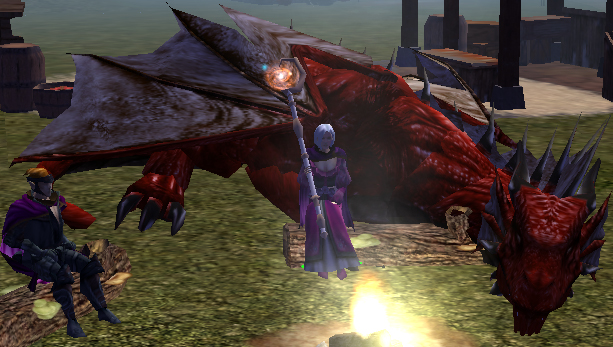
My Cleric of Lastai, Liera- in purple with the staff- sitting 'round a fire with her friends. Yes, including the dragon.

Picture it: a World of Warcraft RPPvP server, 2006. A good friend of mine takes up a wager with a female friend of his to test a “theory”- at least it was nothing but a theory to him, at that time. She had often sparred with him about the idea that women were treated differently in online gaming and he was more than a little sceptical. If this were about treatment in, say, the workplace or the home environment or out in the street, this back and forth might have gone on forever. But this woman had a solution that only a game like WoW made available to her. She made a bit of a wager with my friend: roll up a female character, play her, roleplay (RP) her if you like, and don’t tell anyone you’re a man in real life.

My friend agreed, being the adventurous sort and an avid RPer to boot, and went forward. To this day he still tells me how his experiences over the course of the next month completely changed how he understood the treatment of women in games like this. He found himself flirted with, harassed, the target of other unwanted advances, as well as finding out why chivalrous acts could be construed as condescending or suspicious. He even discovered that in an RP guild he was fought over by some of the male officers in a way that culminated in theatrics that eventually sundered the guild.

In his own words:

“Guys used to hit on you randomly asking for ERP [cybersex] and then if you actually interact on an equal level they think you like them, and if you turn down their advances it’s rage quit time.”

Certainly not every person will have the same experiences or reactions, but what always fascinated me was how easy it was for him to suddenly see through the eyes of a woman in society because of WoW. This is but one of many possibilities offered by roleplaying that could represent revolutionary breakthroughs in how we all understand society and the lives of our fellow human beings.

For me personally, as I have alluded to many times, being able to roleplay as a woman gave me an education similar to my friend’s but also enabled me to simply be myself. Unlike my friend, I expected to be treated differently and sometimes unpleasantly, but I also took in the joy of simply affirming one’s womanhood. In those days I would publicly lie and say that I roleplayed as women to simply express my “feminine side” and what not. I didn’t want to admit to others what I increasingly knew in the most guarded recesses of my mind: that I roleplayed as a woman in part because I was one and had no other way to express my gender. Being a woman was and is awesome to me because being myself is awesome.

Roleplaying means many things to many people. For some, simply playing a single player game as a fictional character constitutes RP. For others, it means consciously and directly acting out that character’s fantasy existence through constructing backstory and plot around them, and engaging in actions and dialogue that would be “in-character” for them. In either case, though, I have come to discover that roleplaying allows an incredible amount of agency to be invested in the player and provides a gilded road that can bypass the often problematic stories and imagery that adorn many games. You may find yourself surrounded by images of women who seem to exist to only cater to hetero male fantasy, but your female character does not have to be that. Indeed she can actively rebel against it, or any number of other ideas that predominate in the game’s setting. In that lies the power of RP.

Indeed, for a long time my women characters were explicitly designed to be strong and confident, never defined in terms of the men around them, but as their equal partners in the game world. When I played Neverwinter Nights I played a Cleric of a sensual goddess. But I did not do so explicitly for sexual reasons. Most of the time she wore conservative robes, but her revealing outfits were reserved for religious festivals and rituals where the sex had a meaning beyond eye candy, as rituals that honoured the sacred act of lovemaking. Whether matronly or overtly sexual she was not simply an archetype but a complex woman who owned her body, her sexuality, and her entire self. I even RPed her journey from worshipping a more conservative god of healing to worshiping this goddess of love as one of self discovery and assertion of herself.

There was more to her still, of course. She was a wise woman (Wisdom score of 30!) who came to the aid of many characters who were having one problem or another and quickly developed a reputation as a kindhearted counsellor. Her crises of faith were born of deep introspection on her part, and as she was middle aged they were part of a “mid life crisis” of sorts. The compelling interactions she had with other RP characters made her reassess who she really was. On the flip side she also loved hard liquor and was never afraid of having a good time with the people she shared her village with, unafraid of partying after a hard day’s battle.

I could go on, but the essence of this is that in the midst of this Dungeons & Dragons environment I wove an interesting female character who could articulate sexual struggles, religion, and the social location of womanhood and still be fun to play. Some of the people I played with were not exactly radically-minded. Some were quite conservative in real life. Yet the character was loved. Strong, complex women are not “political”- they’re just damn fun and interesting.

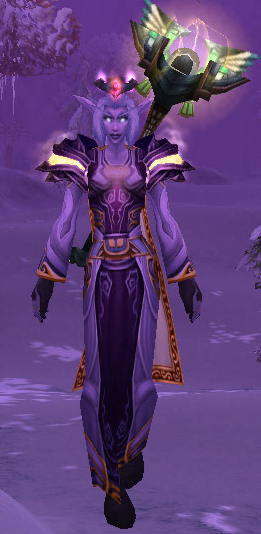
The namesake for this screen name, Quinnae, floating courtesy of her Levitation spell; one of many benefits to being a Priestess of Elune, along with great dental.

On the subject of religion I should relate more personal insights. I often play as characters with some religious grounding, which is ironic considering my history (and I’ll get to that in a moment); Priests or Clerics, Paladins and Druids are often my primary roleplaying characters. On my shelf right now, side by side (perhaps very appropriately) with my gender studies and sociology textbook collection are my many hardbound D&D manuals, a good chunk of which are about the fantasy religions of various settings.

When I was young I grew up with a conservative Catholic father who took “God the Father” a little too seriously. Through his faith he buttressed unchecked patriarchal authority, the subordination of women, and even quite a bit of racism (particularly Islamophobia). It’s no surprise homophobia and transphobia also came to him through his idea of God, and when I came out I faced a fusillade of assaults from him that included saying I was violating God’s will by transitioning and that my “devil reading” had made this happen. I’ll not belabour these descriptions any longer as this should paint a sufficient picture of why, for a long time, I hated religion and looked down my nose at people of faith.

That hatred existed in the midst of my RP life, of course, which began in 2005. But I figured my characters were just fiction, as were their goddesses and gods, and it was all “just a game.” Yet over time, especially as I got into playing my Cleric and reading the more in-depth compendiums about pantheons in D&D I began to realise that faith as a central organising principle in one’s life was something that could be very positive. I was very much blinkered by my self-centered perspective and yet, almost as if against my will, my own characters pulled me out of it. My Cleric was a woman whose faith taught her that love was love, no matter what form it came in, to name an example. Her goddess was a symbol of that conviction in openness, love, and the idea that pleasure in moderation was utterly sacred rather than profane. I came to understand that my father’s Catholicism was not the only form faith had to take.

Faith could evoke metaphors for beauty rather than self-abnegation.

I do not credit RP with all of these realisations, of course. A Christian woman I know and love in Canada, and who happens to be married to another woman, was a huge support in my life as I was coming out and indeed a second mother to me. She’s just been ordained in the United Church of Canada. She and her pagan priestess daughter above all deserve credit for showing me what faith can be.

And yet I also know that roleplaying was what initially opened my mind to what they would eventually teach me. As I looked through the guidebooks and found gods and goddesses for all sorts of things, and vastly different descriptions of all manner of churches, temples, lyceums, and groves for worship I came to realise that what faith was, what it could be, was not limited to bitter, closeminded evil. The Richard Dawkins style of white atheism that I had flirted with up to that point withered under that slowly blossoming realisation. The characters that I would so lovingly roleplay, from my NWN Cleric to my WoW Priest, would chart lives of faith that were not built on hate, or on othering, but on self-empowerment and a sense of social justice that infused their many actions in the game world, whether it was cleansing a den of undead or battling the Lich King or healing the wounded behind enemy lines their faith gave them the power to do what was right and resist oppression or the temptation to oppress.

Had I never been given the opportunity to roleplay religious characters I might’ve gone right on keeping my privileged assumptions about how people of faith were “irrational” and “weak minded.”

The title of my piece is a reference to the Marion Zimmer Bradley book I’m reading at the moment, Lady of Avalon,  where one of the protagonists is known as the “Son of a Hundred Kings,” a messianic figure in the classic fantasy tradition, the chosen one whose coming was foretold by prophecy, et cetera et cetera. My characters on the other hand are not built on that notion of exaltation above all others. They are the daughters of no queens or goddesses, but ordinary women called on to both do exciting things and simply muddle their way through life. They, like quite a few good RP characters I’ve come across in my time, don’t require a legacy or a prophecy to make them interesting.

Roleplaying is not just about slaying dragons or annihilating evil old gods who threaten the world, it’s about capturing the aspects of ordinary life that can make us all who we are. I love those little details. The first Paladin I ever made, Zoe, was a notoriously messy eater . My Priestess, Quinnae, is a brilliant artist and still plays with stuffed animals. My WoW Paladin, Sera, carries wine and fine cheese with her everywhere. Some come from backgrounds of privilege, like Sera, others like Zoe never knew anything but nomadic lives. But all of these little flourishes help them come to life and they evoke depth that is sometimes, or even oftentimes, lacking in the bigger characters written into the canon of all of these games.

When I RP I have no overtly political goal in mind. I never did, I never will. Certainly when I RPed as women I never expected to undergo a transgender transition in real life, or for my views about religion to change. But the effects were there all the same. Even in this fictional space I could be truer to myself than I was, at the time, allowed to be in the “real world.” Despite it all being “just a game” my knowledge of the experience of many women in society was deepened long before I came out (and it was deepened and widened much further).  I had often held a traditionally liberal view that women sometimes had a rougher time of things but it was an academic knowledge held from a distance. Playing WoW, even three years before I came into my own as a woman in the real world, made that knowledge experiential, rather than abstract.

When Gary Gygax first worked with his partners and wrote up what would become the first edition of the Dungeonmaster’s Guide I am certain he never dreamed that his game could promise salvation and comfort to transgender people who could afford to play, and yet there it is as a very positive unintended consequence. The great benefit of roleplaying worlds is that they allow people to transcend boundaries and move in social realms as someone completely different. I haven’t even talked about how one can come to a better understanding of racism or classism through RP.

But above all it allows you to take control in the face of a gaming world that is sometimes or even oftentimes hostile to women, people with disabilities, LGBT people, or people of colour. It allows you to dare to be the character that many developers don’t write, to be the character you want to see in a fantasy realm. It’s a fascinating realisation of Gandhi’s old aphorism: “be the change you want to see in the world.”

I roleplay that change.

Lost In Trans-lation: The Final Chapter/Reckoning/Cliche something-or-other

I’ll not preface this essay with very much, only to say that it is a swan song for the last month and an interesting opportunity that I seized to neatly tie up and summarise my academic and- dare I say- personal journey over the course of the class. My final grade in the course was an A and so was my grade for this essay.

The question I’m answering here is, basically, what did I learn over the course of the last month and how did the readings challenge (or not challenge) me and the views I held when I walked in. My response is as follows:

I walked into the class having done a good half of the assigned reading and with a fair amount of foreground knowledge of both emancipatory politics in general and feminism specifically- both its virtues and its foibles- as well as already being familiar with concepts like intersectionality, epistemological or materials hierarchies, disability studies, pivoting the centre, and many others to boot. Yet I also knew I was going to learn something new, even if it could not be organised in the neat black and white text of printed readings, it would be there etched into my memory. The first thing I ultimately found in the course was a sense of arrival at a new plateau of my own awareness, a realisation of how far I had come and how far I might have to go. While I had already learned many of the basic ideas and issues the class had gone over, they were drawn into relief by the contributions of others to the course material and by the readings I had not studied before, or by re-reading old favourites with a fresh vision. But above all it was the sense that my story, as it were, had value and meaning. As I told the class, I am often leery of alluding to my male past and claiming it gives me some additional knowledge simply because I do not enjoy reminding people that I am a transgender person, and because I fear it undermines my stated gender identity, but I did it anyway because I felt inspired by readings like Gloria Anzaldua’s Letter to Third World Women which rekindled in me a sense of pride in who I was that I had forgotten. For so long I cursed the circumstances of my birth that I felt had made me fall short of the normative standard of ‘white cis woman’- now I embrace them as making me the woman I am. Not normative, but whole. True to herself. That truth is an enunciated one, one that came from speaking up. Several readings enabled me to do that and gave me the impetus to not only tell the class “Yes, I am a transsexual woman” but also that my past gave me insight into the nature of male privilege. I spoke more about my history as a man in front of more people than I ever had before. I put my shit on the paper, yes, but I also had to cast it to the air before eyes I could see looking back at me. A few of the readings helped to make that possible but it was also the context in which these readings were assigned and analysed that helped.

To name a few examples, deconstructing Judith Lorber’s Night to His Day provided me with a platform to criticise something I’d noticed almost a year earlier, which was the subtle cissexist bend of Professor Lorber’s writing. That was a positive assertion of my identity, not only because I was using my trans female experience as something worthwhile and as a site that could produce truth and knowledge, but also simply because I critiqued it on feminist grounds. I queered feminism and the opportunity to do in a setting that was not Internet-based was riveting and satisfying. I had long since read Judith Lorber’s piece, but what it did for me this time around was open up possibilities of active resistance wherein I could make plain my own ideas and my own experience. That was the experience that told me Judith Lorber’s analysis of gender construction as a process was fundamentally correct, the experience that told me I did exactly the same thing she did on the Subway (gendering babies based on subtle cues added by the parents), as well as the experience that told me in no uncertain terms that her misgendering of Billy Tipton and her flagrant appropriation of trans identities undercut the very point that she was making. Where she had attempted to show there was nothing inevitable about gender, she turned and around and resorted to a conveniently reified binary that took a hatchet to the positively asserted gender identities of the people she used to support her argument. It was one of the first of many things that reminded me of one very important thing: how I know what I know is valuable and meaningful. What’s more, it is not something meant to idle like a gilded trophy or curio on a coffee table, a static conversation piece. It is something that had to be deployed, had to be written, had to be spoken aloud.

To that end, Gloria Anzaldua, a writer I already admired, tipped the balance for me. I had long since taken up her charge to write. Writing is a huge part of who I am, my ideological and physical transition has been blogged and analysed by me in a wide variety of ways. I spoke of my experience and wove elegant tapestries with words that others might know where I stood. Like Paula Gunn Allen I seemed to say “Where I come from is like this.” I cannot speak of Ms. Anzaldua alone, however, because the power of what she said is only amplified by the chorus of women whose voices rose in unison with hers in This Bridge Called My Back. While there were no trans women in that anthology I nevertheless felt a deep and abiding connection with the women who wrote in it. As I often say, being trans is about complex relationships. These women spoke to a great many complicated relationships- with religion, with family, with their culture and the hegemonic culture, with sexuality, with feminism. All of these were issues I shared, and all of them were things that Gloria Anzaldua said must be committed to paper loudly and furiously, riding roughshod over those who would say- directly or tacitly- that what these complicated women had to say had no academic or literary value, or at best would be a ghettoised form of literature for idle curiosities and nothing more. What she did for me personally was to remind me powerfully that even though I was not part of certain privileged classes, my voice had value. Trans women in particular are rarely taken seriously. Cis men may (quietly) seek out our dancing, our sexuality, or stereotype us as savants of gender, while others may think of us as walking comedy routines and nothing more. What Gloria Anzaldua and several other writers impressed upon me was the idea that this was not my destiny. She is not alone in this, of course. Many trans women writers, from Julia Serano to Susan Stryker to Andrea James to Raewyn Connell made that clear to me as well. But Gloria Anzaldua was, unlike the aforementioned women, also a woman of colour who knew about where I came from as a Latina, not just as a woman of trans experience. I cannot overstate how much it meant to me to see writers talking about the Bronx, about the Spanish language, and their intimate experiences with life in a barrio or in a Latino family. Even those who were not Latino also spoke of experiences and tensions that mirrored my own. Unlike, say, Gloria Steinem, I felt as if I could talk to these women and they’d immediately know where I came from and why it mattered.

I had been reading Bridge before I even registered for the class, and thus the resonance of those powerful and radical words was already thrumming deep within me. What the readings and class added was a space in which I could engage in a new form of self-assertion. I had already been writing for anonymous internet readers, but class afforded me a space in which I could also use my experience to teach, and to take a firm stand against dominant cissexist ideas. Encountering Gloria Anzaldua in the readings was just fuel for an already brightly burning fire, I suppose. But I always kept her close to my heart when I spoke because I knew that like her I was refusing to be silenced, refusing to be pigeonholed, and refusing to comport my words to dominant standards of acceptable discourse. I might frame my radicalism and the essence of myself in academic terms- what she called esoteric bullshit- but I make no bones about the fact that that is what it is. It is who I am, writ passionately in florid prose. I would not erase myself and say that I could adequately talk about sex and gender without referencing my trans-ness. I would not silence myself and say that my unique personal history was not of great importance or was not elucidating.

In another way many of the readings were a walk down memory lane, revisiting my initial journey through feminist ideology and canon, and the rapid process of self-awakening it involved. Marilyn Frye’s Oppression was an early reading of mine that helped to shape my views about oppression as an interconnected system, and as something that was not confined to one problem or issue, but rather was found in how that problem was actually linked intimately to a web of unjust actions and impositions. Her birdcage metaphor long ago crystallised for me the perfect definition of confinement, wherein focusing on just one bar occasions incredulous thoughts about how such could confine anything, taking that needed long step back to apprehend the whole cage to which that bar is connected reveals the reason for being trapped. Sojourner Truth’s timeless Ain’t I a Woman? was as evocative to me now as it was when I first read it. Her words were a righteous injunction against the racism in the suffrage and abolitionist movements, but also provided such tireless muster to the countless women like myself who never want for occasions to remind others that we are indeed included under that generic term “woman.” My experiences are dismissed by those who wish to claim that I am not a woman, or at best some lesser form of woman whose identity is tolerated at the pleasure of those whose genders are too privileged to question. But Sojourner Truth always impelled me to ask her endlessly echoing question bluntly and insistently. As she eviscerated the white male supremacist stereotypes that had bound her, and took to task the women who were handmaidens of those ideals, she provided hope for women many generations after her. Resistance is always possible, she seems to say. My experiences do matter, she enjoins. This too had a formative influence on me and I smiled as I revisited it in concert with my classmates.

But there was also another shift that the readings drew into a very vibrant definition which was embodied in several readings like Professor Bonilla-Silva’s Colour Blind Racism and of course Angela Davis’ gripping Women, Race, and Class. I was very receptive to these readings because the groundwork had already been laid, so to speak, but what they did was to give voice to musings I had been having as well as ideas that were slowly beginning to coalesce in my mind. Angela Davis’ elegantly stated radicalism drove many points home for me such as how slavery was not just about race, how the myth of the black male rapist serviced sexist and racist systems, how the suffrage movement was a home to both radical revolutionaries and selfish conservatives, among many other things. What struck me one night as I was excitedly telling my mother all that I had learned from her about various tragic episodes in American history and how they related to white supremacy was her response to all of this. She told me with a smile that I never used to talk like that and that I would just as often criticise her for saying negative things about white people. It made me step back and realise that in my younger years, right up until fairly recently even, I had been a dutiful handmaiden for white privilege and adopting many of the very same vapid arguments that Eduardo Bonilla-Silva so deftly dissects with regards to “colour blindness.” My mother reminded me how much I had changed and joked that she had to get used to it. My reply to her seemed weave various ideas from class into its warp and weft. I told her that she was right and that I apologised for questioning her experiences in the past, and apologised for dismissing her experience and her life growing up as invalid or arbitrarily “in the past” and no longer relevant. I told her that above all her life taught her as much if not more than I was learning in class, and that what she knew and could summon from her memory had great value even if it was not signified with a piece of paper signed in calligraphy.

A note must also be spared for Michael Kimmel’s Masculinity as Homophobia whose simple and I would argue misleading title belies Kimmel’s more complex and interesting points, such as that masculinity is racialised as well as simply gendered and that homophobia is often part of attempts to ‘prove’ ones adherence to true manliness. Kimmel is much closer to the academic feminist mainstream whose writing is more ‘professional’ and geared towards a style that is (mostly) impersonal and attempting to present theory in a magisterial voice, and thus lacked the deep resonance that, say, Nellie Wong or Gloria Anzaldua could sing with. Nevertheless Kimmel does draw on a little experience (like the silly games he and other boys would play) to make his points about how masculinity is constructed in a complex series of oppositions, and he reminded me that my lived experience as a male in society is valuable too and shouldn’t undermine me. This is an element of my thinking that is definitely a work in progress but over the last three months or so I have begun to seriously ‘revisit’ manhood and particularly that which I was socialised to express and pretended to for many years. It is, in a way, part of a long term project in which I try to undo my internalised transphobia and make peace with who I was rather than simply adopt a scorched earth approach to the matter. I have read with eagerness progressive work and theory on manhood in society and while the reflection of myself in such was far dimmer and distant for various reasons, I still slowly (and am continuing, slowly) came to realise that I should think just as critically about who I was as I do about who I am, and to accept that as a valuable standpoint as well. I often point out that I do not claim the same standing as a cis or a trans man when it comes to manhood. Being a pre-transition trans woman is indeed its own subjective experience that I do not intend to overinclude in discussions of masculinity. But what Professor Kimmel’s piece reminded me of was the fact that I had a lived experience in the subject position of ‘young man’- even if it was forced, false, and unasked for, things happened and I experienced life through something approximating that subjectivity. This is not a small matter nor something I should ever overlook. Sorting out its meaning will likely take me to many more distant places than what Professor Kimmel explored but gender scholars like him who think analytically about manhood have helped me realise that I could do the same.

In many of these recollections of where the various readings took me I often make a point of saying that I already had some grounding in the material and in the ideas presented. Certainly this class has not radically changed my life. I and the people I love did that. What it did do, however, was provide a temporary but powerful focus in the midst of that transition. The class and the readings therein were part of a continual flow with no easily defined beginning or end. It would be easy to say that I was one way before I walked into class and another after the semester finished. But it would also be lazy, deeply inaccurate, and uninteresting I feel. At least in my own case since it is patently untrue. But these readings were, nevertheless, significant for me. At this phase of my journey through life, this class was something I needed to be a part of. Through the prior semester I had scrupulously kept silent about being trans, selectively stealthing while I was in all four of my classes because I feared losing the goodwill of teachers and students alike, and because I value being understood as a woman. This class was my opportunity to at last stand up and speak out. In many of the readings the contextualising that occurred in class also helped to bring them to life in a way that I did not quite experience in reading them alone in my room or on the train as I so often did in the past. Furthermore, I actually found myself reflected in some of the readings, old and new, which is always a unique and uniquely wonderful experience. Finding yourself in a reading is like seeing through a spyglass and apprehending your refracted face, knowing it for the first time; then you see past it and find the whole world magnified afresh.  That was how I felt as I tore through This Bridge Called My Back, for sure. Talking about it in class somehow only made those voices louder and more insistent to me, a firm reminder to never forget Gloria Anzaldua’s words and to never stop writing. If there is one thing that the readings prompted me to do for various reasons- be it to boost their signals, to challenge or critique them, or to speak passionately about their effects on me- it is to put my shit on the paper.

State of the ‘Corn, Update!

Brief posts on this site are very much like unicorns. Rare, nigh on mythical beasts whose appearance occasions the weavings of stories to be told to your mates over a few drinks.

Anyway, what’s this post about? Well as some of you may have noticed my most recent blog posts have been me reposting classwork, albeit with commentary. Fully original articles will be returning soon, however. But the other reason my creative energies have been a wee bit absorbed has been because I’ve been taken on as a writer at Border House where I’ve recently published a few things. Their editor liked a piece that originally appeared here (my ‘World of Warshaft’ one, about Blizzard and their rather flighty relationship with the concept of privacy) and I’ve been taken on as a staff writer.

If you’re interested, my two most recent articles can be found here:

  • Ain’t I a Gamer?, about the issues surrounding the invisibility of women in gaming spaces and the subconsciously perpetuated ideas that entrench that lack of visibility.
  • Problematically In The Voice of a Night Elf Woman, which is an introspective piece about how I felt returning to World of Warcraft post-transition. This piece may also appear elsewhere on the Internets, so stay tuned.

My attention is split many ways lately, and as the articles point out, yes I’m finally back in WoW (caricature of me with Night Elf ears is forthcoming) but I’m trying to do something much more productive with that this time, and that’s why I’m writing about it and applying the many things I’ve learned over the last couple of years to it.