Unicorn Ethics: A Fragment on My Little Pony

It is the job of fusty, addlebrained academic sorts to take things we all enjoy and take for granted, and then dissect it with the ponderous seriousness of a graying doyen of our particular art. Especially in the social sciences. Teasing out social messages, identifying wider imbricating discourses, and seeing patterns with relation to the media is usually a sombre affair filled with sad news. This is how this movie reinforces patriarchy, this is how this television show transmits transphobic messages, this is how our media is coarsening social attitudes, this is how this commercial is making us hate our bodies, and so on and so on. It is a rare, rare joy indeed when I get to turn my critical eye towards explaining how something in the media is positive in its influence on our society.

When a good friend of mine nudged me into watching My Little Pony: Friendship is Magic I internally scoffed. It sounded cute, and nothing was wrong with cute, but I’m a woman in her 20s, jet setting and on the go, kicking patriarchy’s ass and sipping skinny lattes while jogging between classes and speaking engagements. What use did I have for girl’s television anyway? What’s more, it was probably the usual problematic pap encouraging girls to be docile, quiet, restrained and feminine in a deeply unnerving way, another Cult of Pink devoid of all that can be good about growing up.

To say that I was dead wrong on all counts is an understatement.

The Sociologist as Children’s Hero?

My Little Pony: Friendship is Magic began to arrest me when I realised that the main character was a bookwormish unicorn named Twilight Sparkle who was a serious minded, organised, knowledgeable student with a profound magical talent, proud of her tutelage under Princess Celestia– the benevolent ruler of Equestria– who’s known far more for her wisdom than her beauty it seems. The pilot episode finds Twilight learning several lessons that I would not only feel comfortable with my future daughters learning, but I’d actually fall over myself to get them into this programme. Twilight had to learn the power of friendship, yes, a rather old and clichéd concept in children’s programming. But what sets MLP apart is both how this was done and with whom it was done.

Twilight Sparkle expressing pony values.

Twilight Sparkle is sent to Ponyville by Celestia to make friends as Celestia worries for her star pupil’s social skills. But the plot does not revolve around Twilight dulling her intellect to become a social butterfly; far from it she learns her to use her talents relationally, as a member of a diverse group of ponies who all have distinct skills. She learns a group ethic; teamwork, in other words. One of the show’s most heartwarming messages is that you cannot always do great things alone; this message is a beautiful, at times subtle, contradiction of the selfish ethic of heroic individualism that has become like a cancer on our society. It is not just a paean in one episode, but rather a theme underlying every single one. It is the language through which the programme is expressed.

In all of this, Twilight’s skills and intellectual acumen are not blunted but become essential to her friendships. Her friends love her for who she is and are proud to know the “smartest Pony in Ponyville.”

I rather love Twilight Sparkle—when having her first slumber party she used a reference book on the subject to help her organise it. She is portrayed as an intellectual, she always lives somewhere surrounded by books—I envy her library. She is readily portrayed as a capable leader, a (community?) organiser, and maven of the world’s lore always ready to teach the ponies some esoteric fact. But perhaps the bit that really melted my heart was that Princess Celestia told Twilight to deliver a report about friendship every week, relaying her “findings.”

That’s right, Twilight Sparkle is a budding sociologist. I was sold.

Continue reading

The Revolution Will not Be Puppetmastered

By now word of the great Gay Girl in Damascus hoax has spread throughout the western world and the blogosphere, becoming a much ballyhooed object of derision, snickering, finger wagging, tut tutting and all the rest. For those of you not in the know, here’s Color Lines’ Akiba Solomon’s deft summary of recent events— it precedes an analysis I highly recommend:

On February 19th, shortly before Syria’s Arab Spring uprisings began, an American-born Syrian lesbian named Amina Abdullah Araf launched “A Gay Girl in Damascus.” Araf had been posting comments and debating Middle Eastern politics online for years, but created her own space at the urging of Paula Brooks, co-founder of the news site “Lez Get Real.”

Araf’s blog featured her erotic poetry and her coming-out story—risky material since homosexuality is illegal in Syria. She also spread news of the government’s brutal crackdown on protestors, prompting Time.com to call her “an honest and reflective voice of the revolution.” In late April, Araf claimed that Syrian security forces visited her father’s home and accused her of “conspiring against the state,” “urging armed uprising,” and “working with foreign elements.” Subsequent posts found Araf “going underground,” although she was still able to “encourage other women in Syria to be more upfront” via an email interview with cbsnews.com. Last week, a cousin posted a dramatic account of Araf’s abduction by three armed men. Like the rest of “Gay Girl in Damascus,” that entry is now unavailable to the public.

Because they’re human beings, members of the LBGT and progressive blogesphere took to Twitter, Facebook and petition sites demanding information and protection for Araf. Days later, the blogger’s “Catfish”-style caper unraveled due to skeptical tweets from an NPR reporter; news of fake photos on Araf’s Facebook page; and an unnerving interview with a Montreal woman “Araf” had seduced via Facebook. On Sunday, The Washington Post revealed “Araf” to be Tom MacMaster, a white 40-year-old from Virginia who was raised a Mennonite and attends a graduate program at the University of Edinburgh.

At this point, MacMaster should have just said, “I’ve come down with a terrible case of white, male privilege. Please medicate me.”

Let me explain this very plainly: As a trans, queer woman of colour who writes authoritatively about her experiences I am very directly affected by the aspersions cast by this hoax. My words have power only if you believe them.

Now, this is hardly to claim that this little plague of white cis het guys in women costumes are the sole cause of all doubt and derision cast on those of us women, people of colour, LGBTQ people, PWD who speak out and speak loudly as we testify to our truths. That is certainly not the case. But they play so very deftly into the hands of that rash of men who say that there are no women on the Internet and that everyone claiming to be is really some creepy neckbearded guy in his mum’s basement. It gives a very powerful excuse to people who want to ignore us, erase us, marginalise us further, and another reason for them to simply shut down their minds whenever they read words of power from those the mainstream media almost never listens to.

In impersonating women of colour and queer women, the two fools behind Gay Girl in Damascus and Lez Get Real have done immeasurable damage with their high profile ‘outings.’ When so many of us out there are not listened to, are not given interviews with Time Magazine and CBS News to tell our stories in our own voices, what these two men have done is given every reason to news corporations to be even more gunshy about taking sources seriously if they do not come through the “proper channels.” It was likely as not a battle for some reporters to get their bosses to seriously accept ‘Amina’ as a credible interview subject, for instance. Now it will be an impossible battle when a real woman of colour has something to say to the mainstream press.

Continue reading

Trendy as a Tote Bag: Part II

Times are very hard, to be sure, and as I am now working in the fundraising department of a radical transgender rights oriented organisation I’m seeing yet another dimension to the endless Great Recession unfolding before me. Simultaneously, what I am constantly astonished by is how people in the most economically disadvantaged communities always manage to find a penny here and a penny there to help their sisters, brothers, and siblings in need. We’re out there looking out for each other and that never fails to give me hope.

It sounds a tad bit cheesy, yes, but for all of my snarky sarcasm and the like, I’ve always put a lot of stock in that gift from Pandora’s Box. It’s a precious resource in the trans community. So, what am I waxing all poetic about and what not? Well, this time around I’d like to solicit you all to fundraise for a charity near and dear to my heart– so much so that I’m actually working for them. The Sylvia Rivera Law Project, an organisation for low income trans people of colour, has radical aims that dovetail with the themes I often speak of on this blog. It is hard to imagine a better organisation for me to devote my time and energy to. Indeed, it’s part of why I’ve been a tadbit too busy to write these days. But it is the Goddess’s work and it feels decidedly good.

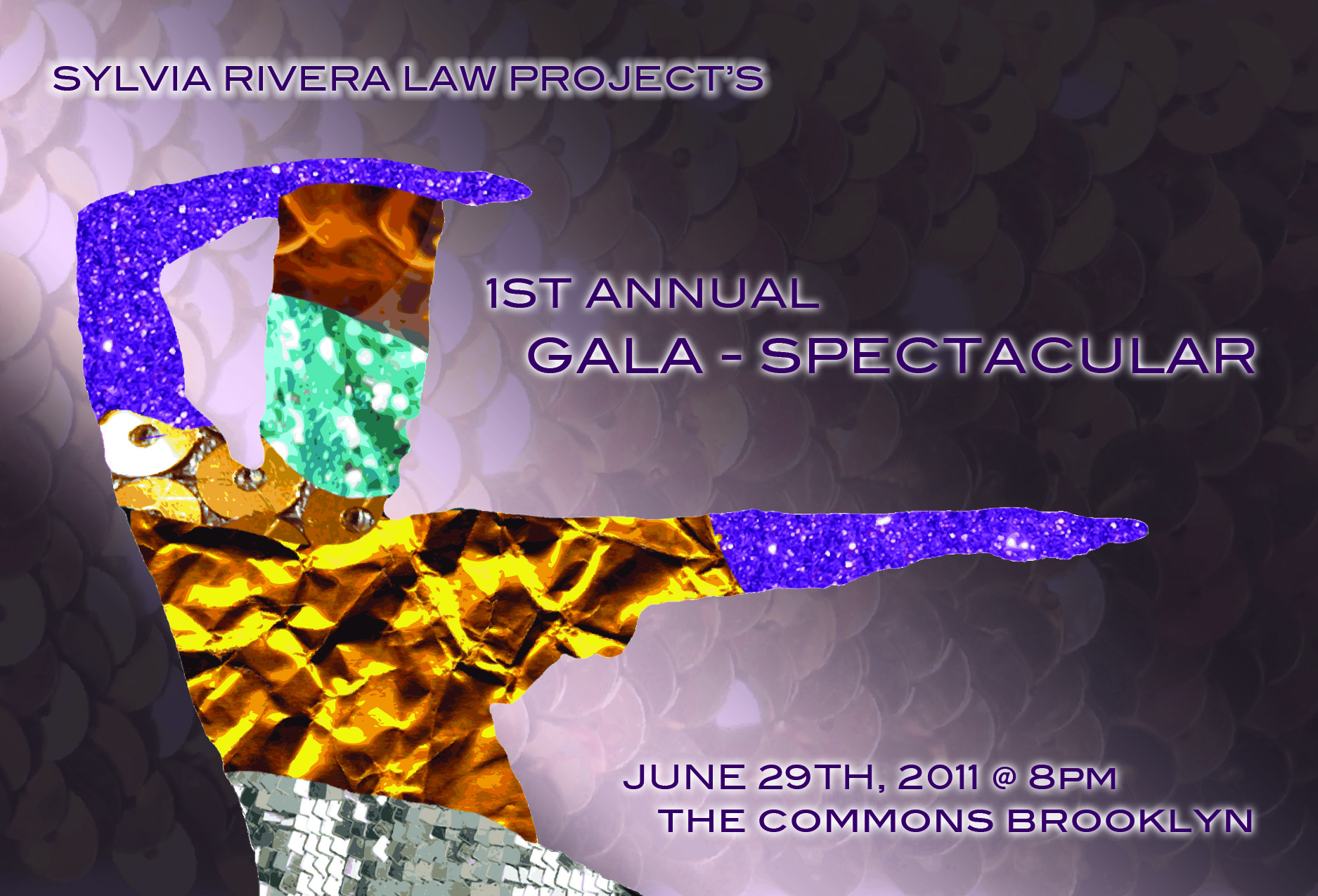
On that note, this is our latest fundraising project:

I’ve been pretty busy helping with the organising and the fundraising that an event like this requires but for the moment I’ve been given a pet project and if any of my readers are interested in doing a spot of good then you can hop on over to Indie GoGo and check out our online fundraiser leading up to this gala. Please feel free to contribute, but if you don’t want to or are unable to, then I encourage you to pass the link along to any friends, colleagues, allies, and so on who may be interested. With initiatives like this every dollar helps.

My work here has been, in no small measure, interesting and a crash course in many things. But it has, above all, been a beautiful insight into the community that my sisters, brothers, and siblings have forged and of which I am proud to be a part. I’m not the kind of woman who is easily persuaded into advocacy and I would have never offered my blog as a place to help our fundraising efforts if I couldn’t say the word “our” with confidence apropos SRLP; if I didn’t feel a sense of ownership, a sense of community, I’d have never mentioned my blog. But I did so eagerly because SRLP isn’t just where I work. It’s a workplace where I can be out as a trans woman without the slightest second thought, and it’s a place where all of the markers of isolating distinction and discrimination do not count against you. A place where I could seek support from everyone on staff when I experienced a transphobic incident a couple of weeks ago.

In sum, I do believe in SRLP and what they do; they practise what they preach and I love them to bits. They are that rarest of organisations that will make my usually cold onyx heart melt and go all mooshy.

This is one of only a few nonprofit organisations that reflects the radical vision I have; radically gender equal and positive, feminist/anti-patriarchal, and as much as possible a non-hierarchical organisation that constantly militates against forces compelling them to sell out. As much as possible, I can say with confidence having seen things from the inside, we really do try to ensure that the trans community has ownership of this non profit and that we are never beholden to the powerful or the “great and good.” Small donations from (yes I’m using the PBS phrase here) people like you make that radical goal possible.

Okay I’m done being all sappy. If y’all are generous I may throw a slug comic up here soon when I get home. Thanks in advance.

~Quinnae

Fatal Error

What human beings see when they behold something like this has remarkable consequences for the other humans in their lives.

It is, by now, a cliché to suggest that transgender people of most any stripe are somehow acting contrarily to nature. This has numerous ideological expressions. On the political right we hear this from conservative Christians and “men’s rights activists,” from science we hear this from any number of would-be psychiatric colonists of our experiences, and from the left we hear this from any number of groups including a certain clique of radical feminists.

What I have found interesting is that these types of feminists– the Julie Bindel set, essentially– come from a school of feminist thought that placed a good deal of primacy on the sacred, natural body; hence their obsession with SRS and the like. I am always reminded of my father (Goddess knows he was no feminist in the slightest) angrily asking me if I was saying that God had made a mistake. Clearly I was challenging Him by saying I was “born wrong” (or something like that). The whole theoretical construct relies on a welter of cis projections and is not based on anything I’ve said, naturally[1]. But the framing of this clique of feminists is much the same: substitute Nature for God. This simple gesture is at the heart of much leftist and science-based oppression, the generative nucleus of all that is right and good is simply shifted from an all powerful white male divine to an all powerful Natural Order/Balanced Ecosystem that we cannot challenge.

It is exactly the same ideological manoeuvre that feminists rightly opposed in sociobiology and evolutionary psychology. A move that allowed the scientists to pooh pooh the religious by telling them there was no God who ordained everything… while preserving the Ur textual explanation for the inexorability of white cis male supremacy in a new form, this time ‘scientific.’ For eco-feminists, there was less emphasis on science as they understood what was going on with the then-ascendant sociobiological explanation for gender. But they simply reinvested a kind of mysticism into Nature. And thus people like Sheila Jeffreys would ask me “So are you saying Nature was wrong?”

What is tacitly ignored in all of this is the fact that humans, by default, act contrarily to nature. Virtually nothing we have done as a species, as a civilisation, has been purely natural. It never fails to make me smirk when I hear arguments about the virtues of naturalism from someone wearing glasses. Such arguments almost invariably are arguments for the preservation, in part or in whole, of the status quo. The “balance of nature” or the “will of God” always just so happens to demand that our present arrangements of power and hegemony, on one particular subject or on all subjects, are pre-ordained and foolish to fight. The set of conservative transphobes on the political right require a vision of a male/female caste system that is ineluctable, easily maintained, and lifelong that can ground itself in the perfectly constructed male/female body. The transphobes of the left, many with roots in various ecological movements, assert that nature has created a perfect body that any changes to (changes that are not sanctioned by dominant ideology, at any rate) are unnatural, aberrant, deviant, and ‘mutilation.’

What is lurking behind all of this is the anthropomorphising of the generative nucleus in each system: God or Nature. The intelligent design movement of the Christian Right in the West provides us with the clearest expression of this notion: God is a designer, a divine watchmaker, whose intelligence is used to carry out His intent in the world and thus all of nature has a sentience-ordained purpose; acting contrarily to that purpose is objectively ‘wrong.’ Since God can be conceptualised as a person, this is easier to swallow if you give yourself over entirely to the religious fervour that enables belief in a literal divine figure, lounging on a cloud somewhere in the heavens. With Nature it is much more clearly a metaphor that has spun wildly out of control. Nature, many transphobic scientists and radical feminists say, has intent as well. We can discern this intent scientifically and politically, and then measure deviance from that standard as an objective metric of ‘wrongness.’ To act contrary to the intent of nature is thus empirically, scientifically, wrong. Politics is removed from the equation, and this analysis is presented to the masses as a neutral, ineluctable truth. One which just so happens to say that the current order of white cis male power is natural and inevitable.

It is interesting to think about why certain cis radical feminists have participated in this discourse, one constructed on a theoretical paradigm that has suggested that women are intrinsically inferior to men.

This is the discourse that radical feminist transphobes are accessing when they deny trans people any semblance of personhood based on how we supposedly challenge the natural order. It uses exactly the same logic, relies on the same Archimedean Point of an all powerful, unchanging divine nature that does not err, and can be easily manipulated to come to conclusions about women that are antithetical to feminism. The ‘perfect body’ of womanhood suggested by some cis radical feminists bears a strange resemblance to the alabaster angel who bears children for the fatherland. To define women solely on the basis of our fertility is not only a losing game, but one that reinforces a central ideological pillar of patriarchy: that we really can be bound by our supposedly universal ability and desire to give birth. Since this is “natural” there can be nothing wrong with it. It is objective, neutral, ahistorical, and apolitical.

Feminists, perhaps better than anyone else, know why that is bullshit and what that imports into our highly political culture. It is precisely my own radical feminism, very specifically, that has given me the strength to confront and push back against these oppressive ideas. It is my feminism which helps me feel, in good conscience, that I am right to oppose any notion that subsumes our shared humanity beneath the weight of an abstract ideal.

The reality that human beings must confront is simple: Nature has no intent. It is not conscious, it is not intelligent or otherwise self-aware. It does not think, it does not plan, it does not design. Nature, as such, is a constantly evolving, changing, messy, illogical riot of constant evolution and adaptation that has no discernable “intent” in the sense humans understand that word. As a woman, my inability to bear children does not define me; to phrase this differently, my inability to bear children has not spared me the ravages of patriarchy. Cis men treat me as a woman, with all the negativity that implies. My lack of a uterus does not insulate me from that. The meaning of “woman” in our society is not synonymous with the meaning of “womb.”

We’re making a very tragic mistake if we think so.

To talk of nature is to talk of something that changes, that evolves. We all know this on some level: not a single one of us looks or is shaped much like we were when we were born. Nature is not a static thing held in perpetual equilibrium. Like the human beings that arose from it, nature changes constantly. Nature is change. To say that what we were born with is intrinsically good, and any alterations thereto are intrinsically bad has nothing to do with nature. It is an ideology. It is, in a word, politics. The world is one that evolves and that blossoms: human life at its best, at its freest, is a life of blossoming, a life constantly in motion whose ultimate course is one of many winding roads and hairpin turns.

To whatever extent it can be determined that evolution has a ‘plan’ or some preconceived order (metaphorically speaking, of course) we as humans, by our very nature (real nature, in this case), are under no obligation or compulsion to follow that plan. One of the things that defines us as a species is our ability to discern evolution and think about it; that awareness is part of how we then step outside of evolution, at least in part, and decide with our own self-awareness what directions we may take.

Women are not ‘intended’ for anything, and certainly not by dint of birth. In my own case, as a woman, as a trans person, as a human being, did God make a mistake? Yes, absolutely. The God conjured by humans, by men in particular, did indeed make a mistake. Because the God is not in the sky, He is invested in every doctor, every clergyman, every teacher and parent, who ever tried to force me to be someone I did not wish to be. It would be more accurate to say that they failed.

But to put it another way, if one believes in Deity of some kind, or a Creator, the best way of imagining it is this (and this applies very much to the Naturalists as well). No, God/Nature did not make any sort of mistake; but we ever fallible human beings have a lot of mistaken assumptions about what we have been given to work with.[2]


[1] I’ve never claimed to be “born wrong” and have long since abandoned any notion of being “born in the wrong body.” The very idea that being trans is the correcting of a mistake is made necessary by a society that imposes definitions on us that are inherently limiting, binding, and always against our will. In a just society, my evolution as a gendered being would have been unremarkable and like any other.

[2] I can’t take credit for this. A discussion with the ever brilliant little light yielded this idea from her and I thought it a brilliant, spiritual and social resolution to what I have always considered a deeply flawed question.

Going Public: The Silences in the Shadows of Privacy

Trigger Warning: Discussions of rape and sexual harassment.

It was a whisper, a murmuring, but an audible one in a few news outlets ranging from the BBC to the New Yorker. A recognition of something oft unregarded, unreported, and unnoticed.

The rafts of journalism produced by the case of IMF Chairman and Socialist party patriarch Dominique Strauss-Kahn has taken a variety of angles on his alleged rape of a hotel chambermaid in New York City except that which may matter most: the perspective of the maid herself. The whisper and murmur I heard was the fact that journalists were noticing this. Philip Gourevitch of the New Yorker said the following in his blog about the French reaction to the rape case:

Listening to the political classes attempting to come to terms with the destruction of Dominique Strauss-Kahn today, I heard hardly a thought for his accuser. It seemed a good measure of the depth of France’s political malaise that it took a Le Pen to show solidarity with the working woman against the Socialist Party’s favorite son.

Emphasis mine. This is the great invisible wall of silence that surrounds rape in our society and puts the lie to any notion that men accused of rape are automatically condemned at the end of a woman’s pointed finger. That a few journalists are at last speaking about this, albeit in hushed tones tucked at the end of articles, is heartening. But it calls attention to the glaring absence of concern for the victims of rape, or even those who- in the public eye- come to be known by the title of “accuser” with all of its hectoring, negative connotations.

In all of the commentary out of France over the last few days what we have seen in cavalcades of speech and soundbites is concern for the IMF, for the reputation of France, for the fate of the Socialist Party. Yet none have said, even with due deference and qualified tones, something to the effect of: “if the accusations prove true, my heart goes out to the victim of this horrendous assault.” We are instead fed the lie that “innocent until proven guilty” or scrupulous neutrality in general means to assume that Strauss-Kahn is the victim of some set-up. To dare to suggest that it is, in fact, likely he raped that young chambermaid is to be hopelessly biased. To say you believe a conspiracy has netted him and that he’s just not that kind of guy- as many French politicians across its political spectrum have- is ‘neutral’ and ‘unbiased’ thinking.

To clutch one’s pearls about France’s reputation but not spare a thought for one moment that this young woman’s reputation may be forever tarnished by this case is supposedly fair and balanced.

To look at the comment sections of many news websites is to find armies of people- mostly men if the screen names are any guide- saying that Strauss-Kahn is innocent until proven guilty, propounding on their virtuous fairness and neutrality, refusing to rush to judgement and so forth. All while saying that some invisible mass, some nebulous powerful force, is presuming him guilty. It is difficult to fathom what it is these people are seeing when most commentary on these articles appears to assume Strauss-Kahn is innocent. As has been said, it is no more neutral to say you believe he didn’t do it and that such a crime is ‘far fetched’ than it is for me to suggest it is, in fact, very likely.

Strauss-Khan has a reputation of sorts. Ironically this is being touted as precisely the reason it would make sense to ‘set him up’ with a false rape accusation. It’s a nightmare that the man himself nursed according to an interview with the newspaper Libération:

Strauss-Kahn then volunteered to the journalists a hypothetical example of something that could bring him down: “A woman raped in a parking lot who is promised half a million euros to make up her story.”

Yet this is rarely described as ‘far fetched’ and ‘fanciful’- even though it is. Malicious false rape accusations- charges made by a woman who knows she was not raped, and is intentionally setting up a man- are exceedingly rare[1]. 500,000 Euros is rather a pittance for leaping headfirst into the jaws of a misogynist media that will eviscerate, with glee, a lying temptress- the figure of many a male nightmare. Most women, even those who have not been harassed, assaulted, or raped, know all too well that there is no joy in dealing with the criminal justice system (whatever country they may live in) when it comes to charging a man as their assailant. To say nothing of that fact that generally women are simply disbelieved. We are the “accusers,” magically transmuted into the active one doing something to a man, rather than reporting something done to us. This is, again, considered a scrupulously neutral posture on the subject.

Continue reading

Subjectifying Trans People: Explorations in Transgender Studies, Part I

What follows is a modified and edited version of my thoughts on two recent readings that I did for my Transgender Studies course. I was responding to a chapter from Viviane K. Namaste’s book Invisible Lives that critiqued queer theory-based transphobia, and to an article by Judith Butler entitled Undiagnosing Gender.  The editing was not extensive, just some minor edits for clarity since this article began as an email written in one draft, and removal of names and personal references. Regular readers of this blog may recognise some familiar themes, such as my almost requisite praise of Anne Fausto-Sterling and talk of ‘dynamic history.’ Usually I wouldn’t belabour that, but this was written for an audience less familiar with my writing, so bear with me! These admittedly lengthy musings were well received by both my advising  professor and my colleague in this independent study.

Viviane K. Namaste:

Her Tragic Misreadings chapter from Invisible Lives is a brilliant analysis of how trans people are often misunderstood in postmodern queer theory. It’s a brief overview, sometimes all too brief, and perhaps vulnerable to criticism because of that. But the points she makes are well defined, sharp, and poignant. Last semester when I critiqued Judith Butler’s Bodies That Matter and her take on Venus Xtravaganza, it was this book I was reading, which you may well recall. Namaste makes an excellent point by bringing to light the fact that, as she says, “Here is the point: Venus was killed because she was a transsexual prostitute.” This is a matter she raises very bluntly in response to the fact that Butler seems to elide that point entirely, and more specifically Venus Xtravaganza’s trans subjectivity. In attempting to assert that her death represented a “tragic misreading of the social map of power” Butler seems to suggest that Venus Xtravaganza’s death was the result of her pursuit of a bourgeois lifestyle.

I disagree with that vehemently.

Naturally I also disagree with Butler’s assertion that transsexual people only offer an “uncritical miming of the hegemonic [sex/gender system].” In the entirety of Bodies That Matter’s treatment of Venus Xtravaganza, what emerges is a rather callous effort to misuse the material that Jennie Livingston recorded of Venus Xtravaganza to support a particularly cissexist reading of trans people. There can be no question that Xtravaganza wanted a nice house in the suburbs with a white picket fence and a “washer and dryer” as she said during interviews, but this has to be understood in the context of growing up in abject poverty and having very few vectors along which to cultivate dreams of a better life. It is particularly unreasonable for a white cis woman with an upper class education to cast aspersions on such desires. I don’t think Xtravaganza misread anything. She knew the risks, she knew the unlikelihood of her long term dreams coming true, but she did what she needed to in order to get by in a world where no one would even claim her body after she’d been murdered.

It is in this vein that I also agree with her critiques of other writers like Marjorie Garber and Carole-Anne Tyler. The issue with Garber as Namaste paints it is that she uses simulacra of transvestism that continually make reference to the transgression of gender boundaries, but does not seem to really dwell too much on the actual lived experiences of people who may be crossdressers; in my view, regardless of the intentions that inhere to her discipline’s epistemology, this is a fatal flaw that dooms her analysis to having an all too limited purview. Namaste is eminently and resolutely sociological when she critiques Garber and Butler by insisting that they do not examine the “material, discursive, and institutional locations” that TS/TG/CD people occupy. The title of her book, Invisible Lives, is her fundamental point: the quotidian lives of trans people, the whys and wherefores of what we do, and the experience (a concept so foundational to women’s and gender studies) of everyday life is completely ignored. This is central to Namaste’s entire work and it is the absence of such from a lot of Butlerian theory that annoys her.

It can be said that Namaste is missing the point of what Butler and other postmodern theorists are trying to do, but I disagree with that for one reason: even if Butler and those like her are being headily theoretical on purpose to discuss that miasma of social construction that is greater than the sum of its parts… the practical and day to day effects of that kind of theorising are what truly miss any kind of postmodern point. To wit, Butler’s theorising that transsexual people ‘uncritically mime’ dominant gender is an old idea that is still used to oppress trans people and actually obviates complex understandings of how everyone reinforces gender in one way or another, whether they are cis or trans; or gay, queer, bi, or het. It leads to the academic fetishising of trans people who are held to a double standard. It is categorically unpostmodern to do so and it actually reifies ontologically strict categories that should be anathema to postmodern theorists (i.e. to say that all people from this constructed category are thus and so seems to go against everything postmodernism and poststructuralism are trying to do).

From here Namaste pivots to a larger critique of postmodern and queer theory and the ability of either to adequately theorise the transsexual or transgender person. The cure to the academic fetishisation is, of course, to provide a detailed analysis of everyday life for trans people, which is a significant reason that it’s important to do so academically.

What I disagree with is her sweeping dismissal of queer theory’s usefulness, but given the time at which she was writing (2000) I think she could be forgiven for seeing an academic monolith in the version of queer theory that dominated the academy when she was writing this in the late 1990s. Nevertheless she is correct when she says: “Critics in Queer Theory habitually fail to consider that their selection of texts is a social process that embodies the production of knowledge and discourses on sexual and gendered objects. In this manner, queer theory is blind to its own institutional workings.” What she goes on to say about what queer theory connotes as “inside” and “outside” (heterosexuality and homosexuality respectively) is also very apt and it leads into a point I have made many, many times over on this subject:

There is no outside to gender. We are all part of the productive power structure that creates gendered meanings in one way or another. It is unethical to suggest that trans people reinforce gender norms without critically interrogating how you yourself reinforce those norms and how other cis people might also be doing so. This is not the first academic quest to search for an “outside” that just so happens to include the academics penning these ideas. For a lengthier and more brutal analysis of the Quest for Outside as I call it, you can see my blog post on the matter here.

It does not work like that. Seriously.

Namaste’s critiques are, ironically, vividly illuminated by Judith Butler’s Undiagnosing Gender. My thoughts on it below are in some ways an expansion of both what I have said here and Namaste’s thinking on how to approach social analysis of trans lives.

Judith Butler, Undiagnosing Gender:

This piece from Professor Butler represents, I think, a profound evolution in her thinking that takes a completely different view of transsexual and transgender people than she seemed to in the early 1990s, and it was with this ‘era’ of her work that Viviane K. Namaste was so critically engaged. In Undiagnosing Gender, however, there seems to be a change in Butler’s perspective that responds to Namaste’s criticism. In writing this piece about the Gender Identity Disorder diagnosis she begins by asking straightforwardly:

“To understand the differences between these two views [broadly, pro- and anti- diagnosis] we have to ask how the diagnosis is actually lived. What does it mean to live with it?”

With that simple framing, Butler takes a rather different road than she did in Bodies That Matter, or even in Gender Trouble and it gives her a rather authoritative tone as she explores this particular issue. I feel that she sketches out rather expertly the two broad scatters of views that surround the issue of GID: those who want to keep the diagnosis to ensure medical access to transition for trans people, and those who oppose it because it stigmatises trans people and permanently relegates them to a second order of humanity.

Continue reading

Raiders of the Lost Etiology

Braaaaaaaaaaiiiins.

One of the rather fun things about being trans is that you live in a world where doctors poke and prod you hoping to find deep answers about why you exist- deep, award-winning, and powerful answers that will at last enable them to explain what the hell is up with us; because it’s not like we’re authorities on our own lives or anything.

To set the snark aside, I’m of course talking about the endless quest to find an etiology- or medical explanation of origin- for trans existence, a recent example of which can be found here. It is a particularly transfixing matter that seems to occupy the place of El Dorado or the Fountain of Youth in the eyes of our medical masters. A Lost Ark of the Covenant with which to at last claim final dominion over us. The ultimate Holy Grail being a “trans test” whereby folks in white coats will be able to objectively prove that someone is trans.

Yet like all the foregoing it is a myth, a legend. There is not likely to be any one coherent, purely biological/neurological explanation for our existence. The drive to research the matter is not inherently evil, mind, but the resources being dedicated to it come into question when studies of this sort appear to be to the exclusion of more directly beneficial research, like longitudinal studies on the long-term effects of hormone treatment on trans people.

Recent studies have been justified by asserting that they will benefit young trans people with early identification of trans-ness. But let us be as honest and realistic as possible for a moment, shall we? What would make things easier on young trans kids is not an MRI scan or some kind of trans test. It would be a world where having a trans child would not be a terrible thing, where bullying of children who defied gender norms would be frowned upon and actively discouraged, where parents raised their children to accept a multitude of gendered possibilities. A “trans test” would not even be a stopgap measure to help young trans people.

When I first came out to my father I naively waved studies in his face that spoke of this thing called “Gender Identity Disorder.” But his first reaction to me was not to say that my gender was valid. It was to say that since it was a ‘disorder’ there must be a ‘cure’- you know, one to make me into a boy again, like he wanted.

Transgender does not need a medical etiology in order to be accepted morally. The entire issue is a massive red herring that deflects a necessary moral and philosophical argument into whether or not we objectively exist by the standards of a game we are rigged to lose. We are already on the backfoot because we live in a world where our voices do not count, we merely concede more ground when we suggest that narrow, incomplete studies that reveal- at best- a small piece of the puzzle should speak for us.

The critical moral argument that we must never lose sight of is whether it is okay to discriminate against someone because there isn’t a biological explanation for their existence. For most any situation, the answer is a resounding “no” among decent people. We do not say that people of faith bring discrimination upon themselves because they ‘chose’ to be a part of a given religion, and when people do say this, they are rightly derided for being assholes. We do not get sidetracked into asinine arguments about how some people are born Jewish and have Jew brains and, y’know, they just can’t help it and that’s why we should be ‘tolerant.’

No, actually. You should avoid bigotry because it’s simply the right thing to do.

Continue reading

Ignorance and Want

Trigger Warning for explicit discussion of rape and its attendant traumas.

Rape culture is an institution, to be certain; one whose powerful manifestations and expressions are found in all too many quarters of our society and whose influence is wide as it is deep. But like any social phenomenon one is well advised to take a magnifying glass to the small drops of mortar that bind together the brick wall of this institution. In reading a thread on a popular website about rape, a woman, who has since deleted her account due to the shaming she endured, stepped forward to make passionate arguments against rape apologism. Eventually she would describe her own experience. I do not have her permission to republish her story, so I will only quote a powerful line from her post that speaks to a general experience:

Have you ever been raped? Do you know what it feels like to be turned into someone else’s object? The worst is how filthy you’ll feel after. You just want to be clean. You want to die, you want to be alone and scream in utter agony. You want to be skinned alive because that’s the only way to get the filth off of your skin and out of you. Despite all this, you’re brave enough to make your way to the police station. You’re alone, you don’t want your friends to see you like this. You’ve got cold cum congealing on your inner thigh and bruises on your neck and wrists. You feel disgusting. You are at the lowest point you’ve ever been.

This began a powerful piece that told the story of her experience levelling an accusation against her rapist, a young man who- in a rather shocking and thoroughly unexpected turn of events- was so popular that the police officer she spoke to warned her off pressing charges lest she “ruin his life.” Popular, well-liked and talented men, after all, do not rape. Their victims, meanwhile, are silenced and shamed into invisibility and forced into finding a way to negotiate with their pain on their own terms as best they can.

Their lives are forever changed while their rapist walks free, unaccounted for, and nowhere near as scarred as his victim. We rightly heap scorn on the people who rape: I myself spared no kind language for the rapist of my friend in last night’s article, calling him a bastard. No words in our tongue are too unkind for him and his ilk. But rape culture is not just about the people who rape. It’s about the vast networks of social support that underlie those incidents of rape, that condemn rape when ‘the perfect rapist’ rapes ‘the perfect victim’ but otherwise excuse, deny, encourage and otherwise call into existence the circumstances that make rape inevitable. To illustrate one manifestation of this that will be the subject of today’s piece, let me quote to you one man’s response to this woman’s moving story on that same site:

One bigoted small-town police officer can’t be representative of the entire society. and there are hotlines and such, etc.

I really hope nobody thinks, “wow, Internet people really don’t take rape seriously. I shouldn’t even try to report it.”

That’s it. That’s all he could muster in response to a lengthy and detailed story of pain. As I read this, blinking, I wondered at whether or not he was moved but could not bring himself to say so. I wondered if he was like Ebeneezer Scrooge, beholding the metaphorical urchins of Ignorance and Want and haunted by his past tirades of “are there no prisons!? Are there no workhouses!?”

“Are there no hotlines and such?” is about the only way I could read that dismissive post, a small effort to banish from this man’s sight the horrible thing that had just manifested itself before him- the ugliness and sheer horror of rape, spoken with certainty by an eloquent survivor. Shocked as surely as Scrooge was shocked when the Ghost of Christmas Present revealed those urchins, shocked by being confronted with the underside of a society that he prefers to ignore and yet has to exist in order for him to enjoy the comforts and privileges he does. This woman dared to show him and all he could do was ask “Are there no hotlines?”

He asks this because he will not face up to the terrible truth that this bigoted small town police officer is a very common character in the narratives of rape survivors. Their dismissals, their bigotry, their scorn and heartlessness are enabled by people thinking that surely most police officers and people in general would be incapable of this. Bigotry is an evil contained only in a few bad individuals, after all.

Are there no hotlines?

This woman bares her soul and she finds only a feeble response that all but mocks how a survivor might feel on stumbling onto the all too copious and common words of pitiable fools on the Internet. They’re “Internet people”- which means they aren’t real, right? They aren’t part of our society, they do not socialise within it, they do not vote or otherwise have an impact on their social worlds. They are merely “Internet people” and if a rape survivor finds herself triggered or wounded, reminded of the shame and the filth that is made to cling to her when one of these “Internet people” pours misogynist scorn upon those who dare to survive and dare to say they have been raped… well she’s just being silly, isn’t she?

After all, are there no hotlines?

To pick up that phone as your hand shakes, as you find yourself struggling to not take up a knife instead of a mobile, is an exercise in will whose difficulty is hard to quantify. To do this means something critical that this man completely elided: you have to admit that you were raped and that you belong to the class of people these hotlines were designed for. Admitting that takes some people months, even years. Admitting it makes you part of that shamed class of people, opening yourself up to incessant second guessing by everyone around you, even those who may call themselves feminist will eventually be guilty of doing this to someone. Far easier, one thinks, to pretend one was not raped in the hopes that the pain will go away. But it doesn’t. It doesn’t because one does not heal by giving a patriarchal society the silence it begs for.

Are there no hotlines?

This also says nothing of the fact the resources that do exist for rape survivors are not distributed equally. As Sady Doyle has pointed out, RAINN, one of the largest anti-rape organisations in the United States, supports organisations that deny assistance to transsexual and transgender women. To be trans in this society is to court shame already, you grow up being told none too subtly that your identity makes you a freak, unworthy of life. To add being raped to this is beyond unbearable, it is a pain that these foregoing words do a poor job of describing but that I have seen first hand in my own life through those I love most. The anguish that comes with admitting you’ve been raped is already hard. Doing so when your rape was framed by your rapist as gleeful transphobia is even harder. You know right away that even if you live in some supposed oasis that white cis progressives adore, like Portland, Toronto, New York, or San Francisco, that you will deal with police officers who will automatically assume the worst of you, who think you’re a lunatic just for being trans, and that your rape was just desserts for being such a freak.

But after all, are there no hotlines?

Are there no laws?

Are there no crisis centres?

On and on the echoes can go, and it is quite clear, as it was in the case of Ebenezer Scrooge that the pitiable questions that queried about ‘some resource’ were a feeble effort at ignoring social responsibility and the enormity of the great crisis before him that his wealth was, in part, responsible for. The existence of rape culture is everyone’s responsibility. Through feeble gestures like that of the gentleman whose words I’ve mocked throughout this piece we try to deflect responsibility, whether we are women or men, cis or trans, we may find ourselves doing this. Let the hotlines take care of the poor victims, let the law take care of the evil people who rape. Just like a nice and neat Law & Order: SVU episode the drama is over at an appointed time, the TV set is switched off, and we go on with our lives. Any time a thought of the want and ignorance in the rape culture of our society intrudes upon our minds we can simply hum to ourselves:

Well, are there no hotlines?

It’s Time I Said Something

Trigger Warning: Explicit discussion of rape and rape apologism follows.

Often is the time that I wish I could update this space every day with thoughts on every topic under the sun, a constant celebration of what is good in the world, and tireless fusillades against what is not. For reasons of both self-care and lack of energy, I simply cannot, however. Yet my silence on one issue is glaring and it is time I said something, regardless of how exhausted I may be feeling right now and how ever much I may just be feeling a burning drive to forget the world exists for a while.

This is not a post about Julian Assange. It is a post that was inspired by Sady Doyle’s bone-shaking message of defiance on her blog yesterday pertaining to her ongoing quest to wrest apologies from two rich white cis men in the media who see fit to tweet personal information about potential rape victims, Keith Olbermann and Michael Moore. This relates to the Assange case, yes, but the reason this case has become such a line in the sand for many feminists is because of the broader social issues that this case touches on, and which, for all the media hullabaloo about Assange and his accusers, has not been discussed substantively by most mainstream outlets.

Doyle’s post is worth reading, to say the very least. The anodyne, lifeless words I just spoke will not do justice to what I am about to quote:

“I WILL NOT GO AWAY. WE WILL NOT GO AWAY. Because all of those women, all of those GODDAMNED WOMEN, all of those GODDAMNED RAPE VICTIMS and people who file rape allegations, they ALL got scared away in EXACTLY THIS MANNER. Using these SAME GODDAMNED TACTICS. They all had to go away, no matter what happened to them, they all just got scared until they went away, and for them, for their sake, because of everything they suffered, I am going to stand outside of Michael Moore’s tower with my megaphone until he comes. Somebody has to stand out here, somebody has to be the one that just won’t go away. Somebody fucking has to do it. Because those women matter.”

Thus I’m going to set those words aside tonight. Because what she has said is fucking true, and it needs to be shouted from the rooftops, the parapets, the mountains, foothills, hillocks, and goddess-damned anthills.

One of my closest and dearest friends, a woman to whom I owe my life, and indeed many aspects of the woman I became were cultivated by her, was raped by someone she trusted. The consent she gave was abused far beyond the limits she set out and she endured having things done to her that she did not ask for her, hearing poisonous words that haunt her to this day as the man who violated her flaunted what he was doing. She hasn’t reported this because of the institutional prejudices that would shoot down any attempt at prosecution, both because of what kind of woman she is, and the kind of sex she consented to have with this man.

So many forces in this world tell women like her, bright Polarises of humanity, that they stopped mattering the moment they were raped. Powerful people think nothing of using and dismissing her, dismissing what happened, hoping she’ll shut up and go away. This man told her she didn’t matter; the police would very likely tell her the same thing.

In the spirit of Sady Doyle’s words, Ms. T, you matter. You matter so goddamn much, you mean the world to me, you illuminated my life and you continue to do so to this very day. I cannot repay, ever, what you have given to me. This green Earth would be a lesser place without you.

These are words that I have told her in snippets, scattered puzzle pieces of the total whole of my love for her and who she is. She likely cannot read this post because of the PTSD that this bastard left her with, and I’d never ask her to revisit this tragedy- so she’ll hear my words in private and in person. But this proclamation of mattering, of love, deserves to be up in lights as well because we still lack the sheer number of outlets telling survivors of rape that they matter, enough to counteract the many forces tacitly and explicitly telling them that they do not.

Those four horrible letters, PTSD, cannot begin to encompass the enormity of life changes that rape visits upon someone. Read through the comments on Sady Doyle’s post as well, many survivors came forward, and their stories are moving. One woman who said she had to live an altered life while her rapist walked free as if nothing happened perfectly echoed a lament from my friend. A lament I have heard too many times from her, when the pain becomes too much to bear. The agony that she fights with every day because of the sense of worthlessness imposed upon her, both by the rape, and by broader social discourses that impose themselves on women is something I cannot put into mere words.

The pain I feel when she is triggered, when she’s crying out to the universe begging for the hurt to stop, for things to go back to the way they were… it’s a fraction of what she endures every day as a survivor. What this man did to her was to make her life such that it’s become an act of courage for her to go out and buy snacks for herself. She cannot forget what happened to her, she cannot enjoy crowds the way she used to, cannot enjoy touch. This happened because she was a woman in a society like ours, and a woman of trans experience; the sense of emptiness rape heaps on you is unbearable, the shame, the agony. I had to tell her, as my own body quaked with a fear that filled my voice, that her life was still worth living as she held a kitchen knife in her hand, teetering on the edge of snuffing that bright spark she embodies forever.

I say all of this because what has been lost in discussions about Assange’s accusers is any real discussion about rape and how women, cis and trans, experience it in our society. The shame and the silence it inculcates keeps the volume of such discussion somewhere slightly above mute and ensures that people think it’s perfectly fine to have a jolly good debate about whether or not doing something sexual to a woman without her consent is rape. While cadres of men wring their hands about withdrawing consent after its given, I have a friend who is still picking up the pieces of her life- and she’s succeeding, damnit, she’s making something of herself every passing day. But no thanks to them, no thanks to the Keith Olbermanns of the world, nor the other so-called progressive men who become Sir Robin and bravely turn tail when challenging social issues of gender arise.

This is not truly about Assange at the end of the day, and fools who think that the unique circumstances of his spearheading of Wikileaks are enough to ring-fence this and say nothing whatsoever at any time to do with sexism has entered the discussion about his accusers and the rape-accusations against him are people I have next to no patience for. I remained silent on this in part because many people were saying what I have tried to say here better than I could. But what Doyle reminded me of was precisely what I have just said, this is not about Julian Assange nor specifically about his accusers: it’s about a society where women who have been raped, or who even dare to use the criminal justice system to get justice after they have been raped, are automatically slandered and disbelieved. The first thought is about how they might be fucking some man over, rather than ever considering the possibility that they are telling the truth. How these women have been treated is how the vast majority of women, especially those who are fully divested of personhood by the state like trans women, sex workers, and immigrant women, are treated when they stand up and grant utterance to their experience with an eye towards justice.

For my friend, Ms. T, for everyone Sady mentioned on her blog, for everyone who responded their with their own tales, and for the armies of survivors around the world who cannot speak, I stand up and say enough is enough.

  • I am sick to death of men coming into every public discussion about rape and putting the words “Duke” and “Lacrosse” together in his post explaining why he’s entitled to shame and mistrust survivors.
  • I am tired of folks quoting a long refuted study about how supposedly 50% of all women lie about rape.
  • I am beyond tired of hearing “innocent until proven guilty” when I never said anything about presuming guilt, only about understanding and putting a premium on the victim’s pain and experience and the fact that she wants to kill herself, because it fucking matters.
  • I am sick to death of men talking about how women get a kick out of getting ‘fifteen minutes of fame’ in a courtroom, as if accusing someone of rape, especially someone who is well liked, is the easiest goddamn thing in the world to do for which there are no emotional and physical consequences.
  • I am tired of people getting on my ass about how I think all men are rapists when I never once in my life have said that.
  • I am sick to death of people making extremely pathetic and tired excuses for anything bad that happens to a transsexual or transgender woman.
  • I am tired beyond words of arguing against people who try to find some way to prove that a woman brought a rape on herself by doing or not doing x, y, and z.
  • I utterly despise and am sick of men who say that talking about rape culture is ‘misandrist’ or man-hating in any context.
  • For that matter I’ve just about had it with people who say there’s no such thing as rape culture despite the fact that we see its workings laid bare Oz-style in every high profile drama about rape, or despite the fact that people like Sady Doyle have to endure high velocity shit sprayed at her in the windtunnel of Twitter threatening her with rape and other harm for speaking out.
  • I’m sick and tired of people who think trigger warnings are hi-larious and represent “political correctness gone mad.”
  • I’m sick of people who believe there is such a thing as “political correctness” and that it protects people like rape victims andor PTSD-suffers when it seems the only ‘correct’ thing to do in these peoples’ minds is mock them.
  • I’m sick and tired of comic artists who make fun of rape survivors.
  • I’m sick and tired of men who heap nothing but scorn on survivors and people who try to help them, then compare paying alimony to being raped in a disgusting bid for sympathy for their right wing agenda.
  • Indeed, I’m sick of anyone who gets very squeamish talking about actual fucking rape but liberally compares anything they don’t like to rape to drive home how much they think being overcharged 50 cents at Pizza Hut or getting sniped in TF2 by a hacking player sucks.
  • I’m tired of people who think prison rape is little more than risque humour.
  • I’m tired of people who forget that both trans and cis women are raped in prison too.
  • I’m *really* tired of people who think prison rape is a ‘just punishment.
  • I’m bloody well tired of people who think sex workers can’t be raped.
  • I want to scream at people who think sex workers being raped is funny, cause to make a shitty pun, or is somehow ‘to be expected.’ As if rape just happens, you know?
  • I’m very peeved with people who think that feminists want to take all the ‘spontaneity’ out of sex by calling for people to be more certain about consent.
  • I’m tired of people who say “Yeah rape is a horrible thing, but…” and then proceed to say something that entirely minimises and/or erases why rape is so horrible.
  • I’m tired of people assuming that if a man is found not guilty of a rape that it must mean the accusing woman lied maliciously in some golddigging effort to extract revenge of some kind. Rather than, say, the fact that the police may have picked up the wrong man.

The fact that I can make this list go on and on is troubling to me on a very deep level. I was not my usual eloquent self tonight, but this post is a cry of outrage, of anger, and a firmly pronounced willingness to permanently commit to this space the fact that I’m as mad as hell and I’m not going to take it anymore. All rape victims deserve better than the very abridged foregoing list of bullshit rape apologism I’ve laid out just now. They deserve to have more people speaking out and proclaiming loudly that the way we as a society deal with rape is deeply flawed and perpetuates oppression. People who say that rape culture doesn’t exist because we criminalise rape clearly have not bothered to listen much when a woman does try to make use of such laws to have her assailant face justice.

Ms. Doyle’s words could very well be my own:

“You all matter to me. I don’t care if they say you don’t matter. I don’t care if they act like you don’t matter. I don’t care what they do to us, to all of us, all of the shit they do to make it possible to discredit and bully us and make us too scared to report, all of the misinformation they spread — it’s not rape if it started out consensual, it’s not rape if it happened while you were unconscious, it’s not rape if you’ve had sex with him before, it’s not rape if you hang out with the guy later, it’s not rape if you love him, it’s not rape if you like him, it’s not rape if it happens to you because you’re worthless, these are all lies – because it doesn’t change the fact that you matter.”

Rock on, sister.

An Open Letter to Kate Bornstein

Dear Auntie Kate, (can I call you that?)

I have had more than a few reservations about your gender theory for quite a while now but have held my tongue for a variety of reasons. Yet as I read through your latest op-ed in Out magazine, The Trouble With Tranny, I was profoundly troubled. I came to a point where I realised I just couldn’t stay silent any more because of the venues in which you’re promoting a certain kind of theory that is, perhaps despite your good intentions, very transphobic. If I haven’t already lost you, allow me to explain.

You begin the article with fond reminiscences about your time with Doris Fish, a prominent drag queen, whose views regarding trans women you characterise in the following way:

“I was afraid of her raw sexuality, but bowled over by her courage. Doris was amused by my quest to become a real woman.” (Emphasis mine)


“Like me in the late ’80s in San Francisco, the majority of MTF transsexuals just wanted to live their lives as closely as possible to whatever their notion was of “a real woman.” They considered drag queens beneath them. The drag queens were amused by the MTFs pursuing the dream of real woman.”

Let me be the first to say that the disparaging of crossdressers and drag queens on the part of transsexual people is, yes, quite morally wrong and represents internalised transphobia. It evokes that hierarchy of legitimacy that too many people of all backgrounds buy into in order to buttress their stability and position in a world that is built on domination. Yes, it’s wrong. I am not more legitimate than a crossdresser, no DQs do not make me “look bad” and I call out any person who claims such. The problem lies with a society that will not learn about us and lumps us all together as one blob of freakish bad, and not with any individual member of our diverse community.

All of this said, I get the distinct sense that you feel more ‘enlightened’ and ‘evolved’ now and agree with Doris Fish in her ‘amusement.’

Auntie Katie, let me reveal to you a bit of truth here. Willing to listen? Good:

I did not transition to be a “real woman”- that’s a useless concept, and a fairly sexist/transphobic one. I transitioned to be a woman, my kind of woman, the kind of woman I want to be, and that involves expressing myself as I am, as a whole person, in ways that break gender stereotypes as much as ‘caters’ to them. I’m not alone in this. A lot of trans women out there feel exactly the same way, and as we’ve unlearned our internalised transphobia and misogyny we are becoming all the more proud to be unique types of women, not archetypes of women. This leads rather nicely into my next point to you. You say the following:

“Years earlier, when I went through my gender change from male to female, I glided through life under the commonly accepted assumption: I was finally a real woman! That worked for me until I ran into a group of politically smart lesbians who told me that I wasn’t allowed to co-opt the word “woman.” Woman was not a family word that included me. My answer to this exclusion was to call myself a gender outlaw: I wasn’t a man, I wasn’t a woman.”

Here you’re making exactly the same, utterly fallacious mistake that too many “meanies” (as you might call them) make. Your experience was thus and so, therefore we all must be such.

Here is a bit more truth- I know, work with, and study the work of politically smart cis lesbians and queer women who would utterly balk at the idea that a trans woman “co-opts” the term “woman.” They are increasingly part of mainstream feminism, from the street to academe, they and their trans sisters would without a moment’s hesitation label such thinking outdated and transphobic. Why? Because how exactly are you going to break apart patriarchal gender norms if you cede “man” and “woman” to biologically essentialist definitions? If you say it’s not possible for someone assigned male at birth to truly be a woman, you’re not being a gender outlaw, you’re being  gender riot police. I don’t think you’d look very good in a black helmet and gas mask, Kate, so I invite you to reconsider your stance on these issues for the benefit of us all.

Because right now, you’re not helping by delegitimising people’s identities. By making womanhood more diverse, trans women are also in the vanguard of disrupting normative notions of womanhood and in case you were not aware, Kate, feminists do internalise gender norms as well; it’s what makes it so easy to take biological-essentialism for granted, as you yourself appear to do.

There is no question that you’re absolutely correct that it’s important to name yourself outside of known and common terminology if you so choose. It takes courage and a lot of perseverance to do this, and I am proud to call those people my siblings in struggle. We’re in this together. So why do you forget that, Kate? It is not my business to say your gender is illegitimate, and snarkily quote people who have no idea what it’s like to have your experience comment on it and pass it off as wisdom. How would you feel if I said with a whiff of smugness that I knew a trans woman activist who was amused by people “pretending” they could be something other than male or female? You’d feel hurt, marginalised perhaps, misunderstood and used. You might feel like they were stepping on you and your well-lived life in order to score cheap political points.

So, think on that. I do not have to attack or undermine people whose identities go beyond male/female. Why must you insist on attacking your trans brothers and sisters? We are not your enemies and we are not the ones who are holding you or The Cause™ back.

You say the following near the end of your article:

“Labels aren’t all that bad when they’re used consciously, but a major downside of using labels to describe an identity — even the labels we wear proudly as badges of courage — is that labels set up us-versus-them scenarios. The next generation of gender outlaws is seeking to dismantle us-versus-them. As a people, none of us deserves to hear the words “You’re not welcome here,” or “You’re not good enough,” or “You’re not real.” My Goddess, we just have to stop saying that to each other, all of us whose identity somehow hinges on gender or sexuality. We have to stop beating up on each other. The Sydney drag queens and transsexuals knew that when they came up with the word tranny to encourage mutual respect.”

You are telling me, Kate, that I am not real, good enough, or even welcome because of my gender, and you condescendingly tell me and many of my sisters that our feelings about the word “tranny”- which are very complex- are invalid. By the Goddess I believe in, yes we do indeed need to stop saying such things to each other, but I have never told you that you’re not real. More power to you in your gender. Fact is, though, I’m an outlaw too; just ask the people who don’t accept my gender for what it is (like yourself), or the politicians who seek to legislate against us as perverts, or the media personalities who liken us to Ewoks and the like.

What a “real woman” is, that’s something that’s determined by the lived experience of every woman on the planet- including trans women- and that’s a set that “diverse” can’t describe, whose vivid difference is a chromatic wonder that words have but the poorest power to illustrate. I never sought to be “real” except in the sense that I wanted to be the real me, who just happened to be a certain kind of woman. One who is now part of that limitless mosaic. I work with plenty of people who identify as men or women, or something else altogether  who have made it part of their life’s mission to work on making the world a better place for all of us, no matter what your gender is.

But with that project comes a need for respect that we all recognise. The word “tranny” is something that, yes, does belong to the community of trans women and male crossdressers/DQs that it is most often used to describe. Do we all agree on its use? Hell no. But many of us respect boundaries, many of us know it’s still a loaded term whose meaning is variable. Whatever its origins, where I’ve seen it used in the discourse is by cis people who are out to wound us. Some of us reclaim it for sure, but it is our word.

“Saying that FTMs can’t call themselves trannies eerily echoes the 1980s lesbians who said I couldn’t use the word woman to identify myself, and the 1990s lesbians who said I couldn’t use the word dyke.”

Then, if I may be so bold, why do you agree with those people exactly? Because that’s what one gets upon reading this article. There are trans men themselves who have explained quite clearly why it’s uncouth for trans men to use the term “tranny”– because it’s not really theirs to reclaim any more than it’s the place of suburban white kids to reclaim the N-word. Reclamation is a site of power that comes from inverting and taking back a word that’s been specifically used to harm you. That’s what gives certain people ownership of certain terms.

To quote Asher Bauer at some length on this subject:

So I hear the T word from supposed allies. And of course, one can always hear it from haters. But I also hear it from other trans people, particularly other trans men. And that pisses me off.

Look, as a self-identified fag, I am all about reclaimed language. Taking a brutal slur and wearing it like a badge of honor is an act of tremendous power. I absolutely encourage all those who have been burned by the T word in the past to go ahead and brand themselves with it if they desire. So no, it’s not reclaimed hate-words that I have a problem with. My problem is with some of the people who think they have a right to the word ‘tranny’ at all.

Let’s clear one thing up right now: while “tranny” is undoubtedly a transphobic slur, it has not been applied to all trans people equally. As I have said before in this column, it is a word that has been primarily used against trans women, drag queens, and other male-assigned people who present in female or feminine ways. It is just not used in an equivalent way against trans male types.

He understands the need for respecting specific circumstances, you should be able to as well. Tranny can, in a certain sense, be a family word of sorts. But please respect people who are part of that family and ask not to be called that in something as broad and general as a call for submissions that you want to be inclusive. There’s a welter of words to use: trans*, transgender, transsexual, genderqueer, genderfuck, and so on. The idea of “summarising it all” under the word “tranny” is both silly and ignorant of history. It’s as absurd as calling all gender non-conforming people “fags” as a super-heading, or “dykes”. It ignores a history that says ‘this word has been used to describe a particular group.’

Yet despite going on at length about how and why you and Mr. Bear have a right to the word “tranny” that my own lived experience and that of my sisters cannot inform or critique, you then say:

“It’s time to reclaim more than names. It’s time to reclaim the moral high ground.”

You do not reclaim the moral high ground by:

  • Defining away peoples’ identities.
  • Pooh poohing them when they tell you to please be a bit more respectful.
  • Quoting people who don’t belong to their experience-group as authorities on their lives (Doris Fish and your patriarchal lesbian friends).
  • Saying we need to name ourselves and then attacking people who do precisely that.

This is a running theme in a lot of your writing, and it is unfortunate; it erases and it hurts. Here’s your “tribal grandchild” saying to you very plainly, beseeching: stop hurting me, Aunty.

Please.

Sincerely,

Quinnae Moongazer/Nuclear Unicorn